

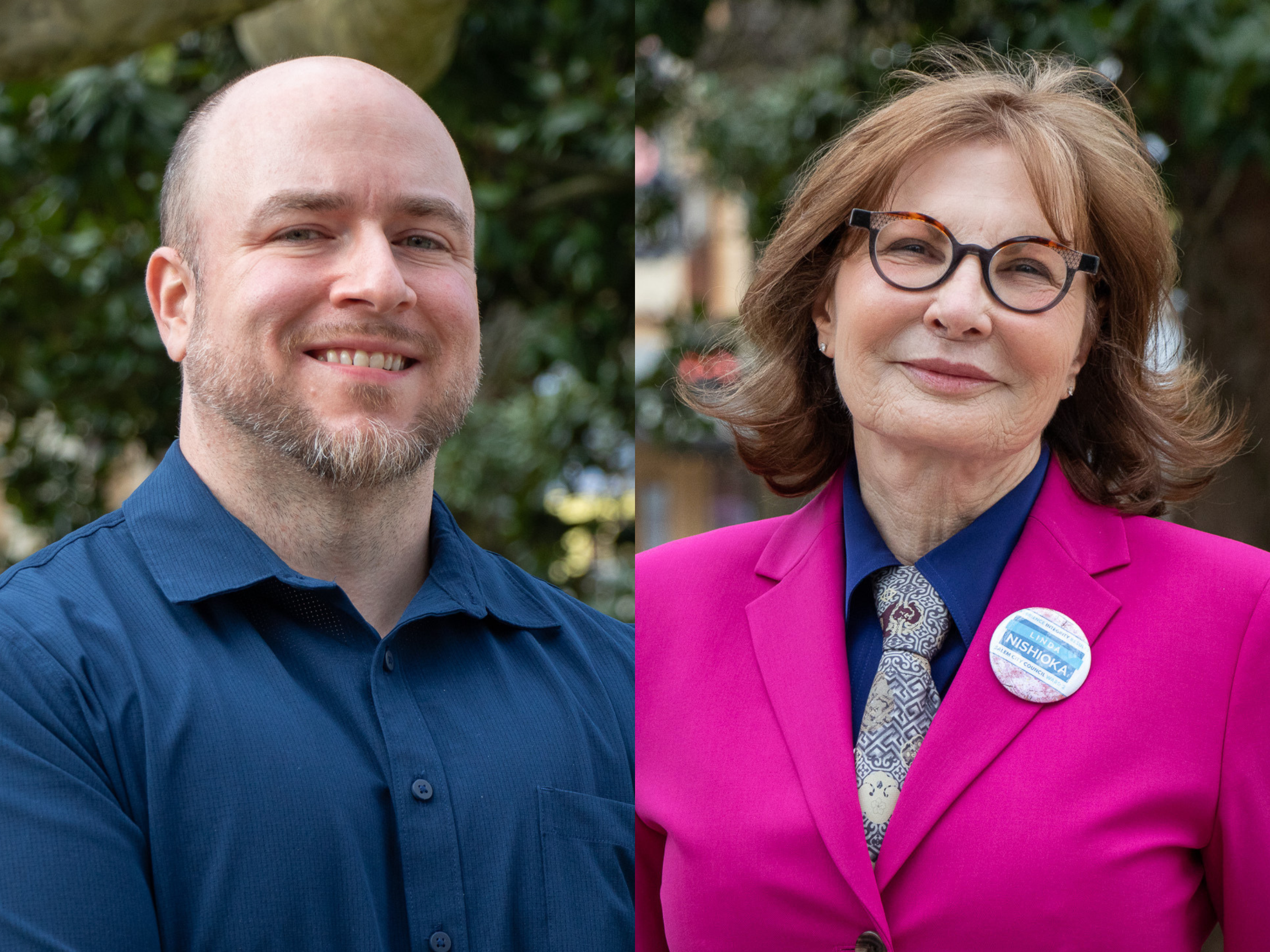
The May 19 election will decide who represents south central Salem on the Salem City Council.
Council President Linda Nishioka, a retired department director at Willamette Ear, Nose and Throat, is seeking a second term representing Ward 2. Her challenger is Manny Martinez, a political newcomer and small business owner.
Ward 2 covers part of downtown Salem south of State Street, and includes Bush’s Pasture Park and South Salem High School. It stretches east to include Geer Community Park and much of the Salem airport.
Election guide: Read more about the 2026 city election here and find your ward here.
City council elections are nonpartisan, and the office is a four-year, volunteer position.
Candidates are campaigning as two slates that are politically opposed, with more progressive candidates backed by Progressive Salem and conservative candidates backed by Marion + Polk First. Nishioka is part of the progressive slate and Martinez is part of the conservative slate.
Salem Reporter sat down with both candidates to talk about their thoughts on key issues for voters, including homelessness, public safety and the city’s budget. See their perspectives below.

Nishioka
Linda Nishioka
Age: 74
Education: Portland Community College, associate degree. University of Oregon Health Sciences Center, bachelor’s degree in dental hygiene.
Occupation: Retired director of Facial Plastic Services at Willamette Ear, Nose and Throat. Previously worked as a dental hygienist and an oral surgery assistant.
Prior governmental experience: Salem City Council, 2022-present, council president since 2024.
Previously served as vice chair of the city’s Downtown Advisory Board and committees for Salem’s historic preservation, Riverfront Park, streetscape and main street design.
Manny Martinez
Age: 41
Education: Berklee College of Music, bachelor’s of music.
Occupation: Small business owner who teaches private guitar lessons, and music educator at Linfield University and the Abiqua School in Salem.
Prior governmental experience: None.
Nishioka grew up in Beaverton, and moved around the country before settling in Salem in 1998. She has lived in Ward 2 since 2000.
She worked for over two decades as a dental hygienist and an oral surgery assistant at practices in Oregon, Texas and Missouri.
Her volunteer work stretches back decades, including a rape crisis center in Texas, soccer coaching and parent groups in Salem schools.
Nishioka was elected to the Ward 2 seat in 2022 after running unopposed, and has been the council president since 2024. As a councilor, her work has focused on housing development, downtown vibrancy and livability.
Last year, the Oregon Government Ethics Commission found that Nishioka, along with Mayor Julie Hoy and Councilors Vanessa Nordyke, Deanna Gwyn, Paul Tigan and Micki Varney, participated in an illegal serial meeting by discussing former City Manager Keith Stahley’s job performance out of public view. The investigation showed that Hoy lied to Nishioka by telling her a majority of the city council supported asking Stahley to resign. Nishioka then warned Stahley, which caused him to resign abruptly. Nishioka conceded the investigation’s findings, while Hoy continues to dispute them and maintains Nishioka lied to the commission.
Nishioka said she considers housing and homelessness, public safety and livability, and fiscal responsibility to be the top issues going into this election. She’s especially concerned about seniors and families on the brink of homelessness, finding ways to increase staffing and funding at the police and fire departments and balancing the budget amid rising costs.
She said that experience, and a balanced approach to addressing issues are what set her apart from her opponent.
“I feel that I’ve done a great job, and I have constituents that want me to be running again. It feels like four years went so fast,” Nishioka said. “I feel like I’ve learned so much. It would be wrongful of me to not continue, because so much of what you have to do is understand what’s happening, and have a longer-term commitment regarding budget, regarding policies. And so I just feel it would be almost neglectful for me not to run.”
Martinez
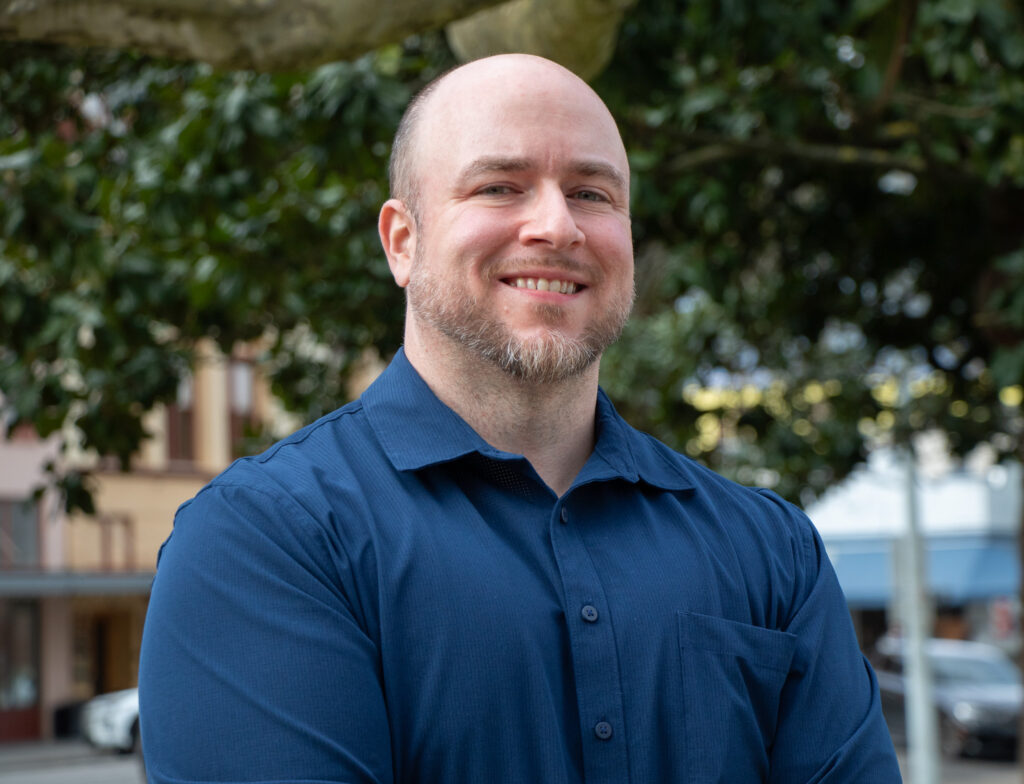
Martinez grew up in Baltimore, and moved to Boston to attend Berklee College of Music. He graduated in 2006. He has lived in Salem and in Ward 2, for 12 years.
Martinez is a small business owner who teaches private guitar lessons for students at all levels, and has performed at venues throughout the community.
He’s been in recovery for seven years for alcoholism, and is a part of the recovery community Salem, where he also does service work. He also plays music and talks about recovery with students at local schools.
Martinez gained political and online traction for his campaign after speaking about his recovery during public testimony at city council meetings on homelessness this summer, and said he is running to bring his perspective to the issue.
“We have a crisis of drug and alcohol addiction in Salem, and I think my experience in that realm is going to be very valuable for city council,” Martinez said. “This will be my first attempt at running for office. I haven’t served in a government role before, but I’ve been following city business for years now, and I’m a quick study, and I will work incredibly hard to learn whatever I have to learn and (will be) able to be effective in the role.”
Beyond homelessness, he said other top issues are public safety, which he said is closely related, and that he wants Salem to be more business friendly.
Nishioka
Nishioka said that the council’s work in addressing homelessness and developing a range of housing options has been effective, and needs to continue.
She wants to continue to support additional infill housing which matches the scale of the neighborhood — options like cluster cottages, duplexes and fourplexes which add housing density. She said that the community also needs to continue to add large apartment complexes, and that previous developments have helped curb rising rent costs.
Nishioka said she’s especially concerned about seniors on the brink of homelessness. She wants to support additional efforts like United Way’s cottage community with low, fixed rent.
She said she has also been pushing the city to explore community land trusts as an affordable housing option, and staff are looking into options. In a community land trust, the resident owns the home but the city or a nonprofit owns the land underneath it as a way to reduce the purchase price.
Services that frequently work with people experiencing homelessness, including sheltering, behavioral health and addiction treatment, are traditionally the responsibility of the state and the county.
Nishioka said it’s hard to advocate for the additional taxes or fees required to greatly expand the city’s role in addressing homelessness when many families in Salem are struggling to afford rent.
“I’m trying to walk that tightrope of, how do we help but not hinder someone else?” she said.
Nishioka wants to see the county put more funding towards shelters, transitional care and addiction treatment. She said community nonprofits have had to take on much of the work to meet those needs. She would also like the Oregon Department of Transportation to stabilize its funding and better address cleaning up camps on its properties in Salem, which includes the spaces underneath overpasses.
If funding allowed, she said she’d want the city to increase options for transitional housing to help move families and seniors off the street.
Nishioka was among those who, for years, advocated to expand the Salem Police Department’s Homeless Services Team and the Salem Clean Team, who work to connect campers with local services and clean up debris. In October, the council unanimously approved funding to expand both to work seven days a week. She said that investment needs to continue.
Nishioka also recently proposed adding a team of ambassadors who would help downtown business owners dealing with the impacts of homelessness.
She said her role as a councilor will also be to help build relationships with those providing services in Salem. That includes helping nonprofits make the most of limited funds after major cuts across the board from the federal level.
“The work we’re doing is proving to be effective. Being poor, being unhoused is not against the law. And I feel that we need to continue the work that we’re doing, which is having them get help,” Nishioka said. “My definition of accountability is helping them get to the services that they need. And I understand it takes time to get people there. It won’t be everyone, but it can be many.”
Martinez
Martinez said that he wants to bridge the partisan divide in the conversation about homelessness.
Much of his campaign has emphasized drug and alcohol addiction as a cause of homelessness, and he said that kindness and compassion alone won’t solve the crisis.
“Everyone wants to see the problem be solved in a way that is kind and compassionate but also tethered to reality,” he said.
Martinez said that, since campaigning, he has learned more about the reasons beyond addiction that drive people into homelessness, and that they include single moms escaping from their abusers and elderly grandmothers with no other options.
“I understand how important it is to have that nuance in the conversation, so we’re not painting with a broad brush. It’s a complex issue, and we need to be able to understand that there’s a lot of different reasons for it,” Martinez said. “But at the same time, driving home where I started with, is that there is a drug and alcohol element and that needs to be addressed through the recovery lens, which means accountability and responsibility so that these individuals can turn their lives around and be helped.”
When asked how he would consider policy toward a single mother using drugs or a grandmother committing crimes while homeless, Martinez said the overlap is occasional.
“The point I’m gently trying to make to the public is that there is an element of crime that happens, and it can be anything from severe crimes like the sex trafficking that we hear about in Wallace Marine Park, or violence, or any more of the serious crimes, but also the livability crimes like defecating on the street, public camping, trespassing and also like harassing behavior on the street, screaming at people making violent threats,” Martinez said.
That’s not okay … We should have empathy for their traumas and the things that have led them out into that situation. But we shouldn’t have to tolerate that kind of behavior, either. That behavior is unacceptable and it needs to be addressed.”
Martinez said he wants to see livability crimes such as public defecation enforced more frequently.
“I will leave it up to law enforcement to recommend what the best way of dealing with that is, but one thing I do know is that we cannot allow it to continue the way that it is. It has to be addressed, and it has to be stopped. We have to raise our standards in the city to not allow that kind of behavior to be normalized,” he said.
He said whether that means increased arrests would depend on the situation.
Martinez said he supports continuing to fund the fire department’s recently launched crisis team, called REACH, which brings a paramedic, a medic and a Marion County health professional to calls related to mental health challenges and substance use. He said he also supports the work of the police department’s Homeless Services Team.
Martinez has posted his eight-step plan to address homelessness in Salem, which says that the issue should be the first priority of every council meeting.
He is proposing creating eight designated, managed camping sites, one in each ward, with bathrooms on site for up to 100 people. He said that he’d work with leaders of local nonprofits to guide what the development and management of the campsites would look like.
As of earlier this year, there were 3,472 people on Church at the Park’s waitlist for its microshelter sites in Salem. Budget cuts recently reduced their capacity. Nonprofit organizations throughout the city have faced budget cuts at the state and federal level in the past year, hamstringing sheltering efforts and threatening sustainability.
Martinez said that using law enforcement to enforce the city’s public camping ban would be a last resort, after every effort has been made to connect people to services.
Under his plan, those who refuse to cooperate and live at the designated sites would be asked to leave the city. He clarified that does not mean providing a bus ticket.
“The opportunity would be to say ‘If you don’t like these new standards that we have, you can go somewhere else.’ That’s not the same as criminalizing and saying, ‘We’re going to arrest you.’ If you’re arrested for a crime, they just arrest you. They don’t give you the opportunity to leave town. That’s the difference,” he said.
Martinez said the city’s work has been too slow, and that residents are calling for bolder actions, when there are still almost 1,000 people living unsheltered in Salem.
“If you can make the argument that there’s been a slight improvement, I don’t know, but it’s not enough. It’s not going quickly enough. It’s not bold enough, and it’s not going to have the long lasting effects that something like my eight step plan would have,” he said.
Nishioka
Nishoka said that Salem’s police officers have been working overtime, and more staff are needed to support patrol units, detectives, and other roles where police are short-staffed and overworked.
She also wants to improve staffing at the fire department. She said that in her time on council, they’ve been able to reduce the use of mandatory overtime at the city’s 911 call center, and she would like to ensure they have up-to-date software.
Nishioka said that federal immigration enforcement has decreased in Salem since the fall, when members of the public testified asking the council to act to protect immigrants in the community.
Nishoka said she’d like to see the city restore its $400,000 social services fund, which was discontinued several years ago. She said that could give the councilors a place to turn when the community asks for funding toward local families impacted by immigration enforcement, or grants for other programs that support people in need.
Councilors voted in February to put $200,000 in one-time funds toward such services. Nishioka said that she had reached out to city staff with the idea about using one-time salary savings from airport staff vacancies, and that City Manager Krishna Namburi found the rest.
“I’m not sure we could find that again in this budget,” Nishioka said. “I hope we don’t need to do it.”
Martinez
Martinez said that the issues of homelessness and public safety have substantial overlap, and that his eight-step plan to address homelessness would improve public safety issues.
Beyond that, he said he believes Salem needs more police officers, and he’d like to see a bicycle patrol team returned to downtown Salem, as Chief Trevor Womack has long advocated for.
On federal immigration enforcement, Martinez said that a lot of people in the community are frightened by the arrests in the community.
“I worry about city council spending a lot of time on things that they have no control over. I think it’s important to hear people’s concerns. At the same time, we have to focus on what we can control. And we have very, very little say in what happens with federal immigration enforcement,” he said. “For everyone who’s upset about immigration situation, that’s something to take to the Capitol and your congressperson. They’re the ones that can affect change there”
He said that he would want to focus additional funds on the homeless emergency, rather than families impacted by immigration enforcement.
Nishioka

Nishioka said that the five-year property tax levy voters approved last year to fund city services brought some breathing room to city budget talks. But the city still faces rising costs outside of its control, including health care, insurance and retirement costs for employees.
She said the council will face challenges in sustaining existing services while answering public demands for increased investments in public safety.
Nishioka said she’d have to have a full understanding of the city’s budget needs and another look at efficiencies within the budget before she’d pursue renewing the levy as-is. She said an alternate levy to support public safety could be what’s needed when the time comes, but it’s too soon to tell.
She said that some fees on residents will be increased, such as garbage removal, due to factors outside the council’s control. But in such cases, she said the council can help people reduce garbage costs by promoting recycling and increasing the usage of compost bins for food waste.
She also supports restructuring the operations fee which shows up on utility bills, by reducing what households and small businesses pay, while increasing it for larger companies. The council will continue to pursue that this year.
Martinez

Martinez said he wants to increase the city’s budget by selling off excess properties, and getting creative with business partnerships.
The major funding mechanism for Martinez’ sheltering proposal is the “2027 Salem Yard Sale,” in which the city would identify and purge excess properties in its real estate portfolio. In addition to revenue from the sales, which he said would provide millions, he said that the city would then pay less in maintenance and upkeep. He said that if a business were to move into the property, that would become new tax revenue.
City spokesman Jason Roberts said that many of the city’s properties are reserved for future projects, and their use is limited to short-term leases.
Selling each city property would involve a lot of variables, and likely would take years. Typically, the funding source that was used to buy the property would also need to be repaid before the city could change the land’s usage.
“There may be some parcels where sale proceeds could go to the general fund, but only if the land wasn’t purchased with grant funding or formally dedicated for a specific purpose. Parcels that were gifted to the city might be eligible. However, most of the city’s larger parcels are tied up in water and sewer treatment buffers, wetlands or parkland, which typically restricts the potential for sale,” Roberts said.
Martinez said that he’d look into loosening the restrictions on funding usage.
“We need to do something bold in order to solve this problem. That’s part of the problem that we have here in the city, is that there’s so many regulations and tight restrictions, but meanwhile, you look in Wallace Marine Park and there’s hundreds and hundreds of people dying and suffering. We’re going to need to get creative and bold if we’re actually going to start solving these problems,” he said.
Beyond the yard sale, Martinez said that he’d like to work with businesses to find ways to generate income, such as advertising on city property.
“You have to have a city council that is business friendly, that is willing to work with businesses instead of trying to hit them with every single restriction and environmental limit regulation and make it as difficult as possible for businesses. We need to make it easier to do partnerships with the business community,” he said.
Campaign finance data is from the Oregon Secretary of State as of Monday, April 27.
Total raised: $15,455
Total spent: $14,013
Cash on hand: -$5,221
Top five donors: Gary Nishioka, $3,000 loan; Oregon AFSCME Council 75 (statewide government employee union), $1,000; American Federation of State County and Municipal Employees Local 2067 (city of Salem employee union), $1,000; Janet Neuberg, $1,000; Cesie Scheuermann, $750.
Total raised: $39,076
Total spent: $27,551
Cash on hand: $16,581
Top five donors: Marion Polk First PAC, $27,757 cash and in-kind; Mountain West Investment Corp, $5,000; Richard Withnell, $2,000; Salem Fire PAC, $1,500; Patrick Carney, $1,500.
Contact reporter Abbey McDonald: [email protected] or 503-575-1251.
SIGN UP: Subscribing to Salem Reporter helps sustain in-depth, local reporting that Salem depends on. Invest in your community’s news. Subscribe today.

Abbey McDonald joined the Salem Reporter in 2022. She previously worked as the business reporter at The Astorian, where she covered labor issues, health care and social services. A University of Oregon grad, she has also reported for the Malheur Enterprise, The News-Review and Willamette Week.
Comments are closed.





Do any of the candidates discuss problems outside the 8 square block of “downtown “ Salem? It seems they are all reading the same script…
As usual, superb reporting 🙂
Thanks Abbey for thorough, balanced reporting. While I share Mr Martinez concerns, doing something bold is too loose of a solution to garner my vote. We are suffering the consequences of bold moves at the national level. I appreciate Ms Nishioka’s compassion and experience with managing the unhoused. It is a worldwide issue magnified by the lens of ridiculous amounts of money in the hands a few. Thank you to both candidates for caring about our community.
If they stray from housing and homelessness candidates get criticized for being out of touch.