Salem’s new city manager plays a unifying role during tumultuous times

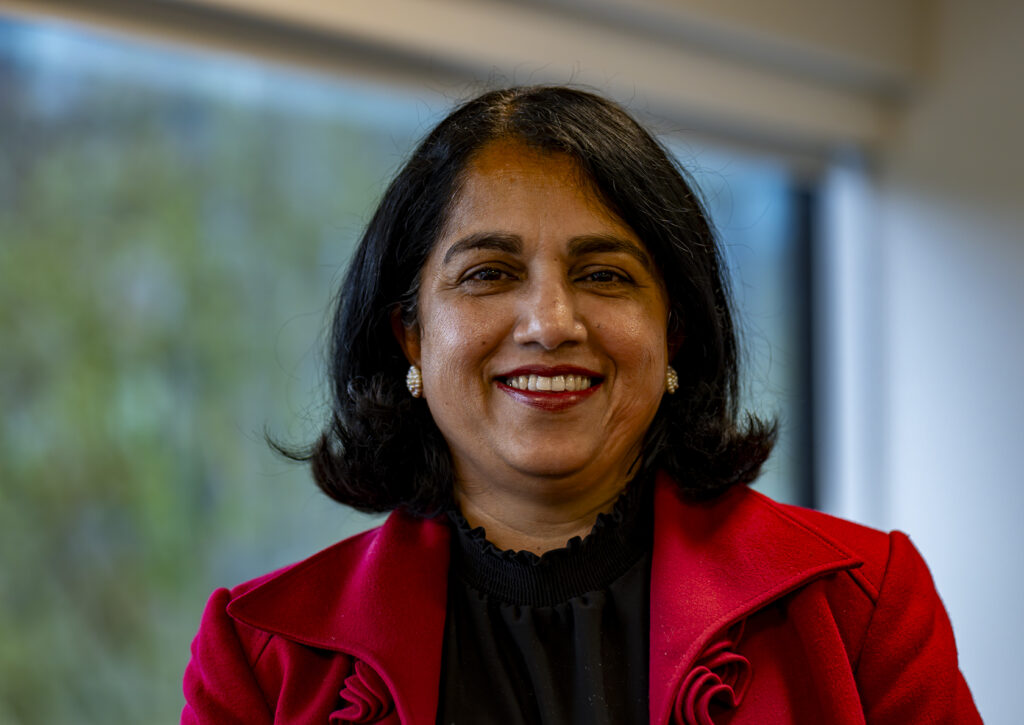
Krishna Namburi was bestowed the childhood nickname “the city manager” years before she ever set foot in Oregon.
Growing up in Vizag, India, she impressed early teachers with her book smarts and emotional intelligence. One commented that she should someday take the civil service exam.
Her father, a government official, seized on the assessment, turning what he hoped would be her future job into Namburi’s unofficial title with extended family.
“Talk about pressure,” Namburi said in a recent interview with Salem Reporter.
It was a calling Namburi resisted for years despite her father’s encouragement. But she’s now held Salem’s top job for about nine months, taking the helm first as interim city manager in March after the abrupt resignation of former Salem City Manager Keith Stahley.
The Salem City Council appointed her unanimously to the permanent role in October.
Her first months on the job included preparing for deep budget cuts while leading the city through a successful effort to seek voter approval to raise property taxes to avoid those cuts.
Now Namburi, 52, has emerged as a unifying figure for a city and a council that have been divided over issues including homelessness and the city’s response to immigration, while confronting financial challenges.
Mayor Julie Hoy described Namburi as “holistic and bold.” Her political rival, Councilor Vanessa Nordyke, praised Namburi as someone who is driven, knows the city inside and out, and has the respect of the city council and staff, before voting to appoint her in October.
Namburi makes a point of shying away from politics and doing her best to consider all the data, angles and the perspectives of others before making a decision. It’s an approach driven by her background in computer science, and honed through 25 years working for the city.
“I am not a traditional city manager and I understand that…Depending on who it is, often it does become political. But I stay out of it,” Namburi said. “I give a lot of credit to this council… none of them…drag me into politics. They don’t. They understand my role and they are respectful of that.”
Namburi said she leans on her team for advice and that she expects open dialogue from those she manages.
“I like to surround myself with people that disagree with me. I thrive in that environment,” Namburi said.
Salem Reporter spoke with a dozen city department leaders, city councilors and community leaders about Namburi’s work and her approach. Some are at odds with one another over major issues facing Salem. They all had praise for Namburi’s leadership, saying her analytical approach and careful consideration have led to increased public trust and a more efficient and collaborative city government.
Salem Fire Chief David Gerboth credited her with improving how city leaders communicate and collaborate.
“I think that Krishna being in that position has led to that trust,” Gerboth said.

A life of preparation
As the city manager, Namburi is the primary leader of city affairs, overseeing 1,400 employees. She directly manages leaders of eight city departments, including the police and fire chiefs.
She works from a temporary office on the fifth floor at 440 Church St. N.E. as City Hall undergoes seismic renovations. There, she keeps city business organized with a whiteboard covered from top to bottom with boxes and arrows and acronyms inscrutable to an untrained observer. On her table are neatly arranged and color coded pens.
Namburi is a homegrown city manager, working her way up from a starting job as a database administrator. The two men who held the role before her, Stahley and Steve Powers, were recruited from out of town.
Where an elected mayor or city councilor deliberates and creates policy, the city manager’s job is to implement their wishes. That means advising, providing feedback, and developing a framework to facilitate the city’s work.
Despite her childhood nickname, it’s not where Namburi expected to end up.
As a child, she loved working through the puzzles and questions designed to hone critical reasoning skills.
As an adult, she said organizing her home remains a favorite hobby — alongside tutoring students in math, physics and chemistry.
Her father encouraged her to follow his footsteps into government and helped her prepare for the country’s civil service exam, but Namburi decided her passions lay elsewhere.
She instead pursued civil engineering, earning a degree in India.
Prior to leaving for the U.S., where she planned to continue her higher education, she met her now-husband, Raghu, at a mutual friend’s house in India. He was on vacation from his job working as an engineer with the Oregon Department of Environmental Quality.
After they married, she came to the United States in 1995, settling in Eugene. Three months later, the couple moved to Salem.
There, Namburi started taking classes in computer science and was working full-time.
She first got her foot in the door with the city in 1999, spending six months as a consultant before accepting a job as a database manager in the information technology department.
She also completed a master’s degree in computer science and steadily worked her way up the city ladder, becoming a supervisor, then department manager, then division leader.

Finally, in 2022, she was promoted to deputy city manager, overseeing her former department as well as human resources, fleet and facilities, risk services and more.
Namburi came into her current role in the middle of a scandal around the former city manager’s departure. A performance evaluation of city leadership under her predecessor, Stahley, found Stahley was bogged down with day-to-day issues and didn’t effectively communicate with city employees about decisions, leading to an inefficient city government that struggled to set priorities.
His abrupt resignation came after backroom discussions among city councilors about his performance. The incident later led to a state ethics investigation and bitter divisions on the council.
Trust in City Hall was low. Salem faced a nearly $14 million budget gap.
Namburi was the logical choice to take over running the city, at least temporarily, and city councilors expressed an interest in keeping her on.
But she struggled with the decision.
“I am a very private person and I also know that I am very analytical and that means I am thinking out loud and I say it the way it is, so often I was wondering if I could survive in this role,” Namburi said. “Because to me it is always very logical.”
She said that although she never took the Indian civil service exam, the many years preparing in combination with her parents’ guidance readied her.
“I learned how to constructively respond through disagreements,” Namburi said. “That’s my parent’s upbringing, for sure…I learned how to see people through their strengths and not their weaknesses.”
Namburi said it was ultimately her father who encouraged her to take the role. He told her that if it didn’t work out, she could always find something else.
Leading through a storm
Namburi’s first act as interim city manager was to announce immediate cost-cutting measures, signaling to the community that she was serious about addressing the deficit.
Those measures, implemented in February, curtailed overnight travel for employees, slashed overtime, reduced supply purchases and new software implementations, and left some jobs vacant.
As city councilors urged voters to approve a property tax measure in May, Namburi prepared for the possibility the measure wouldn’t pass.
She drafted a city budget that proposed laying off library workers and slashing park maintenance.
Namburi explained the rationale for the cuts during a city budget committee meeting where she acknowledged the hardship for employees, becoming visibly emotional.
It was a departure from the typical Namburi presentation during a public meeting: clear and methodical, with a calm authority.

Steve Hall, the president of AFSCME, the union representing the majority of city employees, said he’s known Namburi since she was one of those union employees herself.
She handled a delicate situation with compassion and grace, Hall said. As the budget woes unfolded, she prioritized communicating with employees, routinely meeting one-on-one with anyone who asked.
“I am going to have to fight with city management at certain points on certain things, but if I have to fight with somebody, I’m OK fighting with Krishna, because I respect her and the job she does,” Hall said.
Voters ultimately said yes to raising taxes, and Salem avoided layoffs and cuts.
Gerboth, the fire chief, said he believes the measure would not have passed if not for Namburi’s leadership.
Namburi said she prefers to resolve conflict face-to-face and finds taking someone out for a cup of coffee and hearing them out usually does the trick.
“I take emotions out of everything. In the decision making. I go to the facts. I go to the data. And I always talk about what is the long-term goal for Salem. And when I do that, people usually come on board,” Namburi said.
Gretchen Bennett, the city’s acting-in-capacity community services director, shares an office next to Namburi’s. She said her boss is an approachable leader and easy to connect with.
“She wants innovation and good ideas and she will take them from any level of the organization and she just expects us to do it and I think that is very energizing,” Bennett said.
A clean, safe and healthy Salem
Namburi more recently worked to bring together business leaders, homeless service providers and public safety chiefs to find common ground on addressing the impacts of unsheltered homelessness and petty crime.
Mayor Hoy over the summer called on Salem Police Chief Trevor Womack to come up with a plan to put more police downtown to address perceptions of an unsafe urban core.
Business leaders gave impassioned public testimony and some threatened to withhold their property taxes until concrete steps were made.
Homeless service providers worried that vulnerable people who didn’t have access to bathrooms and shelter were becoming scapegoats. Community tensions were high.
Namburi began crafting a plan to address concerns by increasing city cleaning crews and putting more police officers on the city’s Homelessness Services Team.
She worked with Bennett, Gerboth and Womack to craft a framework, first consulting with both on how city resources could most efficiently and effectively be deployed.

Gerboth said he felt empowered by Namburi who gave him the space to have discussions and to formulate a plan for a crisis team.
That process began with two meetings over the summer, both attended by Namburi, where business owners and employees downtown and in northeast Salem shared their perceptions and experiences dealing with issues related to homelessness.
Patrick Carney, a downtown investor who has been a major voice calling for improvements, recalled asking Namburi a question about a city lease with a homeless service provider toward the end of a meeting.
“Things wrapped up quickly, and she came up to me afterwards and said, ‘Hey, I can put together some of that information you are looking for and I am glad to help in any way,” Carney said. “It was extremely nice to see that when the meeting was over she didn’t just wrap up and hit the door. She came over and asked, ‘How can I help?’”
City leaders, including Namburi, also met with area homeless services providers who initially felt snubbed by being excluded from the first two meetings.
Namburi said city leaders had planned to bring them into the fold but their intent to do so was not well communicated. She met with service providers twice in her office to hear their concerns and assure them that they would be included as plans moved forward, she said.
Lynelle Wilcox, who runs the SafeSleep United women’s shelter, was in Namburi’s office during those conversations and said she was struck by how genuinely Namburi appeared to care about the lives of homeless residents. The city manager took detailed notes.
“She’s like real. I feel like she’s real,” Wilcox said. “She’s seeking the input, not just, ‘Oh God, here’s the advocate who’s going to talk my ear off and tell me I’m doing everything wrong.’”
The final proposal earmarked about $600,000 of city money to go toward a pilot program designed to improve cleanliness and livability in downtown and northeast. City councilors approved it unanimously on Oct. 13.
“I think that it was a very moving experience for her in the sense that this is not the Salem that she wants or maybe has even seen, and so I think that set her on the mission to try to figure out how a clean, safe and healthy Salem could be,” Nishioka said. “She used data that she collected, stories that she heard, and visited with other members of the community to get a feel for what could help.”
After the plan was set in motion, business groups approached the city with a $180,000 donation they wanted to pay for more bicycle mounted police officers to patrol downtown.
TJ Sullivan, president of the Salem Main Street Association, said Namburi consulted with Womack and then went back to the group to negotiate. She got them to agree to dedicate the money to officers for the homeless services team instead.
Sullivan, a former city councilor, has known Namburi since she first came to the city. He said he admires the way Namburi conducts herself as the new city manager.
“I think she would be a hell of a poker player…she is not going to show you her hand, she’s not going to reveal her cards, and she’s going to take everything in a measured, thoughtful way,” Sullivan said. “She is not going to commit to anything without going back to the people who she works with who are more knowledgeable than her, and consult with them before she comes to some kind of decision.”
Salem’s future
Namburi said that as the city continues down a path of newfound but temporary financial stability, it will be critical to invest in proactive services that cut costs down the line.
She said she does not want Salem to be in the situation it was in prior to the passage of the tax measure in May. The stress and anxiety placed on both the community and city employees was unfair to them, Namburi said.
She said one focus for her will be on appealing to the state for assistance and to increase collaboration with the county.
“There is no way we can maintain the services we are maintaining at this level without them helping us out,” Namburi said. “Working with the county to improve services, I think that is important and the partnership is important with the county.”
One arena she sees this approach being beneficial is in addressing drug prevention, treatment and enforcement. She said the goal is to curb drug activity to reduce the need for enforcement in the future.
She said services like the library, parks, and youth development will be critical investments.
Namburi also believes there are ways to reimagine services and be more efficient and innovative in city government.
Namburi said that investing in proactive services requires measuring the effectiveness of the reactive services as a way to assess the entire system.
“I know that requires a lot more resources, I am just saying ultimately I would love to be in that state before I retire or leave the city. But that is a big dream.”
Contact reporter Joe Siess: [email protected] or 503-335-7790.
A MOMENT MORE, PLEASE – If you found this story useful, consider subscribing to Salem Reporter if you don’t already. Work such as this, done by local professionals, depends on community support from subscribers. Please take a moment and sign up now – easy and secure: SUBSCRIBE.

Joe Siess is a reporter for Salem Reporter. Joe joined Salem Reporter in 2024 and covers city hall but also loves surprises. Joe previously reported for the Redmond Spokesman, the Bulletin in Bend, Klamath Falls Herald and News and the Malheur Enterprise. He was born in Independence, MO, where the Oregon Trail officially starts, and grew up in the Kansas City area.