Differing approaches on homelessness, development come into focus at chamber council debate
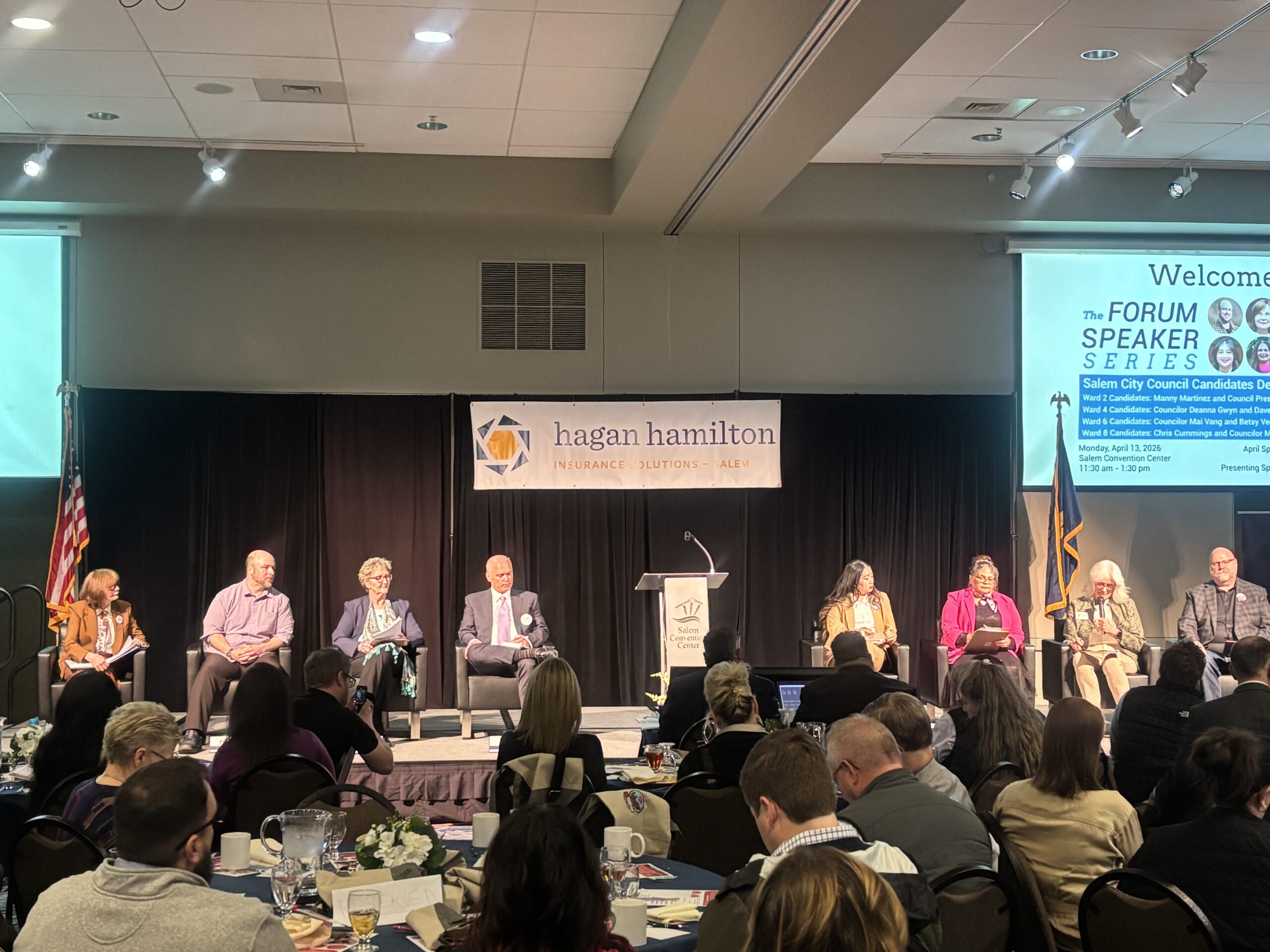
Different approaches to homelessness and development between the two opposing slates vying for four seats on the Salem City Council came into sharper contrast during a forum on Monday, April 13.
The candidate debate, organized by the Salem Area Chamber of Commerce, included all eight candidates seeking election May 19.
2026 election guide
For more information on candidates, how city government works and when to expect ballots, take a look at Salem Reporter’s guide to the 2026 city election.
While progressives largely advocated for a more considered and sustainable approach to the city’s development, conservatives said environmental regulations and red tape make it too complex and expensive to build housing.
Friction about how to deal with homelessness also emerged with progressives advocating for a housing first and service-oriented approach. Conservatives said the only way to deal with the issue is a radical change to the status quo and holding those who choose to live outside “accountable.”
It was not clear on Monday how the city’s homeless would be held accountable should conservatives gain a majority on the council, but some candidates indicated accountability would involve law enforcement.
Conservatives also differentiated themselves from progressives by pushing to draw in businesses to grow the tax base as a way to handle the city’s expected budget deficit over the coming years.
Progressives advocated for pursuing long-term solutions to generate more revenue to pay for services such as charging bigger businesses higher fees on utility bills and working with the state to change tax laws.
The forum was hosted by the Salem Area Chamber of Commerce and included four incumbents on the council: Council President Linda Nishioka, and Councilors Deanna Gwyn, Mai Vang, and Micki Varney.
They were joined by their challengers Manny Martinez, Dave Inbody, Betsy Vega and Chris Cummings.
While council positions are nonpartisan, the eight candidates are campaigning as two slates, with one supported by Progressive Salem and the other by the conservative Marion + Polk First political action committee.
The progressive slate includes Nishioka, Vang, Inbody and Varney. The conservative slate consists of Gwyn, Martinez, Vega and Cummings.
Chamber CEO Tom Hoffert said that the candidates were not provided the questions in advance, though some candidates appeared to be reading prepared statements in response to questions.
Candidates were given time for an opening and closing statement and were asked four questions by Hoffert, who moderated the event. They were also able to ask their opponents a question. Candidates had one minute to answer each question.
Homelessness
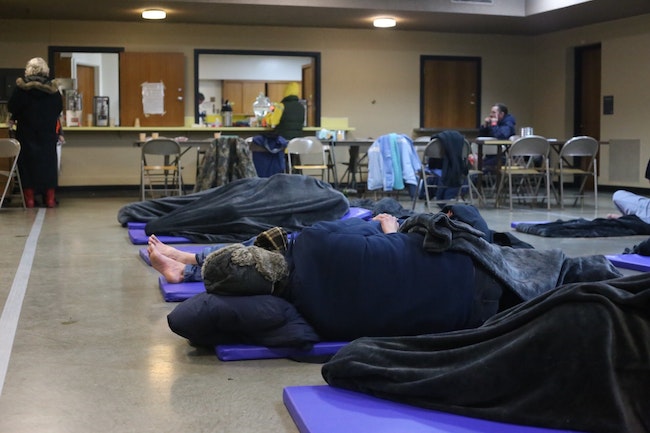
The two slates demonstrated the most friction on homelessness. Nishioka advocated for a proactive approach to homelessness and said the fastest growing population of people becoming unhoused are seniors and working families.
“My biggest goal will be preventing people from falling into homelessness, and that is going to be a very important part of what I want to do in my next term,” Nishioka said.
Martinez wasted no time calling his opponent’s approach “more of the same,” and “trimming around the edges.”
Martinez said the city’s existing camping ban should be enforced and he reiterated his plan to put homeless shelters in each ward. He said there should be a law enforcement component involved in cases of homeless people refusing to get help.
“It has to be balanced out by consequences for people who refuse to cooperate, and that is the compassionate thing to do because sometimes that is what is necessary in order for someone to get the help that they need,” said Martinez. He’s a recovering alcoholic who focused his campaign on solving homelessness.
Toward the end of the forum Nishioka asked Martinez if he had support for his plan to put shelters in each ward and asked him if he had identified a spot for a Ward 2 shelter.
Martinez said he has spoken with unnamed current and former councilors who agree with his approach, but did not say where he would want to put one in his ward.
Martinez asked Nishioka what her definition of accountability was. She responded it was “that we need to continue getting people to the services that they need.”
Varney focused on the city’s successes with current pilot program initiatives expanding police and cleaning crews to address encampments and standing up a mobile crisis team through the fire department.
“Wallace Marine Park, if you’ve been out there, it’s clean from the top of the parking lot all the way down through the boat ramp. We are making a difference and I want to expand on those efforts,” Varney said. “I also want to expand on those efforts, but we also need to keep collecting the information so that we are making data-driven decisions.”
Varney’s opponent, Cummings, said homelessness is on the rise and what the city is doing is not enough. He said the recently expanded Homeless Services Team run by the police department was only making a “dent.”
He too mentioned accountability and said the city must work with Marion and Polk counties on different approaches.
Vega touted her experience as a case manager working with children and said her approach would be compassionate but firm. She said it is “not compassionate to let people waste away from addiction on our sidewalks.”
Her opponent, Vang, said much progress has been made in the past few years on the issue of homelessness and didn’t want that to be forgotten.
“Before then (2018), the city of Salem and the city council did not actively or proactively address homelessness. And since then the council and the city has taken steps to do so, and we can all see that,” she said, citing the expanded police homelessness team.
Inbody leaned into the progressive approach to the issue.
“I know that accountability sounds good. But the reality is, until people have basic services, more times than not, those programs fail. Housing first works better than treatment first, it works better than any kind of abstinence program,” Inbody said. “That may not be what people want to hear, but that is the reality, and evidence shows over and over again that until you give someone at the worst point in their life, the ability to actually survive, everything else is irrelevant.”
Housing and development
On housing and development, progressives candidates voiced support for calculated growth with consideration for impacts on the environment and traffic. Conservatives said they want to cut red tape and streamline processes to get housing built to meet state housing goals as quickly as possible.
Vang, the youngest member of council and only renter, said the issue of affordability is top of mind for her working class constituents in Ward 6. She said the city is currently looking at more options to help ensure renters can stay in their homes as prices continue to surge.
The fact that the city has statewide goals to facilitate more housing also came up.
“We also have a governor who prioritized housing and dictated an additional 30,000 units by 2030. The only way we are going to do that is by having all kinds of housing. We need multi-family, cottage clusters, we need middle housing, we need it all,” Gwyn said.
Martinez said environmental regulations and permitting are two factors that hold up development projects and raise costs for both the builders and the consumer.
“I hear about projects that got tied up because of environmental regulations and I think to myself, ‘Wallace Marine Park, there’s like a million pounds of trash in there,’ so, unless you are screaming from the mountain tops about Wallace Marine Park, I don’t want to hear about your environmental regulations,” Martinez said to applause and laughter.
Nishioka spoke next and said the solution is finding creative ways to build denser where it makes sense to do so. She also said ensuring people can get around town is key.
“We want to make sure that we have on our transit corridors where those are the larger complexes, people who need to be close to the bus system. But in the neighborhoods we need to make sure we are not overbuilding in height and we are keeping the neighborhoods in the same environment that they are accustomed to,” Nishioka said.
Nishioka also advocated for streamlining permitting and making the development process smoother.
Varney focused on the city’s infrastructure which she said is incongruent with its rate of development.
“The big issue I see with it is the infrastructure that we need is not going along with it. People need to get to work, to school and back home,” Varney said. “We need to increase transit options and have transit more accessible, and we need bike and pedestrian routes so that people can get to services they want. And those services need to be closer to where they are.”
Gwyn asked her opponent, Inbody, about his endorsement by the League of Conservation Voters. She said the league prioritizes environmental regulation over housing production and asked him which one of those two things should win out when they come into conflict.
“We need to think about thoughtful growth as we grow. I think a lot of people think of growth as a bad word…but if it is not handled in a correct way it is a bad word,” Inbody said. “We can do both. We don’t have to choose between the developer making money and the community actually turning out with a positive environment.”
The budget crisis
The city’s budget deficit loomed large as a key issue in need of long-term solutions to avoid a financial crisis once the levy passed by voters last year expires in 2030.
“The reality for us is this is the time that we need to use to identify what our priorities are and be honest and frank about the fact that we are going to have to have some difficult conversations about what we are going to prioritize,” said Inbody, who’s seeking the Ward 4 seat.
He said those conversations will have to be about cutting or changing current services in order to balance the budget. He said that time may seem far off, but it is best to start the process early.
“That is not a pleasant conversation, but I’d much rather have it today than having it four years from now when we are one year from the end of the levy,” Inbody said.
Progressive candidates generally advocated for long-term strategies to generate more revenue like charging businesses higher operations fees and working with the state, while the conservatives said the only way out of the crisis is to attract businesses to grow the tax base.
A city efficiency committee last year determined that the city was squeezing more services out of less resources than other Oregon cities.
Gwyn, who holds the Ward 4 seat, said she’d push to bring back that efficiency committee if granted a second term and would prioritize core services like public safety and infrastructure.
“Growing tax base through strategic economic development. And I will oppose new taxes as a first resort. Growing our way out of this challenge is the right answer,” Gwyn said.
Cummings leaned into the notion previously espoused by Salem Mayor Julie Hoy during her mayoral campaign in 2024 that the city has a priorities problem, not a spending problem.
“Before we ask taxpayers for more we should be able to show where the current dollars are going and what’s working and what isn’t,” Cummings said.
Nishioka advocated for working with the state on changing the current tax code which prevents the city from increasing tax rates in a way that sustains services. Those tax codes have created a structural imbalance across the state where tax revenues cannot keep up with rising costs.
“We are not going to be able to fix this problem as a city council,” Nishioka said.
Martinez said tax revenue would start flowing into the city if only the city could deal with the homeless.
Contact reporter Joe Siess: [email protected].
SIGN UP: Salem Reporter is dedicated to covering the people, issues, and stories that shape our community. Stay connected to Salem. Subscribe today.

Joe Siess is a reporter for Salem Reporter. Joe joined Salem Reporter in 2024 and primarily covers city and county government but loves surprises. Joe previously reported for the Redmond Spokesman, the Bulletin in Bend, Klamath Falls Herald and News and the Malheur Enterprise. He was born in Independence, MO, where the Oregon Trail officially starts, and grew up in the Kansas City area.
5 Comments
Comments are closed.


This reporting is a good example of why I am a strong supporter of Salem Reporter. It is fair, balanced, detailed, non-judgmental, and informative. It gives me good information to help me make an informed vote.
Salem has been growing rapidly (over half a percent per year) for decades. What growth will be enough to balance our budget without sales or income taxes, when property taxes are limited to 3% increase per year by the State. I’m curious what ‘growth’ we would need to fix our lack of income and how long it would need to be sustained.
Thank you Salem Reporter for the excellent summary of the Chamber’s City Councilor candidate forum.
The apparent problem: Not enough funds to pay for Salem city services.
The offered solutions:
A. Avoid new taxes vs increase fees and taxes for desired services.
B, Grow the tax base via facilitating new business and industry by reducing local development fees vs support current solution efforts for the urban camper problem and the property tax restrictions caused by the State of Oregon.
The unaddressed issues:
1. Given our limited resources, which specify services shall we agree to eliminate?
2. What responsibility do Salem citizens have fund which community services?
3. When are Salem residents going to wake up and address our aging roads, sewers and plumbing?
Did everyone catch this line, “Chamber CEO Tom Hoffert said that the candidates were not provided the questions in advance, though some candidates appeared to be reading prepared statements in response to questions.” Shame on the Chamber.
Thank you for providing both sides of the debate on the issues. I plan to vote for the conservative candidates, because Salem needs a radical change in the way we address homelessness!