

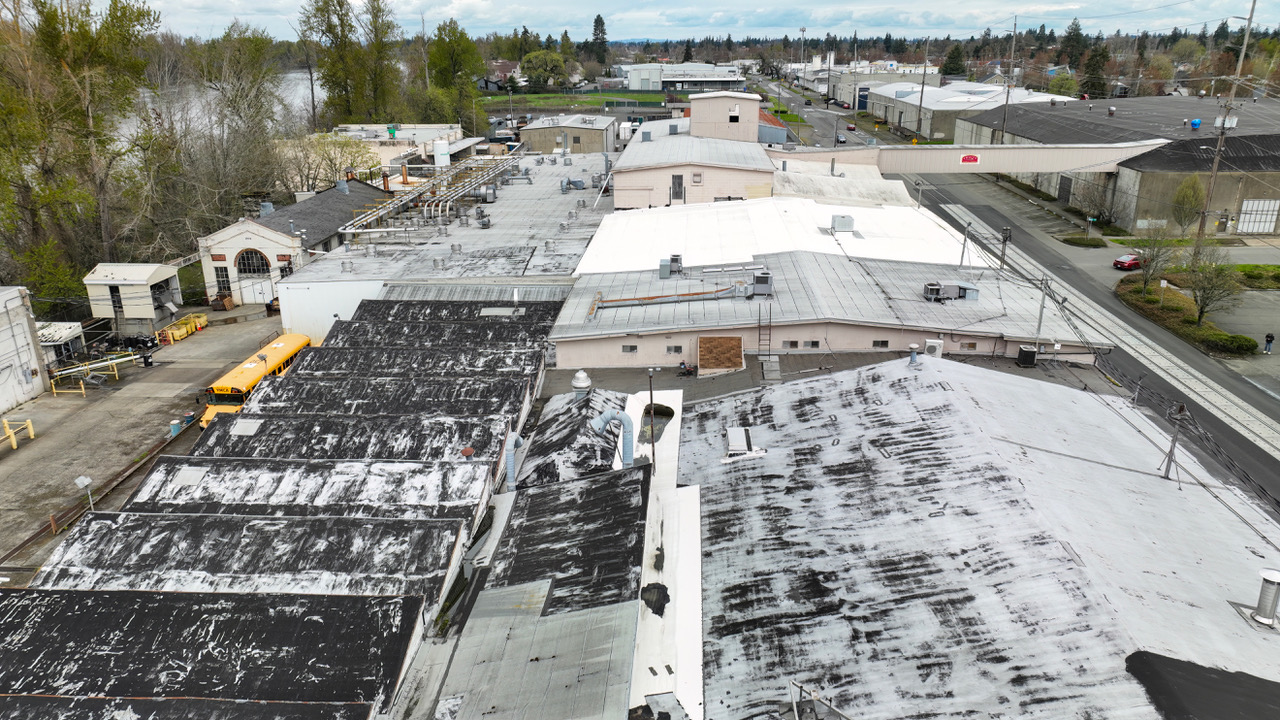
A new developer plans to buy the old Truitt Brothers cannery on Northeast Front Street and move forward with a $150 million transformation of the property, betting Salem is on the cusp of emerging as the area’s next big market.
Aaron Stickney, co-founder and managing member of New Jersey-based SilverSphere Capital, said his firm is under contract to buy the property and intends to begin construction later this year.
He took over the project originally announced by another development team in April 2023.
In October 2024, that group, helmed by developer Trent Michels, announced they would break ground on “The Cannery,” a 383-apartment development with a food hall, marketplace, wine tasting room, and riverfront pathway, on the cannery site along central Salem’s riverfront.
The city’s hearings officer approved the land use plans for the project, but the development stalled due to the complexity of the project.
Josh Kay, manager and broker at First Commercial Real Estate, the firm representing the Truitt family, said the property is “challenging and unique,” and that “any project at this scale requires a tremendous amount of planning, coordination, and due diligence.”
“Trent Michels invested a lot of time and effort into his vision, but ultimately the time and complexity didn’t align for that particular effort to move forward,” Kay told Salem Reporter in an email. “The efforts moving forward will require cohesive and productive engagement with stakeholders. We’re optimistic that we’ll see real progress in the coming months with this iconic piece of Salem, Oregon real estate.”
Stickney said he expects the deal on the property to close on or before May 15, with demolition beginning shortly after. The demolition, he said, should take about four months, and then he anticipates breaking ground in October 2026.
Stickney said the project should take about two years to complete.
He said the funding for the project is secured.
“There’s nothing financially that is going to stop us from moving this forward,” he said.
Though his firm is based on the East Coast, Stickney’s history in Oregon stretches back decades. He lived in Bend in the 1990s, where he developed several projects including a number of apartment projects, luxury homes in the Awbrey Butte neighborhood, and housing near the city’s Old Mill District shopping center.
After returning to the East Coast for a number of years, he returned to Oregon about a year ago to focus on The Cannery. He plans to make Oregon his home to be close to family and to expand his national company to the West Coast.
He now lives in West Linn with his wife and said he sees potential in Salem.
“We put a lot of money into analyzing emerging markets, and Salem came up as one of the next emerging markets. And that is one of the reasons we are focusing on it, and we are making a stake, and are willing to take the risk to be the first to do something different in hopes that it will bring other people in which is only going to help our project,” Stickney said. “It’s been a quiet place for a while, and I think that is going to change.”
Stickney said the plans for “The Cannery” are largely the same as the original developers envisioned, but with some changes to the style and aesthetic to give the project a more Pacific Northwest feel.
He said that would include elements like limestone, brick, awnings, big windows with black trim, and accents from metal paneling and boarded planks. He called the vision for the style “modern farmhouse” which will lean on balanced earth tones to create an aesthetic that is appropriate for the surrounding environment.
Walkways will be set with cobblestone or brick and will be accentuated with landscaping and lighting elements, Stickney said.
He said he hopes to create a “village feel” that will provide a nice space for people to enjoy that is not just another retail space and an apartment complex.
“It’s going to be a combination of things … because the site is massive. You don’t want to feel like it’s this giant building that is all monolithic,” Stickney said.
Stickney said the hope for the development is to have at least one, and eventually maybe two grocery stores. He expects some national retailers to move in.
To pay homage to the site’s history, several structures from the existing cannery space will be preserved and some materials from the original buildings will be repurposed for the project, Stickney said.
Those include the oldest building on the site, dating to 1914, which sits on the west side of the property near the Willamette River. That will be turned into a wine tasting room, he said.
Two piers over the river will also be maintained, though the structures sitting on them will be torn down. One will be turned into a food hall, and the other into a market.
The large cannery building bordering Front Street will be torn down.
City land use plans approved in 2024 for the site remain valid until Oct. 22 and can be extended.
Plans call for a total of 40,000 square feet of retail and restaurant space, Stickney said.
City records showed the project is expected to have 439 bicycle parking spaces, and 422 for vehicles — most in a garage.
The parking garage, Stickney said, will be available to both tenants and visitors and is going to be completely automated.
Above all else, the goal of the project is to create a space that people want to visit and spend time in.
“It is still going to be more intimate … like you are someplace else while still having the same feeling of being in the Northwest. It is just going to feel special, I think that is the best way to say it,” Stickney said. “We are at the end of Market Street, so we are the bookmark. When you come to the end, we want it to be memorable. We want people from Vancouver coming down just to spend the day to see what we created.”
CORRECTION: This story originally stated that Aaron Stickney, the developer taking over Salem’s “The Cannery” project, developed the Old Mill District shopping center in Bend. Stickney developed housing near the Old Mill District, not the shopping center itself. Salem Reporter apologizes for the error.
Contact reporter Joe Siess: [email protected].
LOCAL NEWS DELIVERED TO YOU: Subscribe to Salem Reporter and get all the fact-based Salem news that matters to you. Fair, accurate, trusted – SUBSCRIBE

Joe Siess is a reporter for Salem Reporter. Joe joined Salem Reporter in 2024 and primarily covers city and county government but loves surprises. Joe previously reported for the Redmond Spokesman, the Bulletin in Bend, Klamath Falls Herald and News and the Malheur Enterprise. He was born in Independence, MO, where the Oregon Trail officially starts, and grew up in the Kansas City area.
Comments are closed.


422 parking spaces for 383 apartments AND 40,000 sq feet of retail space? Does anyone REALLY think that is going to work?
The development sounds great and is much needed. But if people can’t park there it will impact traffic and street parking nearby.
Just look at the development at Riverbend and Wallace as an example. There isn’t enough parking, so customers and employees try to squeeze into street parking on Riverbend. And because Riverbend isn’t quite wide enough, parked cars are regularly struck and damaged.
Why does the city repeatedly make this exact same mistake? They say it is to encourage mass transit. That may be true. But it ALSO impacts the safety and livability of nearby streets/neighborhoods.
Hi heatherkingmobile. I live in this neighborhood and am EXCITED to be able to walk to the market and wine tasting room right on the river. I love that we’re reclaiming empty warehouses for people to use!
I don’t agree that parking on the street is unsafe but do think that people would drive more carefully if we built a city that isn’t so car-dependent and more people were walking/biking/using transit. That’s why I was so excited when HB2001 passed so we could begin parking reform. Requiring so much parking has pushed us farther away from our climate goals and hogged land that could have been used to house people. To me, neighborhood livability extends beyond car users, to everyone in the city.
The parking is not street parking. It is primarily a below-grade, vault-style automated parking system designed to accommodate both tenants and the public efficiently, while minimizing the visual and spatial impact of parked cars on the site. Although some surface parking will remain, we have been intentional in responding to community feedback by prioritizing more open space, pedestrian-friendly areas, and opportunities for community interaction. The goal is to create a destination that is welcoming, functional, and enjoyable for everyone.
I agree that walkability is vital. I love having a similar small development just blocks from me. But why can’t we develop for walkability AND address the reality of the parking nightmare that exists every time we don’t plan for enough parking? These developments put pressure on home owner’s street parking, adding traffic and noise to residential streets. Any walkable development will be less walkable or safe with too many cars jockeying for too few spaces.
The project will include a minimum of 500 parking spaces, with the potential for even more spaces in Phase One. All parking will be fully automated and available to both tenants and the public. This system will eliminate the need for drivers to search for parking, providing a seamless, efficient, and user-friendly experience.
I agree! WILL THEY EVER WAKE UP…..?🧐
No more parking meters please.
The old space that is called block 50 build parking. Clean up the mess under bridge. Give back ttil he Marion city Park to the public and people would walk and enjoy the waterfront. Untill it’s clean and safe Salem will continue to decline.So sad..
The parking is not street parking. It is primarily a below-grade, vault-style automated parking system designed to accommodate both tenants and the public efficiently, while minimizing the visual and spatial impact of parked cars on the site. Although some surface parking will remain, we have been intentional in responding to community feedback by prioritizing more open space, pedestrian-friendly areas, and opportunities for community interaction. The goal is to create a destination that is welcoming, functional, and enjoyable for everyone.
I enjoyed reading this article. It was so informative. It makes me feel positive about Salem. Transforming that area from an eyesore into something beautiful, functional and fun is what Salem needs.
I can only hope that investment is made in aesthetics. Signage, low level power lines, please Salem include aesthetics in the design concepts.
And no, few will use mass transit if they want to go down there. Minimal parking will help residents there, but those living there will not provide enough of a market for businesses to thrive. As for auto usage—get used to it. People are not going to give up their cars. It’s been predicted for decades. Still hasn’t happened. Nobody will take mass transit down there.
Salemites (or Salemanders as I prefer) complain a lot about parking but an abundance of parking was the first thing I noticed about downtown when I moved here 20 years ago. Even today, I regularly find free parking downtown which I frequent. In a mixed use site, many will come in during the day to shop while residence are out doing other things- there needn’t be a 24/7 parking space for each tenant. The bike-ability has me thinking it’s time for an e-bike as I see more and more people freeing up traffic with this option. That would help me avoid the bridge which is the biggest infrastructure problem for homes and businesses in west salem. It would be cool if this site developed a kayak dock in addition to bike parking.
The parking is not street parking. It is primarily a below-grade, vault-style automated parking system designed to serve both tenants and the public efficiently, while minimizing the visual and spatial impact of parked vehicles on the site. The system will also include secure bike storage, allowing cyclists a safe place to store their bikes while they enjoy the property.
Although some surface parking will remain, we have been intentional in responding to community feedback by prioritizing open space, pedestrian-friendly areas, and opportunities for community interaction. The goal is to create a destination that is welcoming, functional, and enjoyable for everyone.
E-bikes, walking and increased bus use will be essential parts of the parking and auto congestion solution along with public attitudes changing. Only If/when the public sees these changes as appropriate and necessary will this happen.