COLUMN: What birds can do
Birds have “abilities we once considered uniquely our own, or at least the sole domain of a few clever mammals — deception, manipulation, cheating, kidnapping, and infanticide, but also ingenious communication between species, cooperation, collaboration, altruism, culture and play,” says Jennifer Ackerman, ornithology writer.
We can be proud of what our species has accomplished, and might still do. Yet each day we are surrounded by creatures who do things we can’t. We’ll have no feathers, never lay an egg, nor dive into water and out-swim fish. None of us will ever nest on a vertical cliff face, nor power ourselves on a long migration twice each year.
Feathers are a unique characteristic of all birds. Each feather grows separately and has its specific muscle control system. Feathers are largely beta-keratin, a protein that’s also found in bird beaks and claws. Feathers are lightweight insulation, and can be waterproof when properly oiled.
Flight is shared by birds, some insects, bats, even flying fish. But no other animals are as fast. Peregrines can dive at speeds over 200 mph. The much smaller Vaux’s swift that nests in chimneys here in Salem can also get up to 200 mph in flight. The American kestrel is found in open areas of the Willamette, a small cousin to the peregrine. Both are falcons. Our kestrel can fly 40 mph straight ahead, dive at 60 mph. This is far faster than the insects it catches. The kestrel is quick to accelerate, so it can also overtake smaller birds.
The most impressive use of flight is migration. As many as 40% of bird species may migrate. That’s up to 4,000 species. The barn swallows we see nesting here in Salem can go as far south as Chile. That’s over 6,300 miles, if they flew straight. They don’t. Swallows stay near or over land so they can eat as they fly. Most small birds migrate at night to avoid peregrines and other predators. Swallows don’t because they can zig-zag so quickly they will escape. Peregrine speed means it cannot easily change direction in a dive.
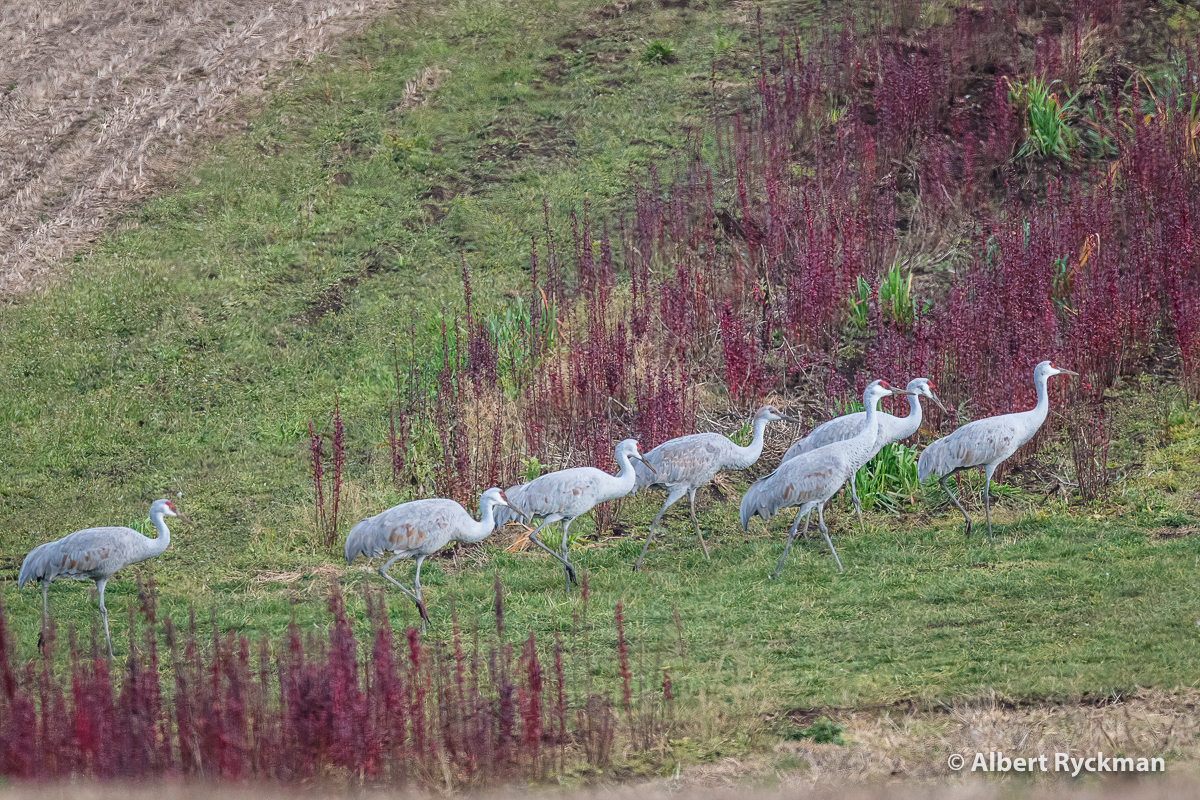
The cranes that winter on Sauvie Island come 1,500 miles down from Alaska. More impressive: cranes from northern Siberia can winter near Sacramento, three times as far.
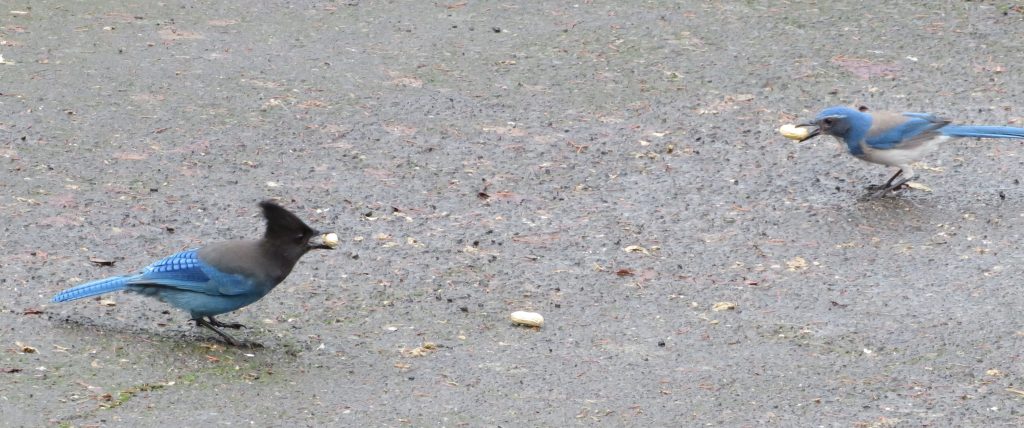
Some birds hide food — caching acorns or suet or seeds or prey. A scrub jay (like the one that lives near you) can hide thousands of acorns and other food, and remember where it is. Don’t try this at home.
Bird species have many forms of communication. We can hear much of what they say, but species also have quiet voices used for private conversations. And their body language is enriched by featherly signals. Many adult birds warn, instruct, correct and encourage their young.
Shared awareness means a chickadee or jay who warns of a predator nearby is warning all birds within earshot. And often small mammals, too. We know now that crows, parrots, jays and other social birds often share information about food, danger, or simply how to play a new game.
Want to know more? For further reading:
“The Bird Way,” Jennifer Ackerman, 2020.
“An Immense World,” Ed Jong, 2022.
For information about upcoming Salem Audubon programs and activities, see www.salemaudubon.org, or Salem Audubon’s Facebook page.
Harry Fuller is an Oregon birder and natural history author of “Freeway Birding” and the newly-published “Birding Harney County.” He is a member of the Salem Audubon Society. Contact him at [email protected] or atowhee.blog. His “Some Fascinating Things About Birds” column appears regularly in Salem Reporter.
A MOMENT MORE, PLEASE– If you found this story useful, consider subscribing to Salem Reporter if you don’t already. Work such as this, done by local professionals, depends on community support from subscribers. Please take a moment and sign up now – easy and secure: SUBSCRIBE.
Harry Fuller is an Oregon birder and natural history author of three books: “Freeway Birding,” "Great Gray Owls of California, Oregon and Washington," and "San Francisco's Natural History--Sand Dunes to Streetcars." He leads birding trips for the Malheur Field Station. He is a member of the Salem Audubon Society, and leads bird trips locally. Harry has just published a new book, BIrding Harney County.