What is remarkable about the Salem area’s economy over the last three years is how unremarkable it’s been.
With the exception of large job gains in one industry, Salem’s employment has displayed a pattern similar to other areas of the state, the state as a whole and the U.S. – growth in healthcare employment, and losses in other major industries. The unemployment rate has hovered between 4.5 and 5%, a modest increase from post-Covid lows and, again, similar to the state and the U.S.
The story is more complicated, however.
To explain the complications and see a clearer picture of the economy, we’ll examine year-over-year job change and employment in some major industries. Also, we’ll look at labor force participation because, as a measure of labor supply, it helps to explain employment and unemployment trends.
But first, let’s analyze job growth.
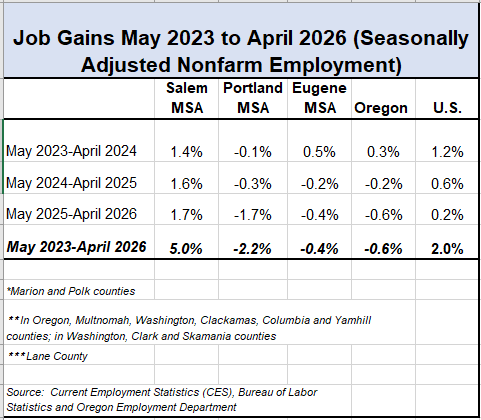
Overall, there’s been job growth in the Salem Metropolitan Statistical Area (MSA, Marion and Polk counties combined) over the last three years, unlike the Portland and Eugene-Springfield MSAs and the state as a whole. Salem has added 9,000 jobs from April 2023 to April 2026, a 5% increase – but largely due to one industry as we’ll see. The Eugene and Portland MSAs lost jobs over this time period, as did the state.
Two industries have added jobs to the Salem area economy: transportation and warehousing, and healthcare.
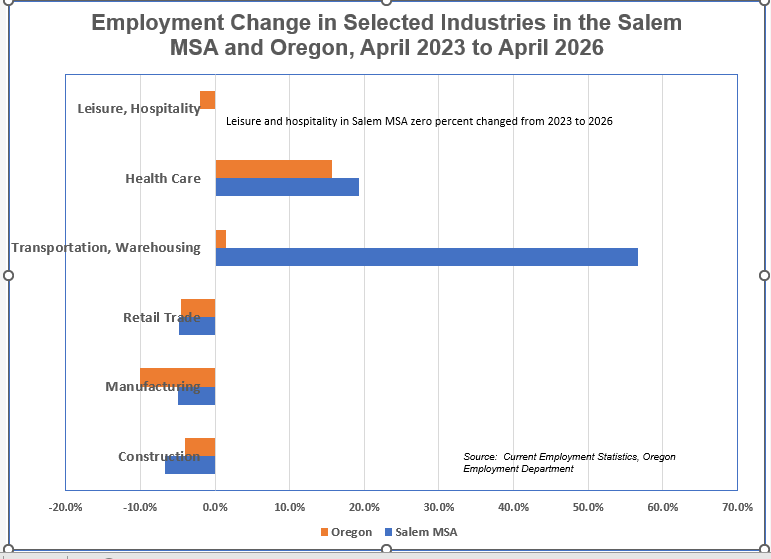
The standout is transportation and warehousing, with huge growth over the last several years, but the explanation is easy – it’s the Amazon warehouse that opened off Interstate 5 near Woodburn, employing several thousand people. Without this explosive add-on of jobs, Salem’s employment growth would likely have been close to zero over the last several years.
Salem area healthcare and social assistance employment grew nearly 20% over the last three years. It is the only industry growing state-wide (with the exception of transportation and warehousing, likely affected by Salem’s huge growth in this industry). In fact, healthcare is the only industry growing nationwide as well.
Salem manufacturing added a handful of jobs over the year (100 jobs out of a total of 11,300) and these were in food manufacturing. Durable goods manufacturing, diversified in the Salem area, has seen employment hold steady over the last several years.
Now for the losses.
Construction employment has declined 4%, losing 800 jobs (out of 12,500) over the last year. Employers are having difficulty hiring workers and at least part of the reason for that is a public policy choice. According to the national Association of General Contractors and other experts, federal immigration enforcement efforts have had an impact on employment in one third of all construction firms.
Retail trade had job losses in the Salem MSA and the state as a whole, a trend exacerbated by the pandemic and not showing signs of letting up.
Leisure and hospitality employment in Salem has fluctuated up and down over the last few years. Employment in April was at the same level as three years ago, 15,900 jobs. Oregon lost two percent of its leisure and hospitality jobs over this time period.
Two industries warrant further explanation: healthcare, and leisure and hospitality.
Employment in healthcare and leisure and hospitality combined comprise more than one-third of Salem MSA’s private sector jobs, and both were hugely affected by the pandemic. The Willamette Workforce Partnership (WWP – the local workforce board and sponsor of this column) is currently implementing workforce assistance efforts in each of these industries.
Although the Salem healthcare industry has experienced growth over the last three years, the industry has not really recovered from the pandemic. High stress levels, burnout and frequent turnover are reported among many types of healthcare workers.
WWP is working with the Willamette Health Council to respond to these challenges. The Willamette Health Council is the community governance body for PacificSource Community Solutions, Marion County and Polk County Coordinated Care Organization (Marion-Polk CCO). This cooperation will produce a plan to aid healthcare industry employers in creating healthier workplaces and promoting improved employee recruitment and retention. The work is currently in the information-gathering stage.
Leisure and hospitality industry employment, although recovered from losing half its jobs in the early months of Covid, is described by an industry staffing report as being in a state of “on-going instability” with turnover rates four times those of all jobs.
WWP, recognizing the importance of this industry to the Mid-Valley, launched a “sector initiative” last March, beginning in neighboring Yamhill County. Industry employers came together at an initial meeting and, with the assistance of workforce board staff, will focus on employee recruitment and retention strategies and creating career pathways to help build a talent pipeline.
Turning from employment to unemployment, the first item to note is that even with Salem’s moderate April unemployment rate of 4.9%, 11,000 residents of Marion and Polk counties were unemployed and looking for work. Add the unemployed to those working, and the result is the number of those participating in the labor force. Divide this by the working age population, and express the ratio as a percentage, and the result is the labor force participation rate, at 62% (the most recently published for Oregon).
Labor force trends are a concern. Labor force participation has been on a slow downward trajectory since the late 1990s, in Salem, Oregon and the U.S.
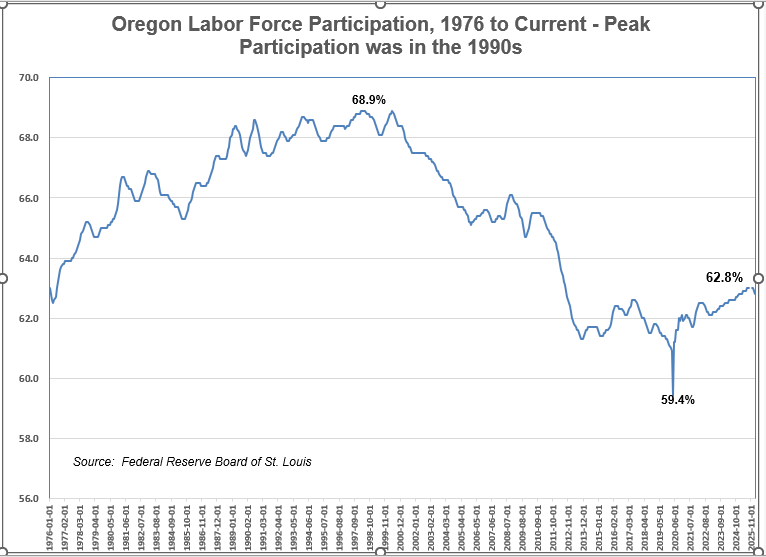
Analyzing labor force participation by age highlights important subtleties. Much of the decline in the last 25 years has occurred in the age cohort 16 to 24. The population in that age group is shrinking and more are going to college. But the percentage of those aged 16-24 not working and not in school is worryingly large.
Those individuals over age 65 have increased their labor force participation, but the numbers are small. And, so far, participation by prime-age workers age 25-54 has held steady. But it is likely that the size of the native-born prime age workforce will shrink over the next decades, affecting labor supply and ultimately economic growth.
In addition to sharing in these nation-wide trends, Oregon experienced a year-over-year population decline in 2022, and the natural rate of growth – births minus deaths – continues to decline. All this contributes to slow labor force growth and slow job growth.
We shouldn’t leave this discussion without a mention of inflation. It’s up from 2.4% to 3.8% over the year and experts predict it will go higher.
The price of gas is the major culprit, but some popular food items have also soared in price (see table 7 in the above link for price increases in individual food items). Food overall is up 3.2% over the year, but meats are up 9%, fish 6.5%, fresh vegetables up 14%, and coffee up 18%.
To summarize – we’re seeing job growth in Salem in two industries, and job losses elsewhere, a moderate unemployment rate that’s been stable for months, and inflation starting to heat up.
Put all this into the context of what the economy has weathered over the last year and a half: threats of huge tariff increases; immigration policy that, according to some, has impacted labor supply; the longest government shutdown in history; and a war with Iran affecting the price of oil and eventually everything else.
Economic forecasting has to be daunting in this environment. The economists of the Oregon Office of Economic Analysis, optimistic in the February forecast (before the Iran war), now see the war and its impact on the price of oil as a game-changer (in the May forecast). Still, they don’t see a recession on the horizon.
Where will the economy be in a few months’ time? Will there be more job losses or a return to growth? Only time will tell.
Pam Ferrara of the Willamette Workforce Partnership continues a regular column examining local economic issues. She may be contacted at [email protected]
STORY TIP OR IDEA? Send an email to Salem Reporter’s news team: [email protected].
SIGN UP: Independent reporting gives Salem a stronger voice and holds those in power accountable on issues ranging from homelessness to health care. Be part of that work by becoming a subscriber. Subscribe today.

Pamela Ferrara is a part-time research associate with the Willamette Workforce Partnership, the area’s local workforce board. Ferrara has worked in research at the Oregon Employment Department, earned a Master’s in Labor Economics, and speaks fluent Spanish.