

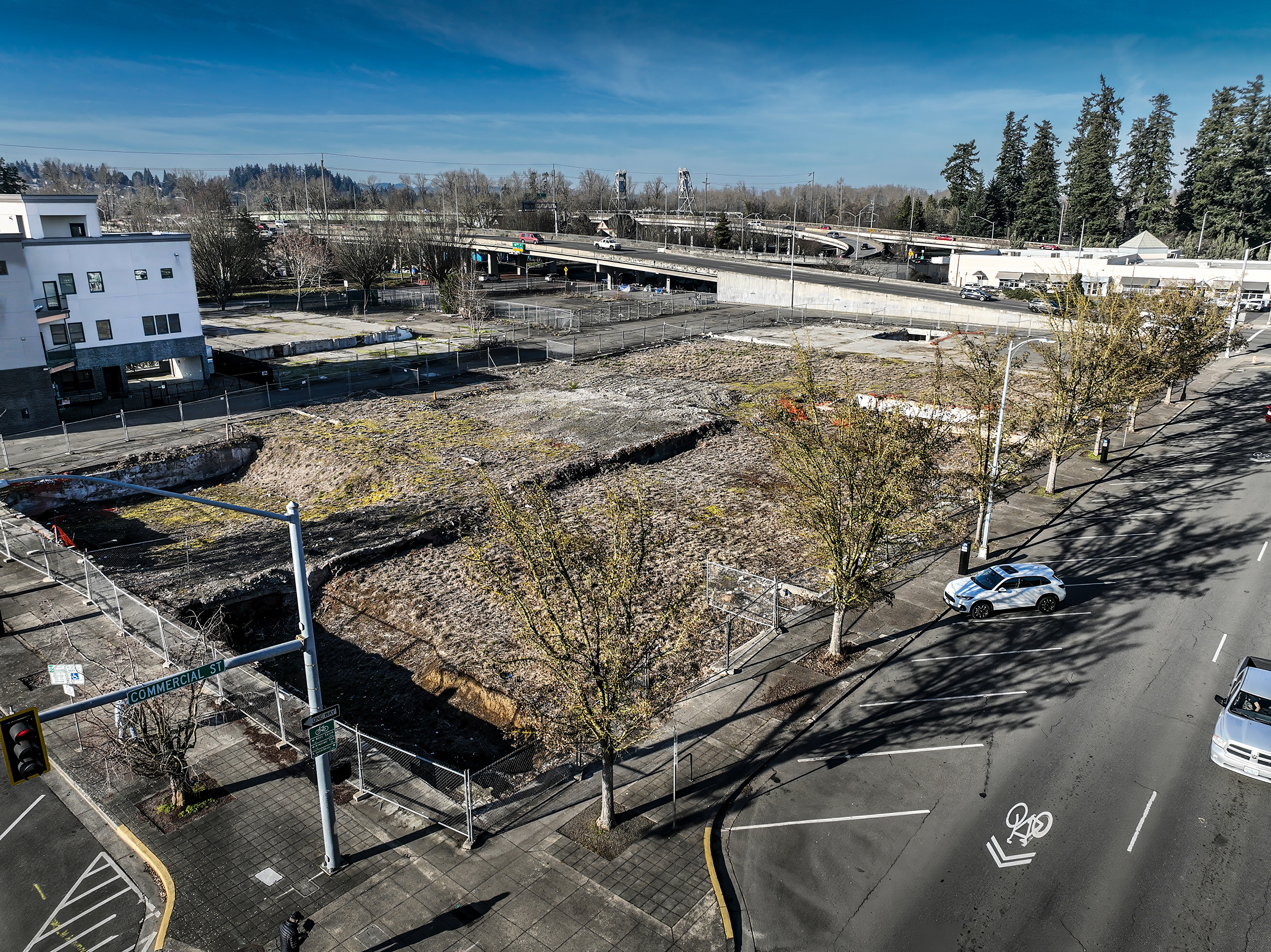
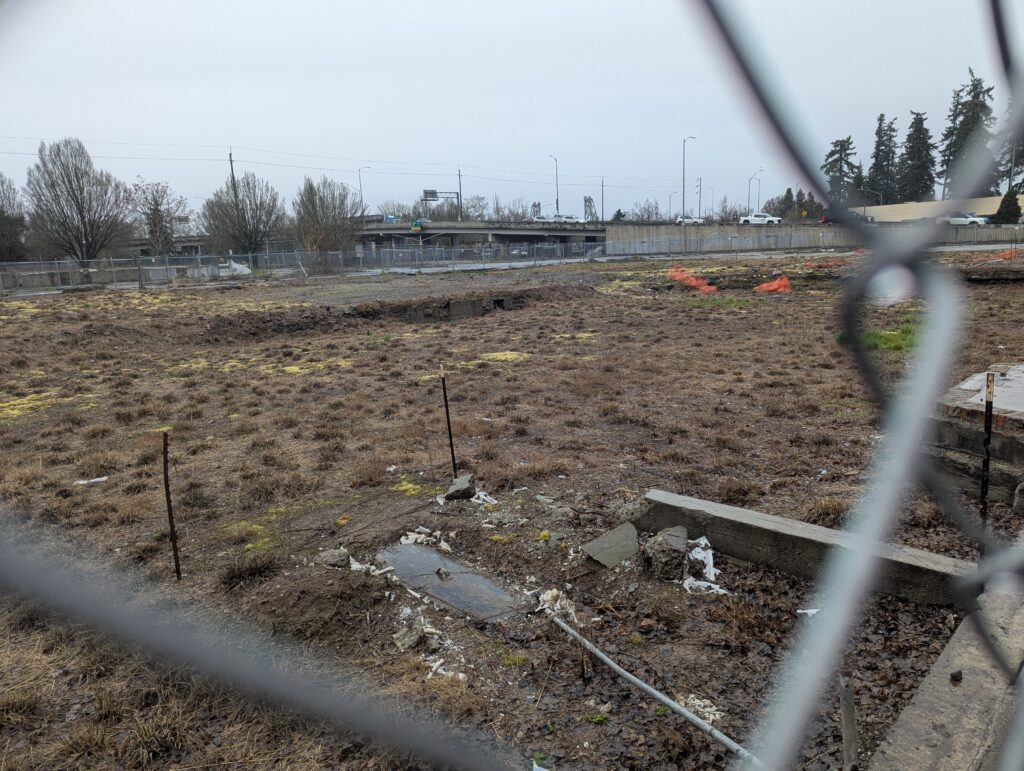
An empty lot covered with dead grass and shattered glass is the first view of downtown Salem for tens of thousands of drivers crossing the Center Street Bridge each day.
City officials unveiled a bold vision for the location two years ago. They hoped for downtown’s first grocery store. They described a complex of retail stores, topped by hundreds of apartments to lure more residents to Salem’s core.
The project, fostered by millions in public funds, would revitalize the sleepier north side of downtown.
But the development has no clear timeline and faces the prospect of even more public money being spent, a Salem Reporter investigation established.
The project with roots going back nearly a decade has been encumbered by environmental concerns, shifting designs and now an uncertain economy crimping the expected private investment, Salem Reporter found. The findings emerge from hundreds of pages of city reports and records obtained through public records requests and interviews with city and state officials.
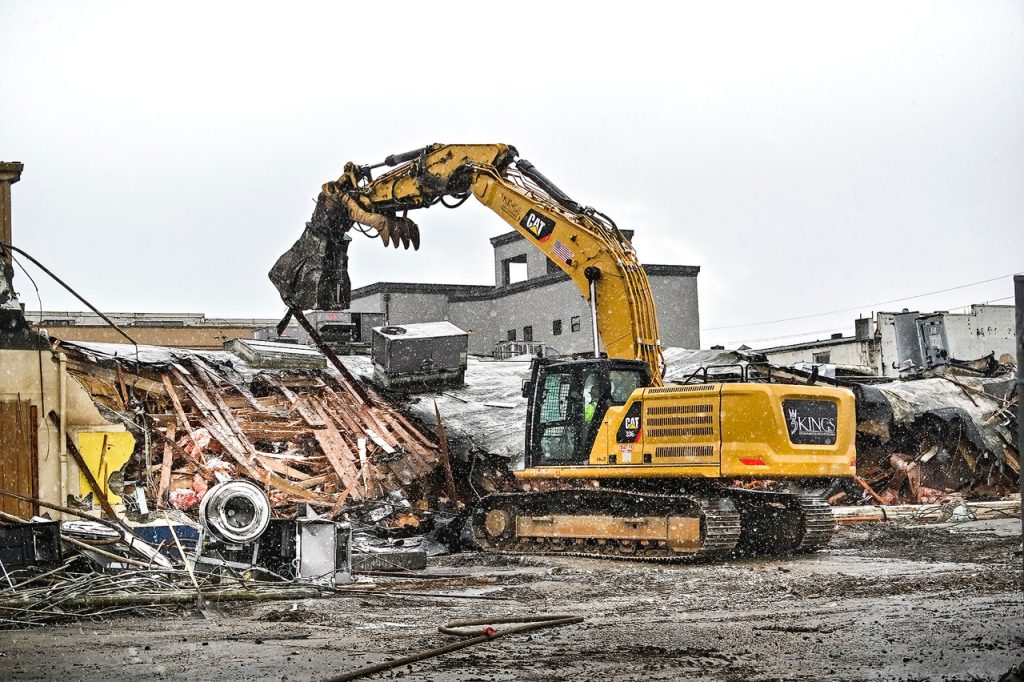
The city-owned real estate has sat empty for the three years since excavators tore down the buildings.
In 2024, city officials picked two Northwest firms to buy and develop the property in a way that met city objectives. There is yet no sales agreement in place.
State environmental regulators still require a plan to monitor and contain soil and groundwater contaminated with gasoline. Only then will the sale go through and construction begin.
And the developers are still working out how they’ll pay to build as costs continue rising and an uncertain economy has investors wary of major projects.
Over six years, the city of Salem has spent at least $5 million in taxpayer money on what is known as Block 50, which sits along Northeast Commercial Street between Center and Chemeketa.
City officials maintain the project is viable and progressing, though, slowly.

A decade ago, the now-barren lot surrounded by chain-link fence was a hub of activity downtown.
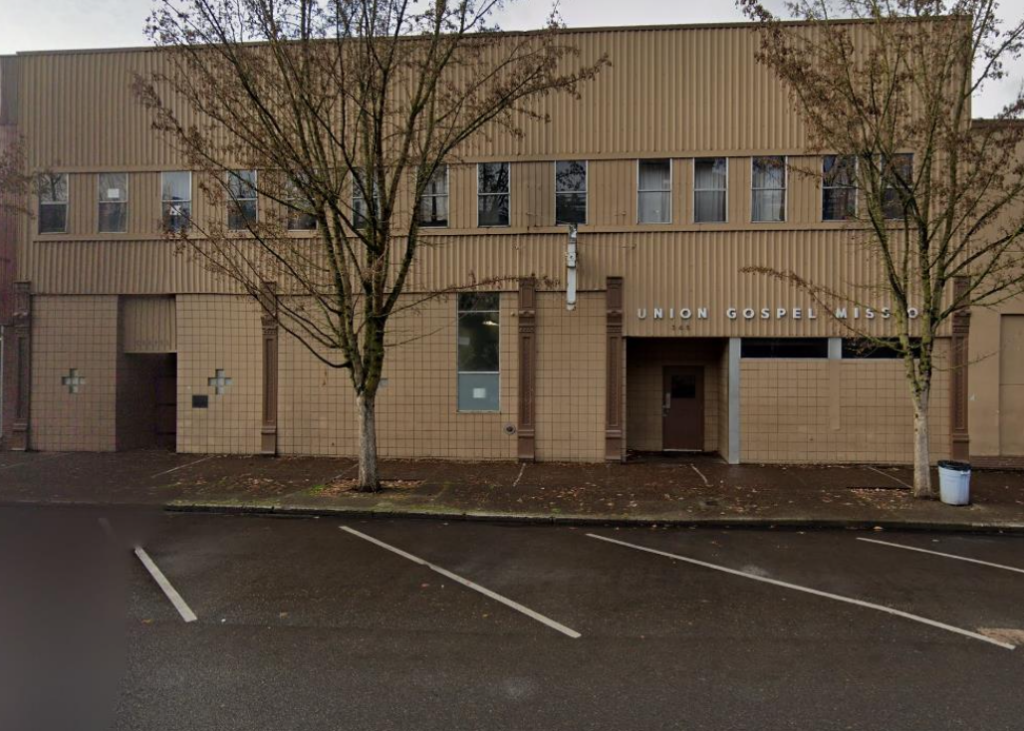
Men lined up along Commercial Street, waiting for the Union Gospel Mission to open its doors.
Customers could pull into an angled parking spot to grab a new faucet at Saffron Supply Co.
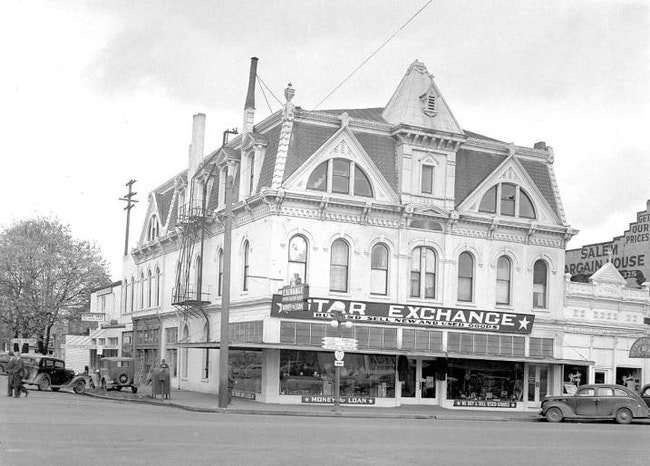
At that time in 2016, nine buildings sat on property stretching from Commercial Street towards the river on Northeast Front Street. The oldest, built in 1888, housed the Oregon Land Company. As a boy, future President Herbert Hoover worked as a clerk for his uncle at the business. The corner building later became home to the Salem YMCA, holding the city’s first swimming pool, then housed the Star Exchange, a pawn shop.
At the north end of the block, the mission had owned its 1.1-acre lot for decades. The building was falling apart and often at full capacity in the winter. Mission leaders were eager to move out and had a vision of building a modern, expanded shelter four blocks north.
To raise the money to move, they needed to sell their building.
There was a problem.
Beginning in the 1920s, a gas station operated on the site over about 50 years under various owners. Underground tanks stored the fuel. They leaked, contaminating the soil and groundwater.
The state put the property on its list of places requiring cleanup due to leaking underground tanks. The tanks were removed in 1997 but tainted soil and groundwater remained.
Gasoline can become vaporized and inhaled. At high enough concentrations, that can cause neurological and breathing problems — including poorer memory and intellectual functioning from repeated exposure.
In a 2016 report to the Union Gospel Mission, Anderson Geological concluded levels of gasoline and other products in the soil and water exceeded safe limits for construction workers. The consultants concluded that unsafe levels of gasoline vapors could enter apartments contemplated for the site.
The contamination “poses an immediate concern and should be addressed in a timely manner,” the report concluded.
Their report noted the size of the contaminated plume hadn’t been identified.
Ten years later, that plume footprint remains an unknown.
The city of Salem commissioned its own report. Stantec, an engineering consulting firm from Portland, agreed in its 2016 report that construction workers could be exposed to more gasoline vapors than safe, but determined the risk to future residents was minimal.
The report recommended collecting more samples from a monitoring well and that a system be developed to prevent fuel fumes from entering new buildings. Those steps could lead the state Department of Environmental Quality to determine no more action was needed on the property.
More tests followed, state records show.
In June 2017, a vacuum truck sucked 194 gallons of groundwater contaminated with gasoline out of a well on the old gas station site.
In a November 2017 report, Anderson Geological noted that samples taken immediately after the removal showed no gasoline in wells. But within months, small amounts had started showing up in water samples again.
That’s common in sites contaminated with petroleum products, DEQ spokesman Dylan Darling said. It’s one reason cleanups can take years.
Plans for the city to buy the site and other properties on the block advanced.
Such ambition had been detailed years earlier in plans to revitalize downtown, assembled in part by legions of volunteers on city committees.
The Downtown Action Plan of 2011 said, “Through strategic public investments combined with private sector leadership, the action plan is intended to support the leverage of over $1 billion in private investment in downtown Salem over the next 20 years.”
One source of money is urban renewal. Special districts capture property taxes that ordinarily would go to local government operations, used instead to underwrite development.
“By making public investments in these areas, cities can remove problems like abandoned buildings and poor conditions. This leads to better property values and encourages private businesses to invest in the area,” the city’s development agency explains on its website.
Salem has repeatedly invested in downtown urban renewal, though not without controversy.
A decade ago, some $749,000 in taxpayer money helped subsidize the construction of an office building at the south edge of downtown as part of a larger plan to redevelop a shuttered Boise Cascade facility. Urban renewal money has also subsidized the Citizen Apartments, currently under construction on a downtown lot long vacant.
The city’s Downtown Advisory Board had identified the Block 50 site as opportune for redevelopment, said Kristin Retherford, city director of community planning and development.
But the project was about more than spurring economic vitality.
Retherford said city officials at the time of the possible Commercial Street acquisition faced political pressure to help the mission relocate because of concerns raised by businesses about the congregation of homeless people.
The aging mission building had fire safety concerns and needed to come down. City acquisition of the property would help the mission add more shelter beds in a new location.
She said city officials felt it was in Salem’s best interest to take on the site despite the environmental challenges.
“There was kind of a tight timeline around moving forward with that acquisition, and it was decided that taking it with this discounted price, knowing that we had urban renewal funds that could assist with any cleanup or remediation that would be necessary, was worth that risk to help the UGM meet their timelines and help expedite that process,” Retherford said.
By late 2017, city officials determined the mission and its neighboring property owners were interested in selling a total of 10 lots.
“The combined property represents a substantial redevelopment opportunity and is a gateway to downtown from the north and west,” according to a 2017 resolution approved by the Salem City Council, sitting as the Urban Renewal Board.
The city’s real estate manager negotiated the sale with the mission, she said. On Aug. 27, 2018, the city agreed to pay $1.58 million for the property, with the sale to be finalized once the mission was ready to move to its new home.
The deal included an $80,000 discount from the property’s market value. Sale documents said the discount was intended to cover future environmental efforts.
“There’s still one small area that may have contamination,” then-UGM Executive Director Dan Clem told the Statesman Journal at the time of the August 2018 sale. “It’s just so minuscule, you can’t tell if you got it all.”
But Retherford said city officials at the time were aware that cost was uncertain.
“I don’t think we had a grasp on exactly how much it would cost … there was still some variability,” Retherford said.
She said it’s common to use urban renewal funds to take on risks private developers are unlikely to assume.
The deal left the city with all liability for the damage caused by those leaking fuel tanks.
“Buyer is a sophisticated purchaser who is familiar with the ownership and operation of real estate projects similar to the property and buyer has or will have adequate opportunity to complete all physical and financial examinations relating to the acquisition of the property as it deems necessary,” the agreement said.
With that deal pending, the urban renewal agency started buying up the other lots. For several years, nothing changed. The Union Gospel Mission continued operating on the site and raising money for its new home.
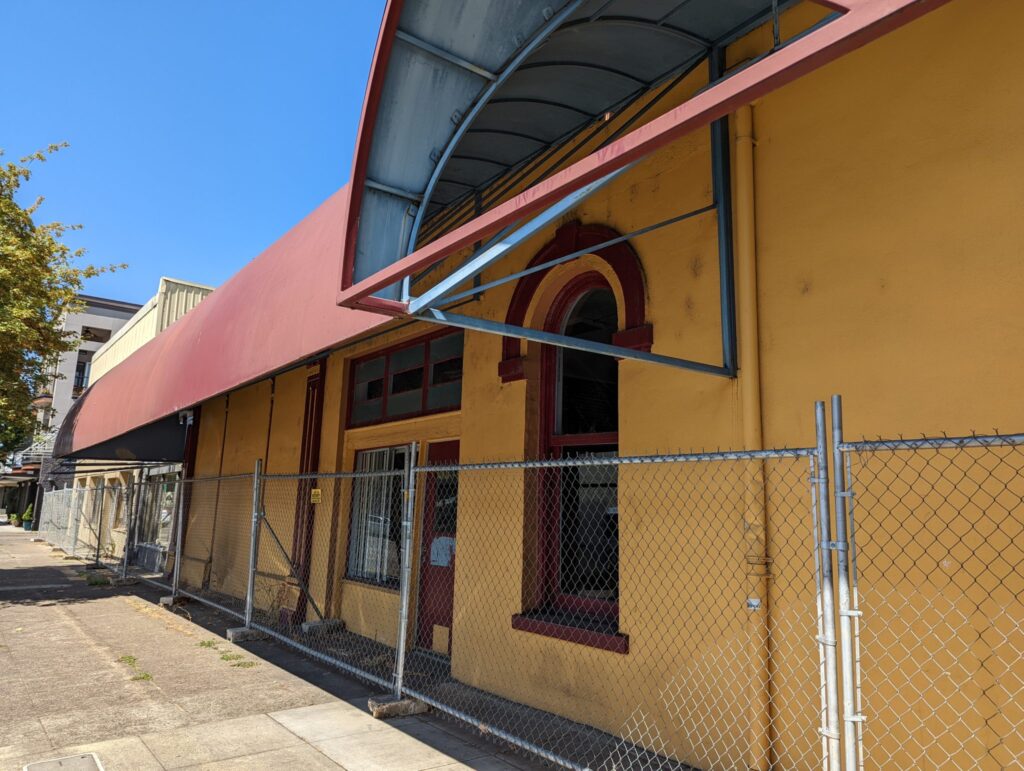
In the spring of 2019, the city paid $2 million for four other lots, purchasing the buildings that held Saffron Supply Co. on Commercial Street and ABC Music on Chemeketa Street. That made city government the landlord for a number of private businesses, and the owners of most of the block.
After the Union Gospel Mission opened its new home in the summer of 2021, the old mission site closed and ownership passed to the city.
The city then set about demolishing nine buildings at a cost of nearly $1 million.
Clearing the land was intended to smooth the ramp for private developers.
Sheri Wahrgren, the city’s then-downtown revitalization manager, told Salem Reporter at the time her goal was “when somebody buys it, it’s as ready to go as possible.”
As the demolition got underway, the DEQ contacted the city in March 2022 about resolving the fuel contamination. The agency was working on a backlog of properties that had held leaking underground storage tanks, Darling said. Later that year, the agency requested more testing and a plan to finally determine the extent of soil and water contamination.
In July 2023 city leaders announced they were seeking developers for a “premier development opportunity” to transform the now-empty property. “The vision for Block 50 is housing or offices with a mix of active services on the ground floor, including restaurants, coffee shops, brew pubs, a grocery store or other retail,” the city said in launching the search for partners.
Developers should propose a project to “serve as a catalyst and model for the revitalization and redevelopment of key formerly underutilized sites in downtown,” the city announcement said.
There was no mention in the public announcement of the fuel in the soil and groundwater. Retherford said details on the contamination and the environmental assessment were provided to developers.
In February 2024, the city announced its selection in a press release.
Two firms, Edlen & Co. of Portland and deChase Miksis of Boise, planned more than 200 apartments and retail space to include a grocery store. Then-Mayor Chris Hoy described the selection as a “milestone for our downtown revitalization.”
Soon after, the city council, acting as the Urban Renewal Board, approved a two-page agreement with the developers with only broad conditions. There was no pricing, no deadlines and no schedule for getting dirt moving.
“Both parties understand the importance of meeting on a regularly scheduled basis, in order to move the project forward,” the agreement said.
As talks with the developer got underway, city officials again engaged Stantec to assess the environmental issues.
The firm reported in late 2024 gasoline remained present in groundwater, though levels had decreased since 2016, when city leaders began contemplating a sale.
Now, regulators want the extent of pollution documented. That would allow planning to ensure workers and future residents wouldn’t be exposed to unsafe vapors or contaminated water.
Without such a plan, the state could hold the developer liable for future cleanup.
Breaking ground won’t be easy.
State regulators now want new monitoring wells installed north of the property to better understand the extent of the contaminated plume.
That means yet another deal, this time with that property owner. That land is on the other side of the Center Street Bridge from the city’s project.
City officials hope to have monitoring data from new wells in six months, said Dana DeKlyen, assistant director of urban development.
Only then can a final cleanup plan be devised that passes muster with DEQ and earns some immunity from liability.
And exactly what that looks like depends on what’s going to be built. Developers’ plans have shifted several times, city officials said, though they still include apartments and retail space.
“There’s just some technicalities that have to be addressed (that) we couldn’t assess at the time of purchasing the property or selecting the developer,” said DeKlyen. “You have to know what the development is to know what it is you have to do to address the environmental issues.”
Meantime, the actual sale of the city land to the developers inches along.
An appraisal to set the market value on the property is pending, with a contract to complete it signed, DeKlyen said. She said the city has waited to pursue that until the city and developer are closer to reaching an agreement on sale because appraisals are only valid for six months.
The sale could include a discounted purchase price or other city money put toward the project, a break to entice developers to move ahead, according to city officials. That includes developers agreeing to provide what are considered affordable rentals by Salem standards.
Uncertainty remains about the path to construction.
“When we took this out to market there was an optimistic expectation from those that were responding that capital markets would be changing and that interest rates would be going down and that hasn’t been the case,” Retherford said. “Costs have gone up millions of dollars.”
Jill Sherman, co-founder of Edlen & Co, said city statements about the project’s status were accurate and that the firm is working with the city and state on environmental issues. She didn’t respond to requests for details on the latest design or a timeline.
A media contact for deChase Miksis didn’t respond to a request from Salem Reporter for comment or to excerpts of this story provided to review for accuracy. City officials confirmed the company is still involved in the project.
And yet another potential hurdle to construction remains.
The state Bureau of Labor and Industries will determine whether construction workers would have to be paid what’s termed the prevailing wage. Such wages reflect local standards and are required on public works projects.
Imposing the prevailing wage could add millions to construction costs on Block 50, city officials say.
“We haven’t felt a huge rush to resolve the DEQ issues because there’s other barriers as well that time could help resolve,” Retherford said. “Some of this delay, too, is kind of buying a little bit of time to see if some of these costs start going down, to see if investors start feeling more confident.”
Still, Retherford maintained the millions spent on the site was a good use of city money. The agency’s aim is to take on projects private developers are unlikely to pursue. She noted several major downtown properties slated for private development have also been stalled for years.
“We really do want this project done,” DeKlyen said. “We believe that it’s a viable project because we’re still working on it but it does require a lot of moving parts to fit together so I don’t have a timeframe. I wish I did.”
“It just takes a long time to get through the processes,” she added. “This is a challenging project.”
Contact Managing Editor Rachel Alexander: [email protected] or 503-575-1241.
LOCAL NEWS DELIVERED TO YOU: Subscribe to Salem Reporter and get all the fact-based Salem news that matters to you. Fair, accurate, trusted – SUBSCRIBE

Rachel Alexander is Salem Reporter’s managing editor. She joined Salem Reporter when it was founded in 2018 and covers education, economic development and a little bit of everything else. She’s been a journalist in Oregon and Washington for over a decade and is a past president of Oregon's Society of Professional Journalists chapter. Outside of work, you can often find her gardening or with her nose buried in a book.
Comments are closed.



Excellent reporting! I have been wondering about the hold up on this project. All this because of a gas tank and folks pushing off responsibility. Good planning, thorough safety measures, and environmental protections now can prevent city problems 100 years down the road, it seems!
With this present kick the can city council and state inspectors, attorney’s and state agencies coming out of the woodwork, a community garden may be an alternative
Great investigative reporting!!
A community garden on top of a gasoline spill?
I was being sarcastic 😎
I do not know if a community garden would be a good use due to the contamination of the soil. It is probably better to resolve environmental concerns. Perhaps the state could access superfund dollars to help with environmental cleanup.
Europe operates on the Precautionary Principal. Companies must document how they have looked ahead at the possible consequences and outcomes, and verify their product/process is safe or how they will deal with safe disposal. Upfront. Kind of like how many Native tribes make a decision based on how it will probably effect the next 7 Generations.
This is one way to tell the story. It tends to focus on how much the city of Salem has spent and the fact that the lot is still vacant. It makes it seem the city is incompetent and wasteful. There’s another way to tell the story, also true. No private developer would ever touch that lot in its degraded condition without strong public incentives and support. Perhaps the story is the diligent effort of the city to find ways to remediate the land and find a tenant despite difficult initial conditions and headwinds from a variety of factors beyond their control. What would the journalist have liked the city to do? What would the journalist recommend the city do now?
Good coverage, Rachel. Thanks.
The 50 block delay is the least of downtown Salem’s issues in fact for the entire state as it is turning into a big sewer. If the governors gas tax bill gets passed in May and haven forbids if she is re-elected that will be the final straw for this once great state that is now a shit hole from one party rule. Business’s and citizens will continue move out. For me and family if the gas tax passes we will be moving out.
I like how the idea of a “hub of activity” a decade ago was highlighted with men lining up for union gospel mission handouts. Well they are still there, make me want to invest.
Salem has become an eyesore. The homeless have taken over downtown. We visit Silverton and McMinnville for great restaurants and clean downtown. No paid parking there too. I say level the entire city .
This was pushed throughout the City Council by that disgraceful man Chris Hoy! He also pushed through spending money on the airport, and the paid parking downtown! He’s also to blame for the homeless problem we have, he pushed to give them anything they wanted. But didn’t give a crap about the residents or public safety!