


What is likely to be the oldest tree in Salem will die on April 1, 2026.
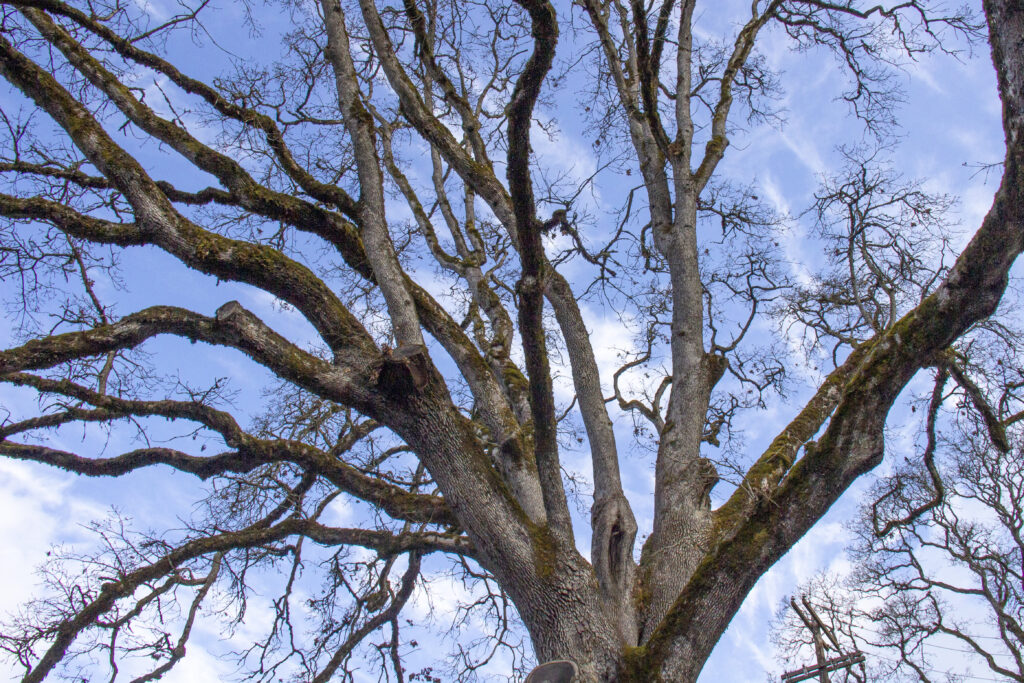
The Oregon white oak’s death by chainsaw comes after a yearslong battle with a fungal infection. The fungus has penetrated from its roots to the branches 80 feet in the air, towering above the Victorian homes which it preceded. The trunk is so thick that it would require a team of at least three to hug it.
From there, slices of it will go to biologist David Craig’s team at Willamette University. They will count the rings, which will end in 2026 and likely date to the 1600s.
“We can go back in time to wherever time starts for that tree,” Craig said.
The tree, likely at least 380 years old, now sits at 1307 Marion St. N.E., across the street from Safeway and across Mill Creek from North Salem High School.
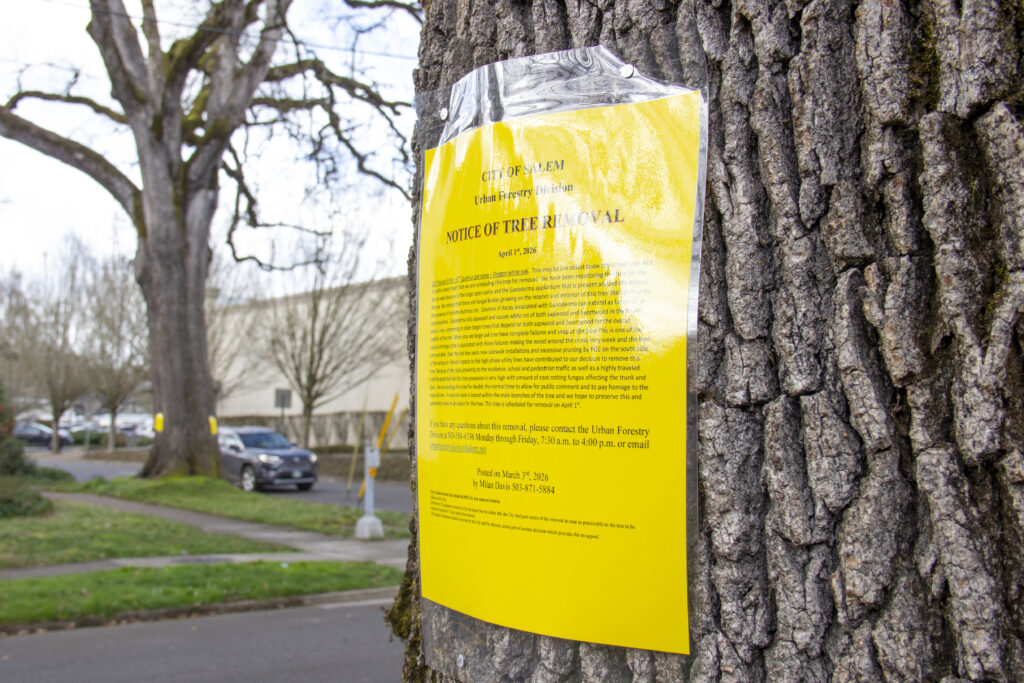
There are yellow notices tacked into the bark, letting neighbors know when the oak will be taken down. The removal has brought a mix of questions, requests for alternative treatments and acceptance from neighbors.

Milan Davis, the city’s urban forester, leads a team of six arborists. Around 2020, when they began inventorying the city’s trees in earnest, those arborists noticed that the old oak had ganoderma, a type of fungus that will thoroughly rot all parts of the tree. As it spreads, heavy branches will fall off, mindless of cars, pedestrians or homes underneath.
More dangerous is the common outcome of the entire tree falling over at the base after its wood softens like a sponge, unable to bear its multi-ton weight.
“There’s no treatment plan. There’s just different stages of trying to save it in its current state,” Davis said. “If we left that tree, it’s not a fear of branches falling one at a time, which still happens. It’s the potential for the entire tree to fail. That’s what we’re worried about.”
After spotting the fungus six years ago, Davis’ team took tissue samples to Oregon State University to confirm the diagnosis. They wanted to be thorough. The presence of shelf fungi – mushrooms that grow flat out of the bark – showed them the tree had long been host to the root rot.
“Typically, when we see ganoderma, it’s an immediate removal for us,” Davis said. “But this tree was so big, and such a landmark for the community, it wasn’t something we were like ‘OK we’re going to do this right now.’ We wanted to monitor it and see how it was doing. But there’s really no coming back. There’s nothing we can do. There’s nothing we can inject the tree with. There’s nothing to really combat this.”
After the notices were posted, members of Northeast Neighbors have questioned the city’s reason for removal. Some have asked for alternative plans, such as trimming the branches.
Davis said he will be attending the neighborhood association’s meeting at 6:30 p.m. on Tuesday, March 10, to answer their questions. The meeting is open to the public and will be at Center 50+ at 2615 Portland Rd. N.E.
Adding to the neighbors’ concerns was the planned removal of another Oregon white oak tree just across the street. It’s likely over 150 years old and is set to be removed on April 1. That tree has had large limbs fall, including one that damaged a car. It has a different rotting fungus – inonotus dryadeus – which Davis said has a more aggressive rate of decay.
Due to the community’s love of the trees, the city put the notices up a month ahead of the scheduled removal rather than the typical 15 days, Davis said.
Davis considers the fungal issue a natural part of the tree’s life cycle, but said that the strain of living in an urban environment has likely added to the trees’ issues.
“We’ve cut down a few trees in Bush Park this year, just recently, that had similar issues and it was near a walking path, so we decided it was too high of a risk to leave that,” Davis said. “There are some of these trees, in some of the parks, where they’re not in busy areas and we will leave them.”
But Salem’s oldest tree is by a school, a grocery store, a busy intersection and several homes.
“If this tree were in a park, we could have potentially put a fence around it to keep people from walking near or under it,” Davis said.
In perfect conditions, Craig at Willamette University said oak trees can have a life cycle of around 1,000 years, depending on how a life cycle is defined.
“They grow vigorously for probably 300 years, and then they have 300 years of health challenges and decline, and then probably another 300 years of standing dead wood and decomposing,” Craig said.
Part of the oak’s legacy of over three centuries is the generations of critters it hosted.
“They live so long, (oaks) have more species that are directly dependent on them than any other single tree type,” Craig said. “More kinds of caterpillars and more kinds of butterflies, more kinds of spiders, more kinds of lichen, more kinds of moths, more kinds of birds that have some part of their life cycle that is connected to them than any other single tree species.”
The tree is also closely connected with the history of the Willamette Valley. The rings of Salem’s oldest tree will have recorded the horticultural techniques of the Kalapuya people, who cultivated the trees through controlled burns. Craig said it will be a rare insight, given that most of the older trees in town were planted after the practice largely ended, around 180 years ago.
“Looking at those trees that experienced that, that witnessed that … we don’t have a lot of them,” Craig said.
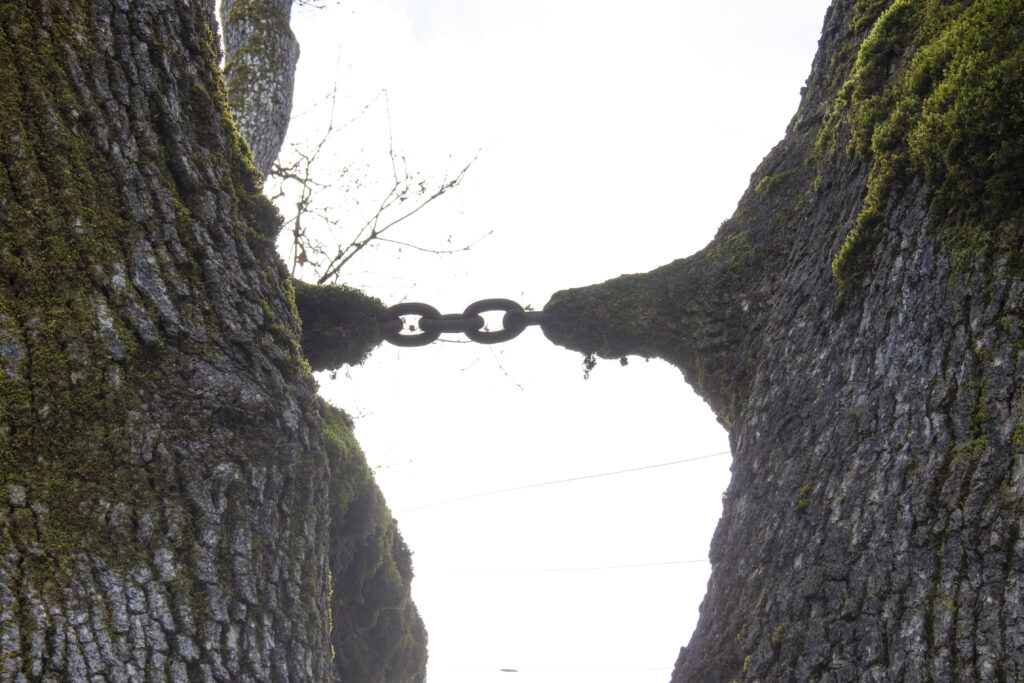
Another historic piece of the tree is visible as it stands: a thick chain between its two largest limbs. The tree has absorbed parts of it over the estimated 78 years since someone wrapped it there. Craig said once the tree is down the chain will be preserved for a display at Willamette University.
Other parts of both trees will be sent to the woodworking program at Marion County’s juvenile detention facility, Davis said. The city will likely look for a way to collaborate with them to have furniture made for the city.
“Hopefully we’ll have some pieces that we can show from this living tree,” Davis said.
Craig said he hopes that before the trees are taken down community members will come to hug them and take pictures to help document their final days.
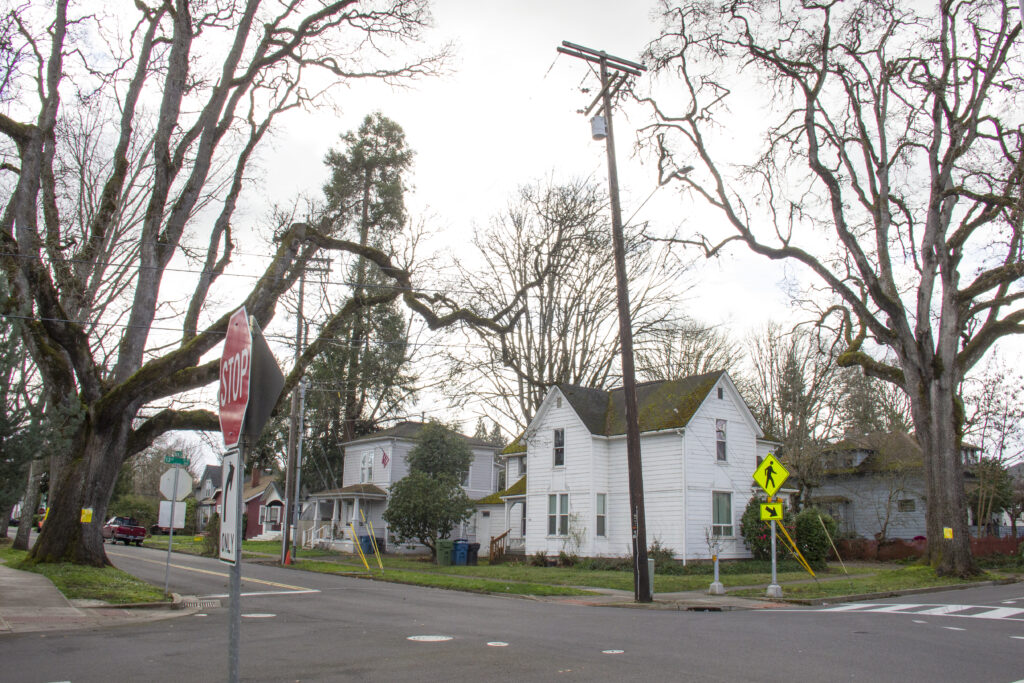
Teri Finch, who has had the tree outside front of her Northeast Marion Street home, hopes neighbors will come together to commemorate the tree.
She looked up at its branches Monday morning and began to cry.
“It’s just majestic,” she said.
Finch said she understands the city’s decision. Since she’s lived there, fallen branches have knocked out her power, and there have been lucky misses where they’ve fallen without a car parked there. Her gutter is bent in a few places from where limbs have knocked them.
Finch was crying for the tree, but also for her dog, Bodhi. He’s slowing down at over 13 years old, and the tree has been there for his whole life.
“He’s just been my little pal. We know every inch of the park … it’s just, things going away. You’ve got to kind of look at it in a philosophical way, that when things go, there’s rebirth. And things run their course. My dog’s had a great life,” she said. “And this tree has had a long run of it too. It’s just sad to see things go away.”
Contact reporter Abbey McDonald: [email protected] or 503-575-1251.
LOCAL NEWS DELIVERED TO YOU: Subscribe to Salem Reporter and get all the fact-based Salem news that matters to you. Fair, accurate, trusted – SUBSCRIBE

Abbey McDonald joined the Salem Reporter in 2022. She previously worked as the business reporter at The Astorian, where she covered labor issues, health care and social services. A University of Oregon grad, she has also reported for the Malheur Enterprise, The News-Review and Willamette Week.
Comments are closed.





Tragic
Great job reporting! Information included history of oak trees in our area. I believe that the oaks are indigenous to our valley, that they also have a lifespan that needs to be regarded for the safety of everyone. I appreciated the information regarding the indigenous people of our area, which to me, is history that we all share. Thank you for the article.
Loved this article about native oaks. I went to pay my last respects t today.
Please do an article on Marion County Juvenile Department and their work with wood. It is a common misconception that all is used for firewood. I hope that beautiful oak, walnut, etc. logs can be sold or given to woodworkers to be used for flooring, for furniture, etc. does the juvenile dept. saw into planks? Dry the wood?
also missing – article on the styrofoam – what happens after we deposit our styro at the place on Center St?
where does it go? do the proceeds from selling it go to the juveniles to pay their fines for misdeeds?
Tragic