Salem police chief wants more help from county, state to address unsheltered homelessness
In response to community frustration about unsheltered homelessness, Salem’s police chief and the Marion County district attorney said that law enforcement is only part of a complicated approach to a problem that requires constant collaboration to address.
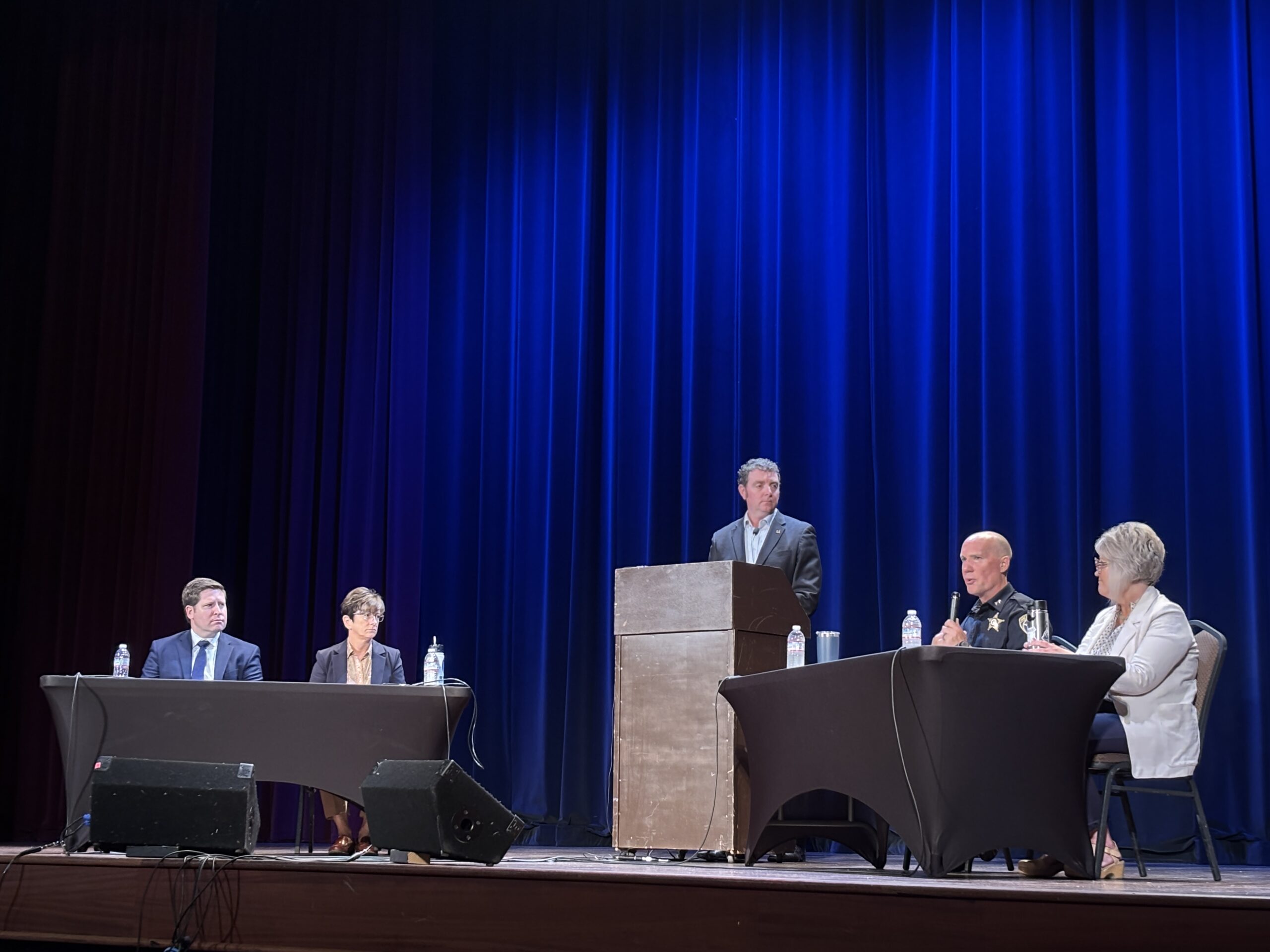
The topic was the dominant point of discussion during a panel at the Elsinore Theater Wednesday morning hosted by the Salem Main Street Association.
The four panelists, Salem Mayor Julie Hoy, Salem Police Chief Trevor Womack, Marion County Commissioner Colm Willis and Marion County District Attorney Paige Clarkson, sat on stage and gave presentations before taking questions from those in the audience of hundreds of business owners and other concerned residents.
Many attendees queried panelists about how local government can solve unsheltered homelessness, largely rehashing complaints raised for months about a perception of downtown as unsafe, unsanitary and overrun by vagrancy.
Marion County Sheriff Nicholas Hunter later sat on stage to answer questions and Interim City Manager Krishna Namburi, and City Director of Community Planning and Development Kristin Retherford also participated in the conversation from the audience.
In response to questions about how to “get rid” of homeless people, Womack made clear that police are not responsible for solving unsheltered homelessness on Salem’s streets.
Instead, he said, his department is focused on doing what it can to manage and mitigate unauthorized camping via the department’s Homeless Services Team which is slated for possible expansion as part of a city initiative to improve conditions.
He said the focus for solving homelessness should not be solely on his department, but on state and county agencies in charge of providing mental health and addiction services.
“That is not a city function and yet you see more and more cities starting to step into that because of pressure from the community because other people are lacking,” Womack said. “So, we need to put pressure where pressure needs to go to solve this problem and help me manage the problem that is happening right now on the streets.”
Womack reiterated ongoing city efforts to bring back the department’s eight-officer bicycle team and to enhance the city’s Homelessness Services Team and city cleaning crews to seven days a week as the city’s push to help improve downtown.
Salem’s downtown business community committed $360,000 to put two bicycle-mounted police officers to work later this year.
City councilors will vote to accept the private funds and to advance its plan, which includes a crisis response team made up of medical workers and mental health specialists run by the fire department, at its next city council meeting on Oct. 13, Namburi told the group.
Willis addressed the audience before leaving the event early to attend a county commission meeting. He said he supports further collaboration between the county and the city in improving conditions downtown. He also said there needs to be better communication between law enforcement agencies across the state to prevent repeat offenders from crossing into Marion County to potentially commit crimes.
“I do think that we need to do a better job of making sure folks aren’t victims of crime in downtown Salem,” Willis said. “That people feel safe in downtown Salem.”
Clarkson outlined some immediate measures her office is taking in collaboration with the police department and the county sheriff’s office to address issues in downtown Salem.
Those efforts include a city-county law enforcement team led by a special prosecutor in Clarkson’s office which focuses enforcement where it is needed most.
The team, she said, can deal with any criminal matter ranging from repeat lower level criminal offenders downtown, to gun violence in northeast Salem, but that the team is strategically deployed to handle specific cases that have the potential to become more severe over time.
When it comes to unsheltered homelessness, there is little the district attorney’s office can do on its own to provide relief. She cited her office’s commitment to following the law.
Clarkson said while it is frustrating for business owners to call the police and be told that a disruptive unhoused person cannot be arrested or held in the county jail, her office must act lawfully and ethically.
Clarkson said it is against the law to hold certain offenders in the county jail.
“It is a collaboration. It isn’t something that I can just decide on my own, or the sheriff can decide on their own, or a patrol officer can decide to change on his or her own,” Clarkson said. “This is something that we have to work together to determine if we are doing the right thing in the face of what our community is experiencing out there.”
A ‘blueprint’ for downtown
In response to the community’s frustration about the homeless in the streets, Hoy said she wants what the community wants when it comes to cleaning up Salem. She also said she understands the limitations when it comes to solving many of the issues and that it largely boils down to working with other jurisdictions to achieve results.
“I would come back to that collaboration piece where we need enough resources in order to have what folks who are on our streets actually need. We need to sort out what the needs are and make sure we have enough of what is required to address their issues,” Hoy said. “I think right now we are dealing with an extra difficult situation with the State of Oregon and the Department of Transportation properties. That seems to be where the folks are right now for the most part. And we need collaboration with them.”
Hoy also touted the city being accepted into the Bloomberg Harvard City Leadership Initiative Collaboration Track program run by the Harvard Kennedy School. She said representatives from the program will be coming to Salem in the next month to meet with a group of 30 city officials and business and nonprofit leaders to discuss issues in Salem.
“We are beginning to build a blueprint for downtown that we will then be able to apply to northeast Salem in terms of public safety,” Hoy said. “So, super excited about that.”
Parking revenue
The discussion touched on parking revenue given business owners downtown were charged an annual parking tax in addition to Salem charging for downtown street parking beginning July 10. The new parking program has brought in significantly more money than city officials estimated.
Namburi said the city will first need to build up savings for its surplus and contingency fund in its new parking fund. She said that any new proposals on how to spend parking money surplus dollars might will go before the city council for discussion in January.
Contact reporter Joe Siess: [email protected] or 503-335-7790.
A MOMENT MORE, PLEASE – If you found this story useful, consider subscribing to Salem Reporter if you don’t already. Work such as this, done by local professionals, depends on community support from subscribers. Please take a moment and sign up now – easy and secure: SUBSCRIBE.

Joe Siess is a reporter for Salem Reporter. Joe joined Salem Reporter in 2024 and covers city hall but also loves surprises. Joe previously reported for the Redmond Spokesman, the Bulletin in Bend, Klamath Falls Herald and News and the Malheur Enterprise. He was born in Independence, MO, where the Oregon Trail officially starts, and grew up in the Kansas City area.