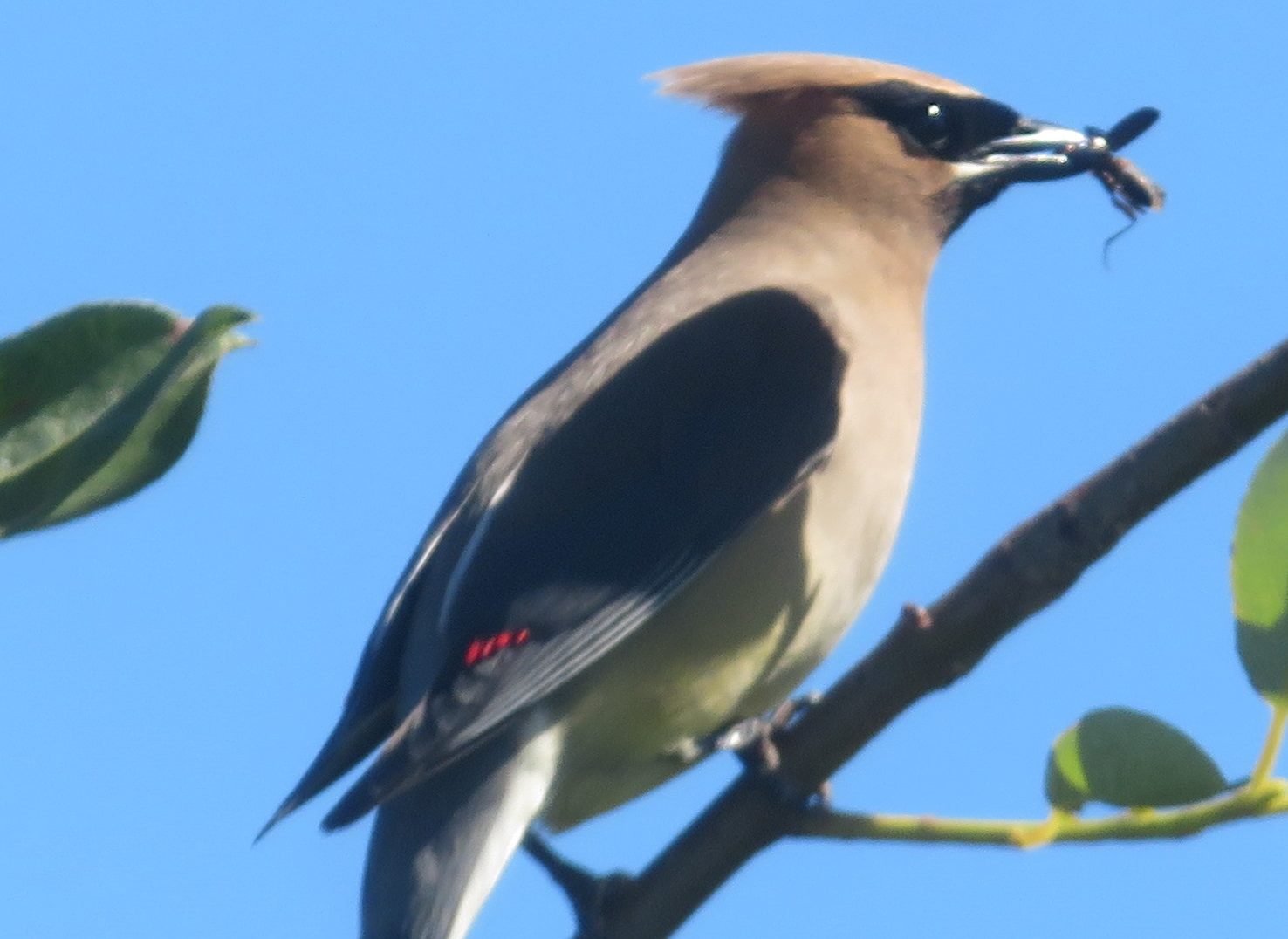
Right now our local cedar waxwings are harvesting fruit as it ripens. I see them regularly at Minto-Brown Island Park. They will be eating hawthorn, dogwood, snowberries, sour cherries, even some of the blackberries I can’t reach myself.
The waxwings are usually in small flocks, and frequently one will fly out from a perch, grab a flying insect and return to a nearby perch.
This is a species found across North America south of the Arctic. The waxwings breed in forests with deciduous trees, so they enjoy the Willamette Valley.
As the fruit vanishes and insects become unavailable, most waxwings migrate south, but a few can be expected on most local Christmas bird counts. Fruit with a hard exterior and waxy cover will not all rot or ferment – for example, hawthorn. That can be eaten in winter and provide nutrition. By then, blackberries and crabapples are gone.
In later summer the local waxwings will go for cottoneaster, pyracantha, holly and other later ripening treats. Every September a flock comes into our Salem garden and clears out our ancient crabapples in a few hours—thousands of small fruit.
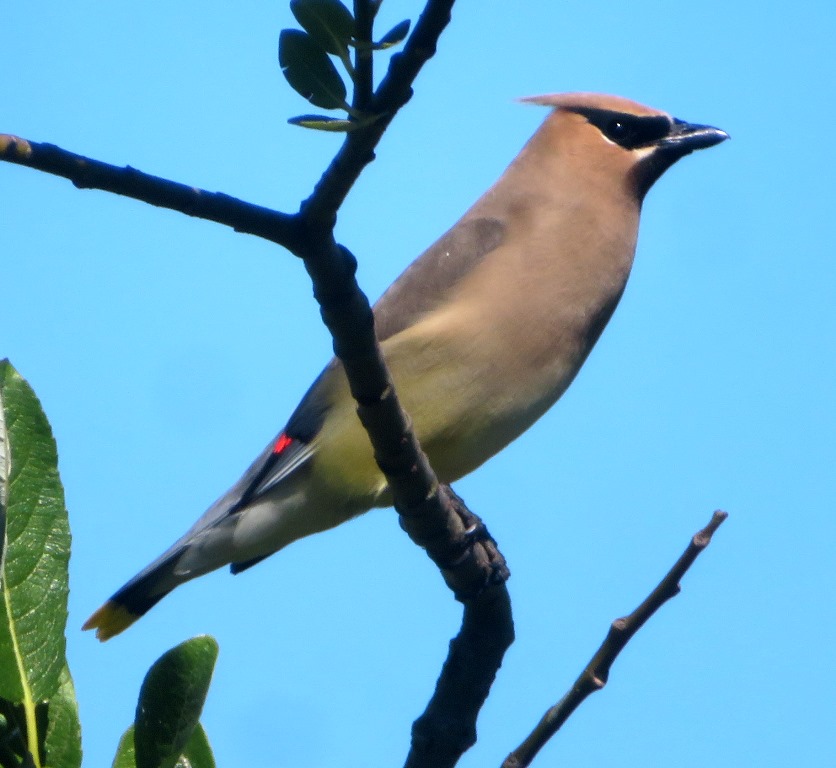
The waxwings’ crest, colors, the gold bar at the tip of the tail on adults all make for a glamorous bird. The only other crested bird we have locally is the Steller’s jay. A grown waxwing is just over 7 inches tall, with a wingspan of 1 foot. Their voice is very high pitched. When a flock is in flight they are usually in a tight group, not scattered or strung out like swallows, robins, crows and most other local flocks.
The name? Because they eat so much waxy fruit the bird secretes the excess wax onto the tips of its feathers. Also, their digestion takes all the nourishment from the fruit pulp and then the bird excretes the undamaged seed. Waxwings, robins and scrub-jays are notorious for planting seeds along hedgerows, under grown trees, inside a thicket. If a neighbor has a rowan tree, you can bet the waxwings will plant rowan seeds all over nearby ground.
Waxwings tend to breed mid-June through August when the fruit supply is maximum. The nest is woven of sticks, grass and leaves — an open cup not too high up in shrub or tree. Should you find a nest: the eggs are pale blue or blue gray, sparsely spotted with black and gray blotches.
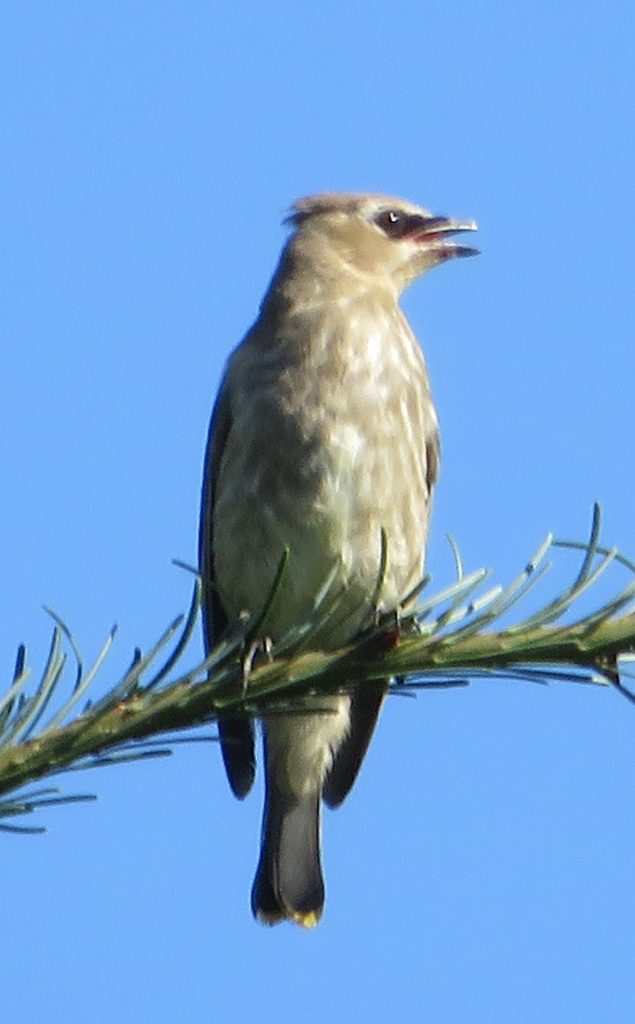
If a waxwing pair nests successfully in June, there can be another brood before the end of August. By mid-July I was already seeing fledged youngsters. They have less crest, a preliminary attempt at the tail’s gold bar, and a streaked chest. You will see juveniles mixed in with adults. These flocks are often on the move, looking for that next tree or thicket that has good fruit. And they will be seeding the next generation of fruit-bearing trees and shrubs.
For information about upcoming Salem Audubon programs and activities, see www.salemaudubon.org, or Salem Audubon’s Facebook page.
Harry Fuller is an Oregon birder and natural history author of “Freeway Birding” and the newly-published “Birding Harney County.” He is a member of the Salem Audubon Society. Contact him at [email protected] or atowhee.blog. His “Some Fascinating Things About Birds” column appears regularly in Salem Reporter.
A MOMENT MORE, PLEASE – If you found this story useful, consider subscribing to Salem Reporter if you don’t already. Work such as this, done by local professionals, depends on community support from subscribers. Please take a moment and sign up now – easy and secure: SUBSCRIBE.
Harry Fuller is an Oregon birder and natural history author of three books: “Freeway Birding,” "Great Gray Owls of California, Oregon and Washington," and "San Francisco's Natural History--Sand Dunes to Streetcars." He leads birding trips for the Malheur Field Station. He is a member of the Salem Audubon Society, and leads bird trips locally. Harry has just published a new book, BIrding Harney County.