A statewide petition led by Salem Mayor Julie Hoy seeking to make it easier for cities and counties to remove homeless people and their belongings from public spaces won’t reach the ballot in November.
Oregon Business & Industry, a statewide chamber of commerce backing the petition, confirmed to Salem Reporter Wednesday that it will not be collecting any additional signatures in its effort to put the issue before voters in November. The move was first reported by the Statesman Journal.
The group said the final description of the initiative, set to be printed on ballots if it gained enough support, would have been too confusing to voters. Their proposed title was changed after homeless service groups raised concerns that it was misleading.
The organization, along with Hoy and Portland lawyer and policy advocate John DiLorenzo, first filed the petition in October 2025, calling it “The Local Control & Safety Act.”
They sought to repeal a 2021 state law that requires cities to justify whether removing someone from a public place where they’re sitting, lying or sleeping is “objectively reasonable as to time, place and manner.”
Several organizations that serve homeless and low-income people, including the Mid-Willamette Valley Community Action Agency and the Oregon Law Center, then asked state officials to review the ballot’s title and description which would go before voters, saying it needed to be clearer to comply with state law.
After a state review process, it was given the official ballot title of “Repeals ORS 195.530, which regulates local public property laws on sitting, lying, keeping warm/dry.” The Oregon Supreme Court certified that title in late March.
The approved title stated that a “‘Yes’” vote repeals ORS 195.530, which requires any local public property laws be reasonable to regulate sitting, lying, keeping warm/dry outdoors, including for homeless.”
It stated that a “‘No’ vote “retains statute imposing reasonableness requirement.”
“(The initiative petition) sought to restore local control and safety by repealing an outdated law. The ballot title that was issued, however, presents voters with a much more complex set of questions and likely would have led to confusion when votes were cast. That is the reason we stepped away from the effort,” said Oregon Business & Industry spokesman Erik Lukens in an emailed statement to Salem Reporter.
Lukens did not respond to questions about when the organization made the decision to stop collecting signatures, the total amount of signatures gathered or what specific phrasing they believed would have confused voters or raised questions.
Hoy did not respond Wednesday to a request for comment on the decision.
The initiative would have needed 117,173 verified signatures to qualify for the November ballot, according to the initiatives page on the Oregon Secretary of State website.
The petitioners had submitted 1,260 signatures in November in order to begin the ballot drafting process, but hadn’t submitted any more as of June 17, said Oregon Secretary of State spokesman Connor Radnovich. He said the petitioners haven’t yet formally filed to withdraw the petition, and that petitions are rarely formally withdrawn.
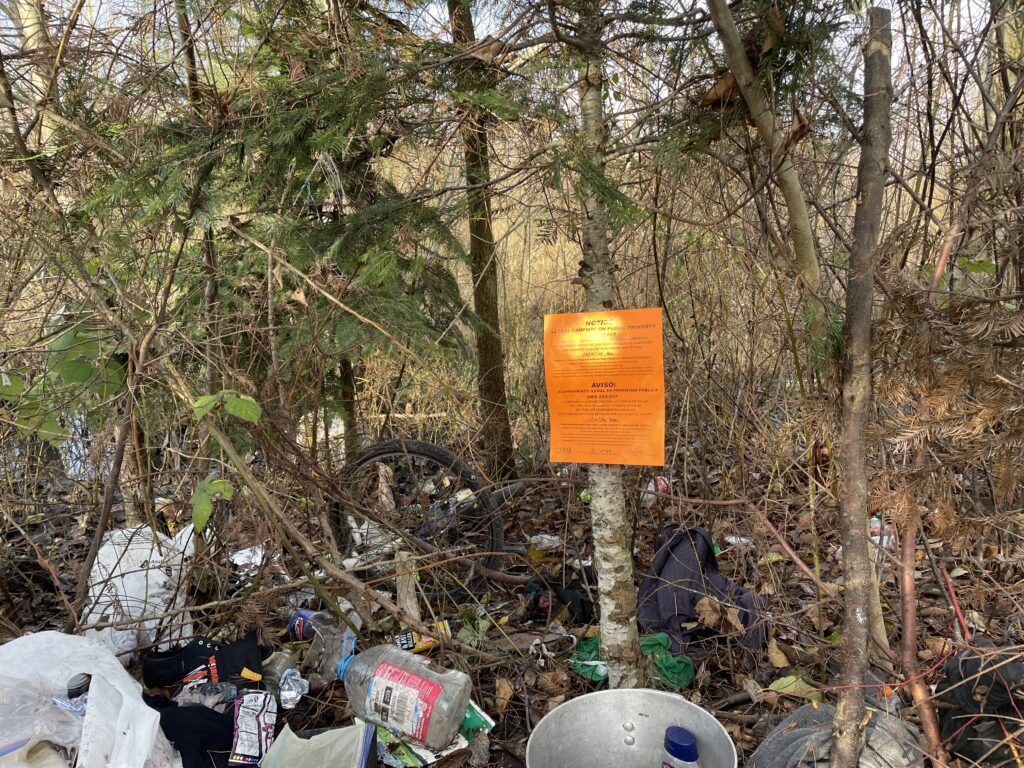
Under the current state law, the city of Salem has the ability to ban camping on public properties, including parks and sidewalks.
The petition sought to repeal ORS 195.530, the law that requires the city and council’s removal and regulation of people sitting, lying, sleeping or keeping warm and dry outdoors be enforced reasonably.
It is separate from the law that requires that cities give people a 72-hour notice before clearing an encampment, which was not addressed by the petition.
Jimmy Jones, executive director of the Mid-Willamette Valley Community Action Agency, was part of the work group that developed the law the petitioners sought to repeal. He said it sought to codify protections for homeless people while giving local governments a better framework for enforcement to avoid lawsuits.
He said that what’s considered reasonable is established by legal precedent. It would be considered unreasonable for cities to clear an encampment during a winter storm, or to repeatedly target the same people three days in a row as they move to different places around the city.
“(It) essentially is a due process clause as to how those decisions to trespass are made. They couldn’t just do it arbitrarily,” Jones said.
The law codified protections for homeless people that came from a Grants Pass lawsuit, where homeless residents claimed the city’s shelter could not meet the community’s needs and that their policy of steep fines and repeated arrests constituted cruel and unusual punishment.
The U.S. Supreme Court overturned that ruling in 2024, but Oregon’s laws built around it remained in place. That led some, including the petitioners in their filing, to seek to align state law with the Supreme Court’s ruling.
“So you started to hear even moderate Democrats from blue districts say things like, ‘We need to repeal or modify these protections, because they’re under a lot of local pressure,” Jones said.
Hoy’s originally filed petition stated that “homelessness and unsanctioned public camping represent a clear and present danger to unhoused Oregonians and community safety,” and that encampments in public spaces negatively impact tourism and economic growth.
In an Oct. 27 city council meeting, Hoy said that repealing the law was about restoring local control, and was unrelated to increasing camp sweeps and arrests. Hoy, who said she was leading the petition as an individual and not as the mayor, previously did not respond to requests to clarify what she hoped to do with more flexibility, and said any changes would be up to the council.
Jones said he found the originally proposed ballot title and description to be misleading, which is why he and other agencies asked the state to change it.
“It talked about local control. And who would ever be against local control? It talked about public safety, and everybody wants more public safety. It didn’t really talk so much about ‘This is repealing this particular law, which does these particular things,’” Jones said.
The final ballot title, certified by the state Supreme Court in March, had some changes from versions the petitioners suggested in December as part of a public comment process. Changes to the ballot initiative included adding “keeping warm/dry” to the title, and new phrasing under descriptions of how the law would change should voters approve it.
Lukens, the spokesperson for Oregon Business & Industry, said in an emailed statement Wednesday that filing the initiative petition was a last resort, and they’d prefer that the Legislature repeal the law.
“Unfortunately, local governments continue to be hamstrung by Oregon’s outdated approach to addressing unsanctioned camping in public spaces. We are disappointed that the Legislature took no action to address this problem in 2026 and are turning our attention to 2027,” Lukens said.
Jones said that he prefers the law to remain in place.
“The consequences of repealing that were going to be quite terribly horrific for the homeless population. It just isn’t simply a matter of allowing local government to do whatever they want. There would have been a consequence to that, and that’s what the public should have known more about,” Jones said.
Jones said his agency, the Oregon Law Center and others spent months working to defend the existing law by educating the public and policymakers and filing public comments, and he expects to do it again in the future.
“It was time that could have been spent on doing something else. To the extent that we constantly continue to have to play defense on this, it’s a distraction from doing the work of the people,” Jones said.
Contact reporter Abbey McDonald: [email protected] or 503-575-1251.
SIGN UP: “I love and respect what Salem Reporter does for our community.” Salem Reporter covers the people, issues, and stories shaping our city. Stay connected to Salem. Subscribe today.

Abbey McDonald joined the Salem Reporter in 2022. She previously worked as the business reporter at The Astorian, where she covered labor issues, health care and social services. A University of Oregon grad, she has also reported for the Malheur Enterprise, The News-Review and Willamette Week.