
How ODOT clean-ups work in Salem, and what the city council wants to happen next
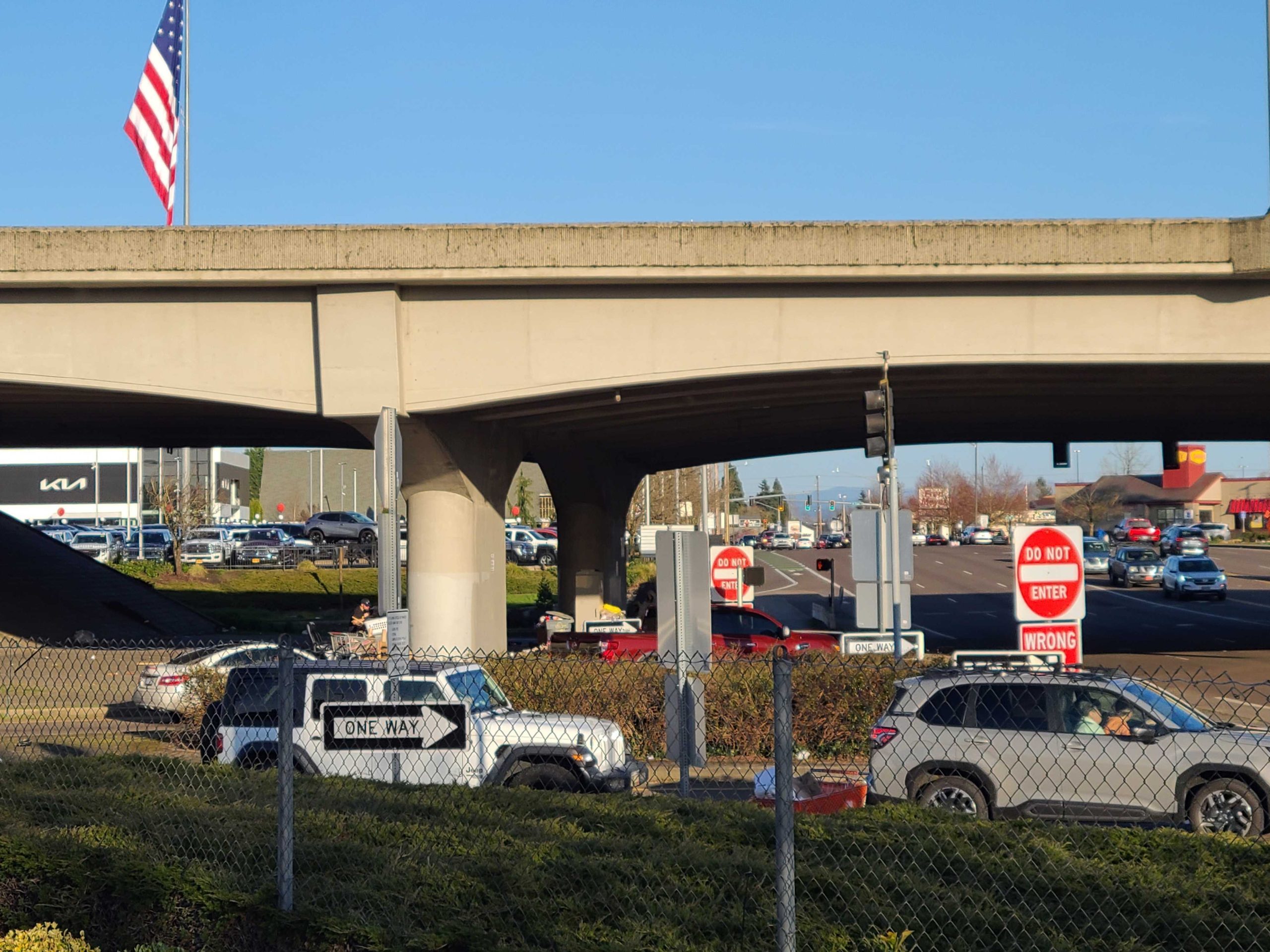
City of Salem leadership says it can’t do much to address camping under overpasses, bridges and other public areas owned by the Oregon Department of Transportation. Differing responsibilities mean city crews don’t go pick up trash there, and the Salem police team that connects people with resources and issues trespassing notices typically won’t do so in those places.
Such work is up to ODOT, which is facing increased scrutiny in Salem and across the state for its response times to clearing campsites. Those encampments can grow in size as more people move in over the weeks, and accumulate trash along roadways.
Comments to elected officials and on social media about homeless camps in Salem often focus on areas controlled by the state, including the fenced areas near the Market Street exit of Interstate 5 and tents under the Center Street Bridge.
Though city employees and ODOT’s regional coordinators have been meeting each month for years to coordinate priorities for cleaning locations, city staff are now taking steps to plan longer-term goals.
The issue came before the Salem City Council on Jan. 26 after Mayor Julie Hoy put forward a motion intended to increase the frequency and quality of ODOT’s clean-ups.
“ODOT has historically scheduled clean ups for its right-of-way within Salem approximately every six weeks, however more recently those clean ups occur less often. Even then many ODOT owned properties within the city may not be addressed when their crews are in town. Further, the quality of ODOT’s cleaning is not consistent. In many instances, ODOT crews may leave substantial amounts of trash and junk behind,” Hoy wrote.
The council unanimously approved Hoy’s motion, which asked city staff to coordinate with ODOT to make a plan with a timeline and key goals to address cleaning and maintenance of ODOT properties.
The motion comes amid increasing pressure on the city to address the impacts of unsheltered homelessness, what’s also shaping up to be a top issue in the upcoming election. The city frequently receives complaints about camping happening on ODOT properties.
In the council meeting, City Manager Krishna Namburi said that ODOT has indicated that funding issues make any additional, expedited efforts at the city’s request unlikely. State legislators will be working this session to find ways to cover the agency’s $240 million budget hole. New taxes and fees lawmakers passed last year to address the agency’s budget shortfall are likely dead after a successful Republican-led effort to refer them to voters.
Gretchen Bennett, who oversees city community services, first began working in homeless service coordination for the city in 2020. For at least as long as she’s been in the role, she said there have monthly meetings with ODOT’s regional coordinators to talk about target properties for sweeps and available sheltering resources for the people being asked to move. They’re also in regular communication as issues arise.
Bennett said that her team is trying to identify additional opportunities for coordination, and figure out what’s possible with limited resources. They will try to respond to the council’s request as soon as possible, she said.
“It’s kind of a top-of-mind priority for all of us, and we’re trying to work through: ‘OK, what would we need exactly to take some different, or newer, steps?’” Bennett said.
Bennett said top areas of concern include northeast Salem near the Interstate 5, and neighborhoods with ODOT property like on Northeast Silverton Road and Northeast Hawthorne Avenue.
City teams regularly ask people to move and clean up trash from city-owned property, which includes most sidewalks and public parks. The city’s police and cleaning teams typically give people longer than the legally required minimum of three days to move after a notice is posted, unless there’s an immediate danger like traffic or flooding.
Those teams recently began working seven days a week, and aim to remove new campsites before they grow. At established longtime encampments like Wallace Marine Park, they aim to connect people with services to slowly reduce the size of the camp.
For state-owned properties, ODOT schedules cleanups in advance, and posts notices at the location ahead of time, typically between 10 and 19 days before crews arrive, said spokeswoman Mindy McCartt in an email to Salem Reporter. In areas with “no trespassing” signs already posted, that timeline is condensed to between 24 hours and 7 days.
ODOT’s crews typically spend two or three days per week doing clean-ups in the Salem area, said McCartt.
“We regularly clear camps from state highway rights of way in partnership with local law enforcement and, when available, social service providers. During cleanups, crews collect trash, debris, and personal property. After debris is removed, crews assess the area to determine what additional work may be needed to fully restore the property,” she said.
ODOT’s main barrier to increasing the frequency of clean-ups on their properties is staff availability, according to McCartt.
“The same maintenance crews that conduct campsite cleanups are also responsible for maintaining highways, responding to emergencies, and addressing higher-priority safety issues. As a result, crews may be redirected when urgent or weather-related work is needed,” McCartt said.
ODOT also requires that law enforcement, typically the Oregon State Police, be present throughout the clean-up, and they too can be pulled away by other calls, she said.
The city would need to sign an agreement with the state in order to work on ODOT properties. In Portland, ODOT had a yearslong agreement to fund the city’s cleaning work at campsites. Due to departmental budget issues, the state pulled that funding last year, and the contract was not renewed.
“In general, ODOT retains responsibility for cleanup and maintenance on state-owned right of way. Any work by another jurisdiction on ODOT property would require a formal agreement and need to align with state requirements and processes,” McCartt said.
However, she clarified that city staff can still work on ODOT property.
“There is no legal restriction that prevents city staff or Salem Police from being on ODOT property, engaging with people, responding to safety issues, or taking enforcement action when appropriate. Law enforcement routinely operates across jurisdictions, including on state property, when conditions warrant,” she said.
Many community-suggested options discussed during the council meeting would involve complex processes to achieve. One suggestion was to move excess boulders from construction sites to underneath bridges, which would prevent people from setting up camp and sleeping there.
Bennett said such a move would involve figuring out who owns the boulders, ensuring the area isn’t a flood plain or a disruption to seismic retrofitting plans, and likely damaging trucks in the transportation process. The city would also need to sign an agreement with ODOT to make landscaping changes.
Fencing would be another mitigation tactic. Last year, the agency put up fencing under the Northeast Market Street overpass. Bennett said ODOT has been working its way through a statewide plan for such landscaping changes.
“They’ve been doing these strategies as they can find budget,” Bennett said.
ODOT isn’t committing to any additional expenses ahead of the legislative session, Namburi said during the meeting. That also means the city can’t do the work to install fencing, then ask the state for reimbursement. And they’ve indicated they won’t have the bandwidth to give the city a solid timeline on such changes, Namburi said.
Ultimately, Bennett told Salem Reporter that she wants people to be able to live in a safe, forever home rather than under overpasses and along roadsides, and she wants those locations to be clean.
That will take more than just moving people from place to place.
“You need alternative shelter, and you need alternative housing, and you need services and support for people with health issues, and you need a team to be able to clean and remove trash and debris. You need all of the things in order to accomplish that,” Bennett said.
Ahead of the January vote, several councilors expressed that they didn’t expect much to happen as a result of the action, given the limited state budget and how many cities are facing the same challenges.
“This is one of those many downstream effects that we see. And we all want to balance affordability with transportation funding. So I’m hopeful that the Legislature can address the challenges that we face,” said Councilor Vanessa Nordyke during the meeting.
Councilor Irvin Brown thanked the city staff for the work they were already doing, and said asking them to make a timeline felt like an “impossible task” to give them. He also said that if the city put up fencing and boulders, they’d need to find a suitable place for the displaced people to go.
“I’m not convinced the state is going to be able to meet us halfway,” he said. “I struggle with this being on our shoulders again, knowing that we don’t have the funds to take care of it.”
In her closing remarks, Hoy said she wants to know where the state stands when it comes to the people being moved around. Hoy, in her private capacity, is seeking to repeal a state law that requires cities to justify whether removing someone from the public place they’re sitting, lying or sleeping is “objectively reasonable as to time, place and manner.”
“The people creating the need for cleanups are real people with real-life struggles. That does not go unnoticed. The people living in unmanaged camps need help. Whether they want the help or not is another matter,” Hoy said during the meeting.
CORRECTION: This story has been updated to include further clarification about the city’s ability to work on state property, with additional comments from ODOT spokeswoman Mindy McCartt.
Contact reporter Abbey McDonald: [email protected] or 503-575-1251.
LOCAL NEWS DELIVERED TO YOU: Subscribe to Salem Reporter and get all the fact-based Salem news that matters to you. Fair, accurate, trusted – SUBSCRIBE.

Abbey McDonald joined the Salem Reporter in 2022. She previously worked as the business reporter at The Astorian, where she covered labor issues, health care and social services. A University of Oregon grad, she has also reported for the Malheur Enterprise, The News-Review and Willamette Week.
8 Comments
Comments are closed.







Isn’t the definition of insanity doing the same thing over and over and over again and expecting a different result without a change being made to the process? How frustrated would you be if you cleaned up a mess at your house, and through no fault of your own someone else came and made another mess in the same exact spot and you had to clean it up again? Seems to me we should be focusing on the root problem of why people return once the area is cleaned rather than scheduling clean up after cleanup after cleanup and still having the same problem.
I drive by the Front St underpass daily, and the amount of garbage with the homeless living there is, for lack of a better word, embarrassing as a Salemite. Why can’t the city or ODOT place a large garbage receptacle there for the homeless to use?
why do they not buy a big piece of property for homeless instead of paying odot to clean keep track of who comes and who goes have garbage dumpsters and bathrooms and all build more pods reminds me of constaion cams with fences around them these are pepole to
So if a criminal were to commit a crime and then run into an ODOT area, it sounds like the police could not pursue the criminal. If a crime is being committed with people camping illegally then how is there a limitation on the jurisdiction of the police? Put up signage that says no camping, and arrest and fine the people that disobey. That’s how it works for everyone except the homeless.
Its been time to get tough on the homeless drug addicts for a long long time yet nothing is done. Open air drug use and sales, garbage, urine, feces, needles and general filth. Lets face it, soft on crime liberal leadership is how we got to this place. Its not a housing crisis its a drug and mental illness epidemic. So until you’re will to vote differently and demand action from feckless state and local government get ready for more of the same.
You are absolutely right!
Compassion is important but enabling is not healthy or helpful. Neither does ignoring the problem help. Rules and laws are for protection. Broken ones do not protect anyone, homeless or not. These people need help but many don’t realize it . Others, if funding from the government, in whatever source , they obtain it, were cut off or at least managed appropriately, maybe, they would begin to realize their need to change. There are a lot of smart intelligent people in office and in the community that could and should come together and come up with a resolution instead of walking on eggshells.
The large majority of homeless are folks who will never be employed regardless of drug addiction and mental health issues. Once you have a criminal record it is never forgiven no matter how long ago it was taken care of thru the courts. Without the ability to secure employment what good does it do trying to move folks into housing? Are they going to live rent free the rest of their lives? Am I missing something that there is an allowance for that? All these millions of dollars being spent are going somewhere but in all these years it most certainly is not housing homeless. It’s more likely gone to some folks housing “upgrades” if you know what I mean…