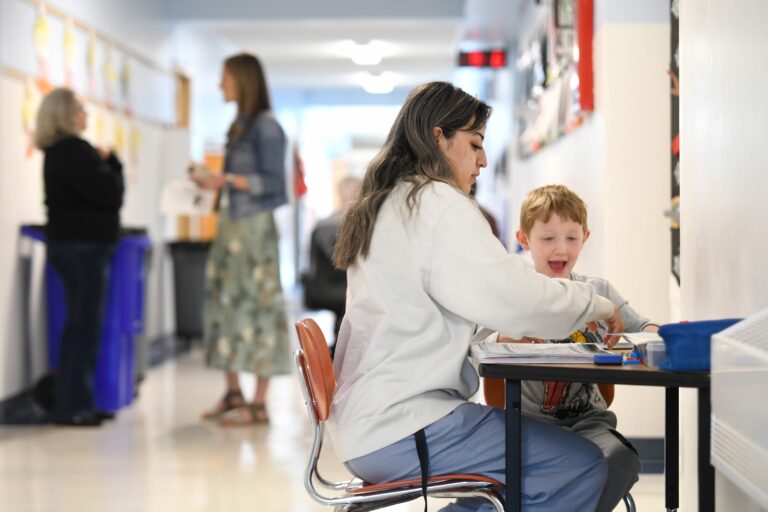
After Stephanie Lassetter first tests her algebra students on graphs, she commonly hands out Cs and Ds.
But this school year, the veteran McNary High School teacher said the average score was a high B on a topic that often proves challenging, even for students who haven’t struggled before in math.
The difference? With a strict phone ban in place schoolwide this fall, she said the number of students not paying attention in class has fallen dramatically.
“Kids are completing things. They know each other’s names because they have to talk to each other now,” said Lassetter, who’s been a teacher for two decades, including 18 years at McNary. “The student engagement and collaboration is significantly better than it has been.”
McNary is one of five high schools in the Salem-Keizer School District that began this fall using pouches to lock up student phones during the school day. Students keep the pouches with them or in backpacks.
Sprague and McKay high schools tested the pouches last year, and district officials decided over the summer to expand their use to all high schools. That came as Gov. Tina Kotek issued an order requiring Oregon schools to ban phones, including during lunch and breaks.
Middle and high schools in the district already had policies banning phones — many during class only, with some bans extending into passing periods and the lunch hour. But educators and administrators said in practice, those bans were unevenly enforced, with some teachers allowing students to listen to music or play games after finishing work.
Such policies put the onus on individual teachers to enforce bans, said Scott Gragg, McNary’s principal, something that became “burdensome” and ate up class time. Now, administrators and campus safety workers enforce the phone ban, freeing teachers to focus more on teaching.
Students are expected to lock their phone and earbuds inside a pouch that closes via magnet while heading into their high school building. Several middle schools use the pouches as well.
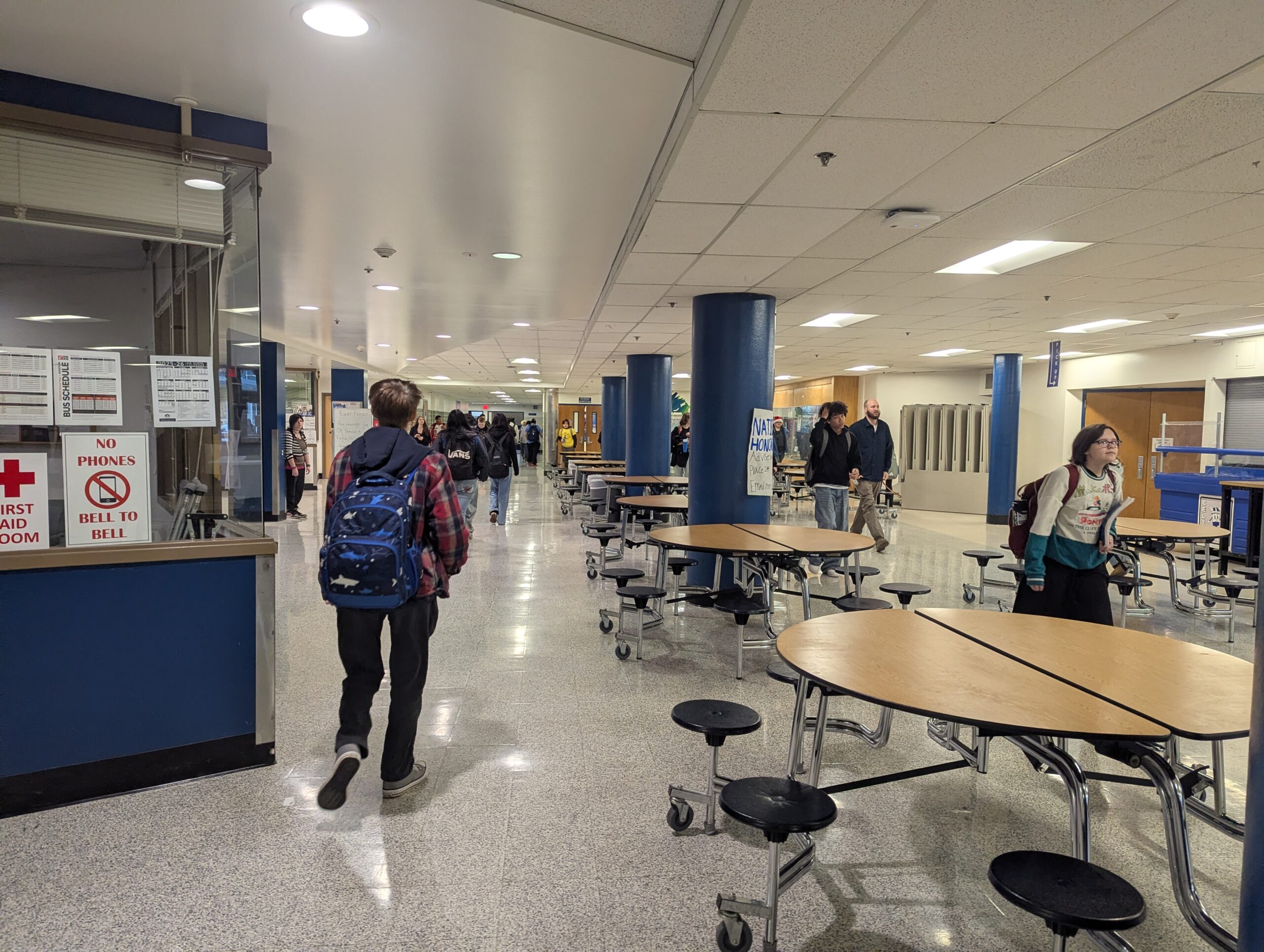
And phones are now banned for the full school day across the district, including lunch and passing periods.
“The more we make school predictable for students, the better chance we have of being successful,” Gragg said.
Administrators said there’s so far little concrete data they can attribute to phone bans, like impacts on attendance. But anecdotally, they’ve heard overwhelmingly positive comments from educators about the ban with students more focused and engaged in class.
Leaders of the teacher union said feedback has been all positive from their members.
“The kids are engaged and phones are away and they can actually connect with their teachers,” said Larry Ramirez, the district’s high school director.
Reactions among students have been more mixed, ranging from grudging acceptance to intense frustration.
Salem Reporter spoke to a group of leadership students about McNary. They varied in their opinions on the ban’s impact, with some saying students were more focused in class and other saying they hadn’t seen much change.
Some said they were more anxious with the ban in place and wanted to be able to contact their parents during passing periods, lunch or school breaks. Two said they felt more “disconnected” while at school.
“It doesn’t affect anyone, it doesn’t affect classes if I’m on it during passing time,” senior Josalyn Netzel said.
They said students who complete their work or pay attention in class shouldn’t be penalized for classmates who use phones instead of focusing on lessons.
“We’re in high school now. Students need to learn to take accountability for their actions,” said Macarthy Nelson, a senior.
Several raised concerns about emergencies. The school recently had a fire drill caused by a faulty toaster. School employees were more focused on keeping phones put away than on ensuring students were OK, sophomore Emma Cleveland said.
“Their biggest focus was making sure we weren’t having our phones out,” she said.
The pouches in particular drew student ire.
Students said many of their peers simply don’t put their phone in the pouch at the start of the school day, and questioned why school employees appeared more focused on students having pouches in hand than on whether phones are actually inside them.
Nelson said she was absent from school when the pouches were issued. On her first day back, knowing she couldn’t lock her phone up, she left it in the car. Rather than being allowed to go to class, she said she was questioned by school workers about where her pouch was and threatened with detention unless she got her phone from her car and locked it inside a pouch – a process that made her late to class.
Gragg said with 2,000 students entering the school in the morning, showing the pouch is meant to signal that a student understands a phone is to be locked away.
“It’s the quickest way for us to honor the policy and also acknowledge that some students may elect a different plan with their phones,” he said. “There’s reasons why processes look a certain way that might not actually apply” to every student in the school.
Gragg and other educators acknowledged the pouches themselves are little deterrent to determined students.
Still, he said, “We’re seeing very few cell phones out, we’re confiscating very few phones.”
About 130 high school students across the district have received an exemption from the phone ban, typically for medical reasons or disability accommodations.
Those students get a pouch that Velcros, rather than locks. Decisions on such accommodations are made at each school by a team that can include nurses, counselors, teachers or others, depending on the student’s need, said Ramirez, the high school director.
Those exemptions have proved a sticking point. Ramirez said those decisions are final at the school level, but that hasn’t stopped some parents from contacting him to seek exceptions for their children.
Mel Fuller, a school board director and parent of two students at Parrish Middle School, said exemptions “do not appear to be easy to get,” with some parents advancing their children’s cases to the school board. She recently posted on her Facebook page asking for feedback on the ban and said she got a range of responses, with educators generally favoring it while parents struggled more.
“Overall it’s been pretty successful,” she said, summarizing her impression based on the feedback.
Angelo Arredondo Baca is the educational guardian for his younger sister, a senior at South.
She has diabetes and relies on her phone to monitor her blood glucose and blood pressure. Getting an exemption to the phone pouch was fairly simple, he said, since her need was documented with a doctor’s note.
But he said the ban still has been challenging for her. In a school the size of South, not every teacher or security worker in the hall will know which students have medical exemptions.
“There’s been a couple times where she’s pulled her phone out in class or in the hall for medical purposes and a teacher has gotten upset with her for doing that,” he said.
He said that’s made her nervous to use her phone when she needs to, resulting in her sometimes missing blood pressure checks. Previously, she never had issues staying on top of her health.
“She still worries about it,” he said.
Arredondo Baca voiced skepticism about phone bans while running for school board earlier this year, but he said academically, they seem to have had a positive impact at South.
His sister’s grades are up, and she’s noted fewer people distracted in class.
“She does say that students are more attentive, she’s more attentive to class instruction,” he said.
With phones largely gone from lunchrooms and school hallways, students and educators say they’re seeing some shifts at school in social patterns, activities and even technology.
Students in some cases have gotten creative, using district-issued Chromebooks to communicate in shared documents. But some retro technologies are also making a comeback.
At McNary, Gragg said students are now playing cards at lunch.
Sam Williams, a sophomore at West Salem High School, said a friend brought in walkie-talkies to communicate “as a gag for the first week of school.”
Williams, like other students, isn’t a fan of the ban, saying it’s mostly made communicating with friends to coordinate things like study groups more difficult.
And the once-common practice of asking students to fill out a survey for class research or invite them to learn more about an activity by posting a scannable QR code on signs in the hallway no longer works.
“Those QR codes have become completely obsolete,” she said.
Lassetter, the McNary math teacher, said she’s had to redo some assignments which relied on students briefly recording things on their phones for data points.
But she’s also seen old iPods crop up in class as students seek internet-free ways to listen to music. Her husband, a teacher in another school district, has reported a resurgence of Walkmans.
She said she doesn’t care much whether the pouches themselves remain in use. But with phones away, she said conversations in her classes are deeper.
“That lightbulb moment is really fun to see. It feels like there’s more of those,” she said.
Contact reporter Rachel Alexander: [email protected] or 503-575-1241.
A MOMENT MORE, PLEASE– If you found this story useful, consider subscribing to Salem Reporter if you don’t already. Work such as this, done by local professionals, depends on community support from subscribers. Please take a moment and sign up now – easy and secure: SUBSCRIBE.

Rachel Alexander is Salem Reporter’s managing editor. She joined Salem Reporter when it was founded in 2018 and covers education, economic development and a little bit of everything else. She’s been a journalist in Oregon and Washington for over a decade and is a past president of Oregon's Society of Professional Journalists chapter. Outside of work, you can often find her gardening or with her nose buried in a book.