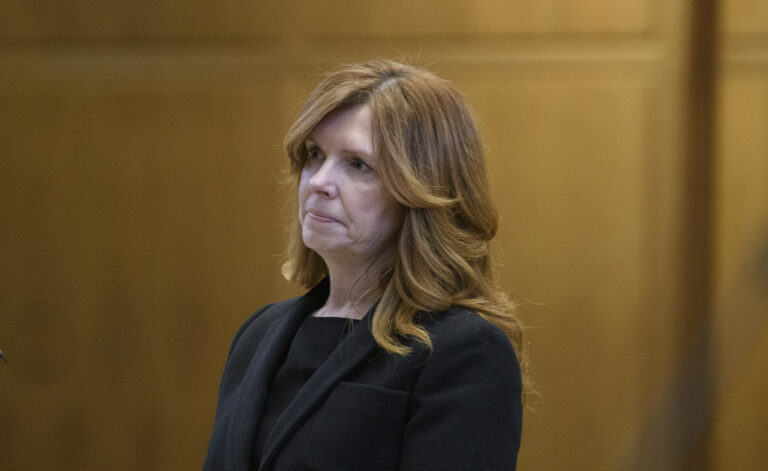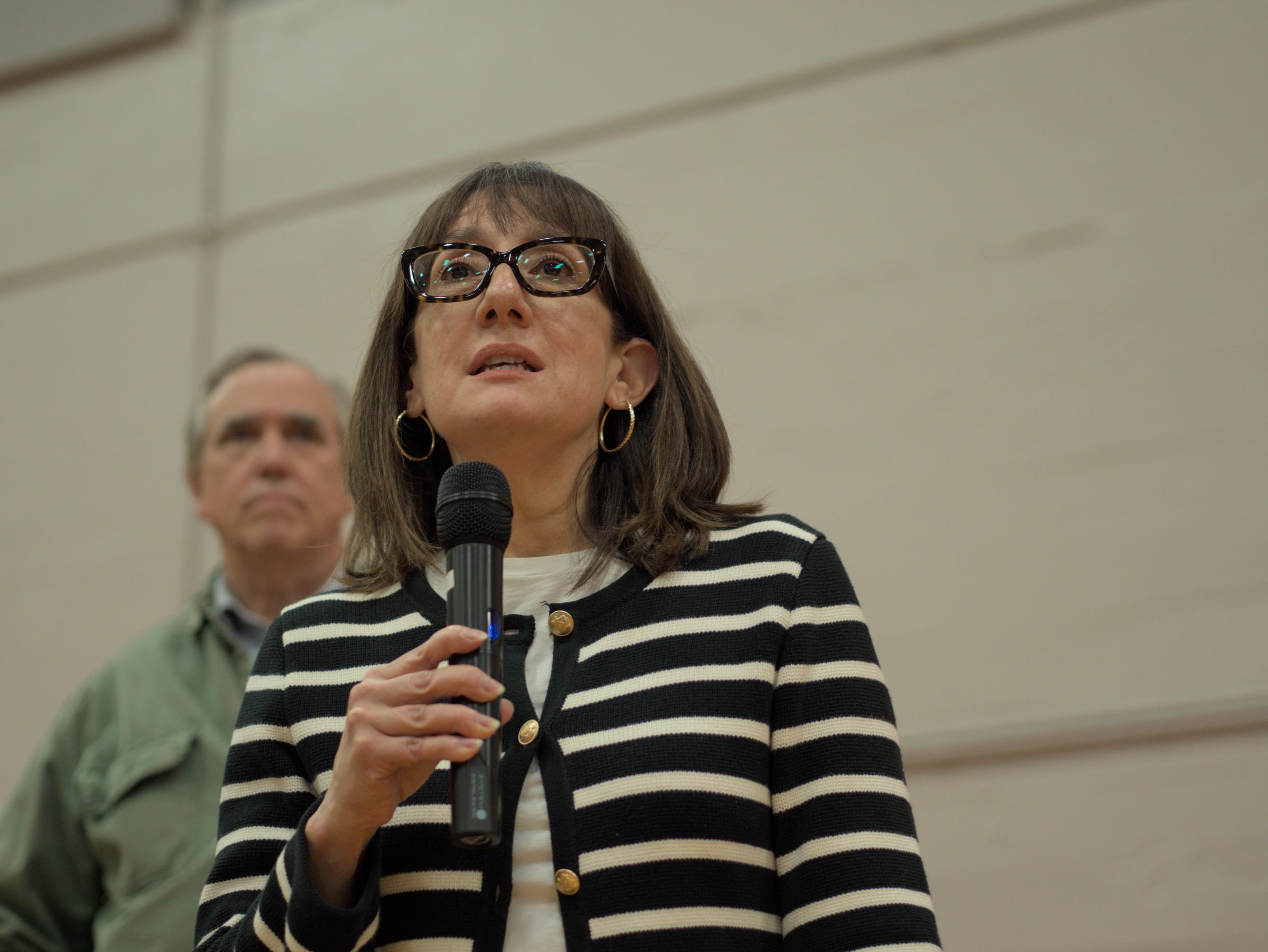
While gathered around a table with her staff on a January retreat in Tigard, U.S. Rep. Andrea Salinas, D-Oregon, learned President Donald Trump’s administration was freezing trillions of dollars in federal spending.
The retreat was meant for Salinas and her team to prepare for Trump’s second term and plan how to manage and respond to frequent and big White House news.
Salinas became angry at the far-reaching impacts such a freeze would have in Oregon’s Sixth District, which she represents.
“I’ll never forget this, I said, ‘Oh my goodness, we need to hear from our constituents directly. Let’s put something up on the website where we can intake stories,’” Salinas said in a recent interview.
By the end of the day, Jan. 28, her website had an online survey for people in her district to report to her directly how the funding freeze affected them.
Since then, the survey has received 131 responses from nonprofits organizations, business owners and people who lost funding due to the federal freeze or are worried about funding cuts.
Trump’s second term as president has brought rapid and sweeping change to the federal government, with new policies and cuts often rolling out in a chaotic fashion.
That’s left Democratic representatives like Salinas, who is in her second term, at times struggling with how best to respond.
Early in Trump’s second term, Salinas and her team made a rubric to guide how she responds to national news and policy changes along with which issues to focus on.
The rubric considers whether a federal action “constituted an egregious abuse of power,” and directly affects people in Oregon’s Sixth District, if Salinas has received a large number of comments from constituents about it and if it impacts at least one of Salinas’s top priorities, Salinas spokesman Sam Forbes said.
The top issues are mental health care, environmental protection, agriculture and economic policy, such as tariffs.
To keep herself from responding to every piece of news, Salinas said she weighs what she’s able to take tangible action on, like pushing for legislation or signing a letter, versus what she wants to bring attention to or get off her chest.
To do that, she records videos for social media to share her thoughts on topics in national headlines, like funding cuts for Head Start or the security of military information.
As a congresswoman, her days, which usually last from 8 a.m. to 9 p.m., start and end with a collection of stories from Salem news sources that her staff assembles.
Other than local outlets, Salinas gets Washington D.C. news from sources such as Jake Sherman, a political journalist and analyst who runs a publication focused narrowly on Capitol Hill.
She also gets lots of text messages from her former colleagues in the Oregon State Legislature, she said, who reach out to her a few times per week. They help her better understand how what is happening at the federal level will affect Oregon issues as the legislature works on the state’s budget.
To follow how federal issues affect the Sixth District, Salinas said two of her staff are out in the field in each county within the district. Others take in calls from constituents and plan how to address their issues or needs.
As Salinas keeps in touch with Salem-area organizations and businesses, she said she regularly hears concerns about whether their operations will receive funding or how tariffs will impact them.
“Trump made that insulting comment the other day about, maybe kids won’t get 30 dolls for Christmas, they’ll only get two,” she said. “I thought, wow, I wish I had a big forum where I could ask my district, how many families give their kids even two dolls for Christmas? But that one doll could be out of reach by Christmas.”
Salinas sits on the House Agriculture Committee and the House Science, Space and Technology Committee. Relationships with her Republican colleagues have been “hugely frustrating,” since January, she said.
“I will say, we don’t get much information from the administration or even my Republican colleagues. They’re very tight-lipped,” Salinas said. “I tend to get a lot of the same talking points from a lot of my Republican colleagues that I’ll hear in the news anyway.”
Under the second Trump administration, Salinas said, a lot of the bills she’s working on have been moving slowly compared to her first term. Despite a Republican majority in the House then, it was easier to work with colleagues across the aisle.
She said Republican representatives aren’t signing onto bills without approval from the White House, slowing the process down.
“The fact that they keep having to bend the knee and go to the White House before they even … sign on to a bill or to co-sponsor something with me, they have to go get permission, and that’s wrong,” she said.
Salinas said she is seeing this slow-moving among Republicans happen in her work to reintroduce bills that previously passed in the House Science, Space and Technology Committee.
“We were sent here to represent 750,000-ish people in all of our districts across the United States, and to make the best decisions based on what their needs were, not what the White House needs,” she said.
She said she doesn’t have deep relationships with Republicans in Congress compared to other Democrats, so she usually has more surface-level conversations that echo mainstream media talking points.
But she maintains positive relationships with some colleagues on shared issues.
Salinas said she works closely with two “great” Republicans on the Congressional mental health caucus, which she co-chairs with U.S. Rep. Don Bacon, R-Nebraska, and U.S. Rep. Tony Gonzales, R-Texas.
The caucus officially launched last week with a focus on raising awareness of mental health and passing legislation to expand “quality, affordable care,” according to the caucus website.
Another frustration, Salinas said, is how cuts made by Elon Musk’s cost-cutting initiative, the Department of Government Efficiency, leave legislation ill-equipped to have an impact.
In the House Science, Space and Technology Committee, Salinas introduced a bill that would standardize nucleic acid testing and be implemented by the National Institute of Standards and Technology. Nucleic acids are used in diagnosing and treating diseases and developing vaccines, and the bill would improve security and risk management for researchers working in those fields.
Even though the bill passed the committee, Salinas said it feels ridiculous to pass legislation while the federal government cuts funding for the National Science Foundation.
“You can’t have it both ways and you can’t talk out of both sides of your mouth,” Salinas said. “We can’t pass bills and yet, at the same time, defund these agencies that are going to help us be the bright beacon of innovation and technology around the world.”
Contact reporter Madeleine Moore: [email protected].
A MOMENT MORE, PLEASE– If you found this story useful, consider subscribing to Salem Reporter if you don’t already. Work such as this, done by local professionals, depends on community support from subscribers. Please take a moment and sign up now – easy and secure: SUBSCRIBE.

Madeleine Moore joined Salem Reporter in 2024 and reports on a variety of topics including public safety, addiction, treatment and the criminal justice system. She came to Salem after graduating from the University of Oregon in June 2024 with a bachelor’s degree in journalism.