A new program in the Marion County Circuit Court is working to keep Native American children with their families or other tribal members by helping parents overcome struggles that landed them in the child welfare system.
The effort supports the Indian Child Welfare Act, a federal law enacted in 1978 to stop the systematic removal of Native American children from their communities through adoption to non-Native families.
Marion County is just the second county in Oregon to dedicate a court docket to Native child welfare cases. Court and state officials worked on the program for eight months before it went into effect in November.
Juvenile dependency cases typically start with the state Department of Human Services deciding they need to remove a child from the custody of their parent or guardian or expressing concerns for their safety in a written statement.
If a child is identified as Native, federal law requires that the state make “active efforts” – as opposed to just “reasonable efforts” – to avoid taking the child from their parents, according to Marion County Circuit Judge Manuel Perez, who oversees juvenile court.
He described reasonable efforts as telling somebody that they need treatment and where they need to go. Active efforts means telling them, “You need treatment, here’s where you need to go – and I’m going to give you a ride,’ he said. “More than just pointing in the right direction, it’s actually facilitating that.”
State law also requires that a child’s tribe be notified ahead of any court proceedings related to their custody.
A five-year, $2.5 million federal grant paid for the Oregon Judicial Department to provide “developmental and administrative support” to help Marion County establish the docket, according to agency spokeswoman Sarah Evans.
Klamath County debuted one in 2022. Adrea Korthase, the state’s Indian Child Welfare Act analyst, said Multnomah County is working to establish its own such court.
She said the program allows courts to work with families, tribes, case workers, attorneys and volunteer advocates to pursue the best outcome for Native families involved in the child welfare system.
The federal law applies to any case where a court is determining the custody of a Native child.
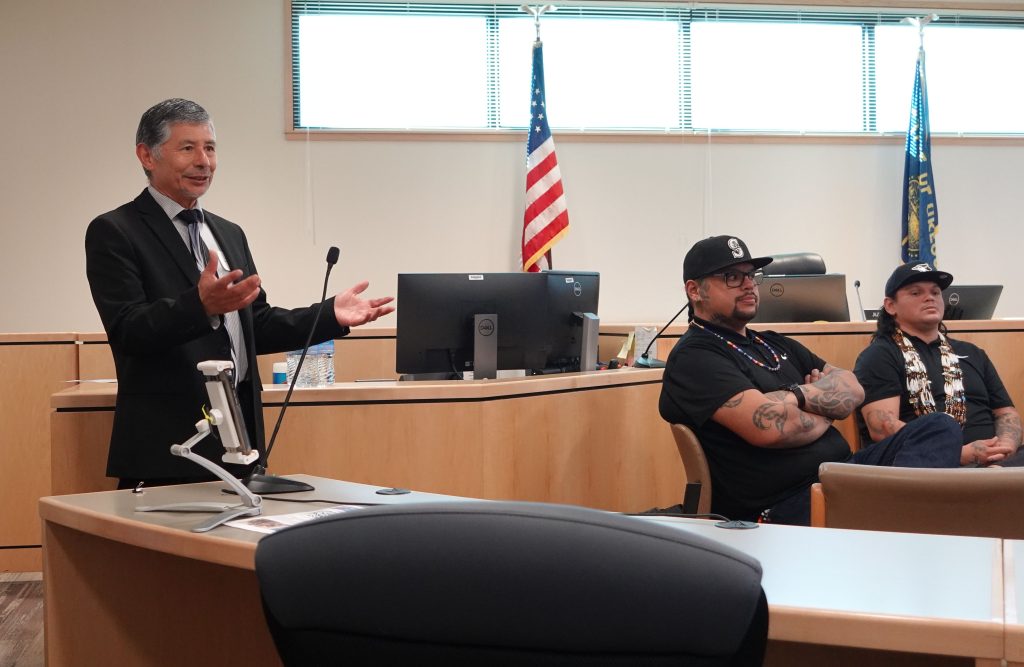
Marion County Circuit Judge Manuel Perez, who oversees the juvenile court, doesn’t wear his judicial robe, sit at his bench or swear in anyone in when he’s deciding Native child welfare cases.
Instead, he wears a suit and sits at eye level with the families, case workers, lawyers and tribal advocates in his Salem courtroom.
Perez said he wants court to feel like a “dinner table discussion” for Native families.
“I don’t want them to feel intimidated,” he said. “We want the court to be a healing place for them as opposed to a place they’re going to be judged.”
Ferrell DeGarmo, a peer support specialist for the Confederated Tribes of Grand Ronde, said that practice falls in line with Native tradition and helps families feel more comfortable being honest and vulnerable.
“Our people would sit like that and talk, where nobody was above. There was no hierarchy,” he said. “People who’ve had cultural teachings or knowledge before they ran into their struggles, they noticed that stuff.”
DeGarmo said he feels honored to advocate for children and families in the new court.
“Reunifying our families and breaking generational cycles by helping our family dynamics heal within the tribal community is something that I’m very passionate about,” he said.
Perez said there are only around 25 Native child welfare courts in the U.S. There are currently around 18 such cases pending in Marion County, of which four or five are awaiting a judge’s decision.
In the program’s early stages, Perez said nine Native families in Marion County were involved in the child welfare system.
“This is hopefully kind of unifying them,” he said. “They belong to different tribes, but the problem is common and the resources are common too.”
DeGarmo often opens court proceedings with a Native song and prayer. He hopes to change the view some families have of a courtroom as a negative place.
“The message I bring is that this is a sacred space,” he said. “It’s a chance to heal your family.”
The judge hears from a “qualified expert witness,” typically someone familiar with tribal customs and parenting norms, who testifies about whether they believe the child can safely return to their parent.
The judge checks with DHS about their progress toward reunifying the family and any barriers they need to overcome, as well as how the child is doing and what cultural activities they are engaging in to remain involved in their tribe. The judge also hears updates from the parents and foster parent, and a tribal advocate explains whether they believe the state is doing everything they should be to return the child to their parents.
Native children in the child welfare system are often placed with another tribal member, whether or not they are part of the same tribe. The court would need the tribe’s permission to place the child elsewhere, such as in foster care.
DeGarmo said the relationships he’s built with local service providers come in handy when the judge requires parents to meet certain criteria, such as seeking treatment or completing courses. “I, nine times out of 10, might have those connections already, and I can kind of fast track that for them,” he said.
His involvement also helps break down barriers with Native families, who don’t view him as a caseworker, investigator or court employee. “I’ve had to live through a lot of what they might be experiencing, and even if I haven’t lived it personally, I guarantee I know people who have and some of them are within my own family,” he said.

Typical dependency hearings involve about four hearings within a year of a child’s removal, while Native child welfare court hearings take place around once a month.
Most hearings run about 10 minutes.
Perez said he makes sure to compliment parents when they make improvements to help keep them engaged in the court process. “They have been doing well, they just need to be recognized for it,” he said.
He said it’s too soon to assess the results of Marion County’s newest court, but he has noticed initially reluctant parents become more open to accepting help from the court.
The judicial department plans to work with researchers in the future to assess how effective the court has been, according to Korthase.
She said the Grand Ronde tribe recently donated Native art pieces and the judicial department bought a “land acknowledgement plaque” recognizing the Indigenous people of Oregon. They remain on display in the juvenile court.
“Everybody is really dedicated to making sure that the court environment is the most welcoming it can be,” Korthase said.
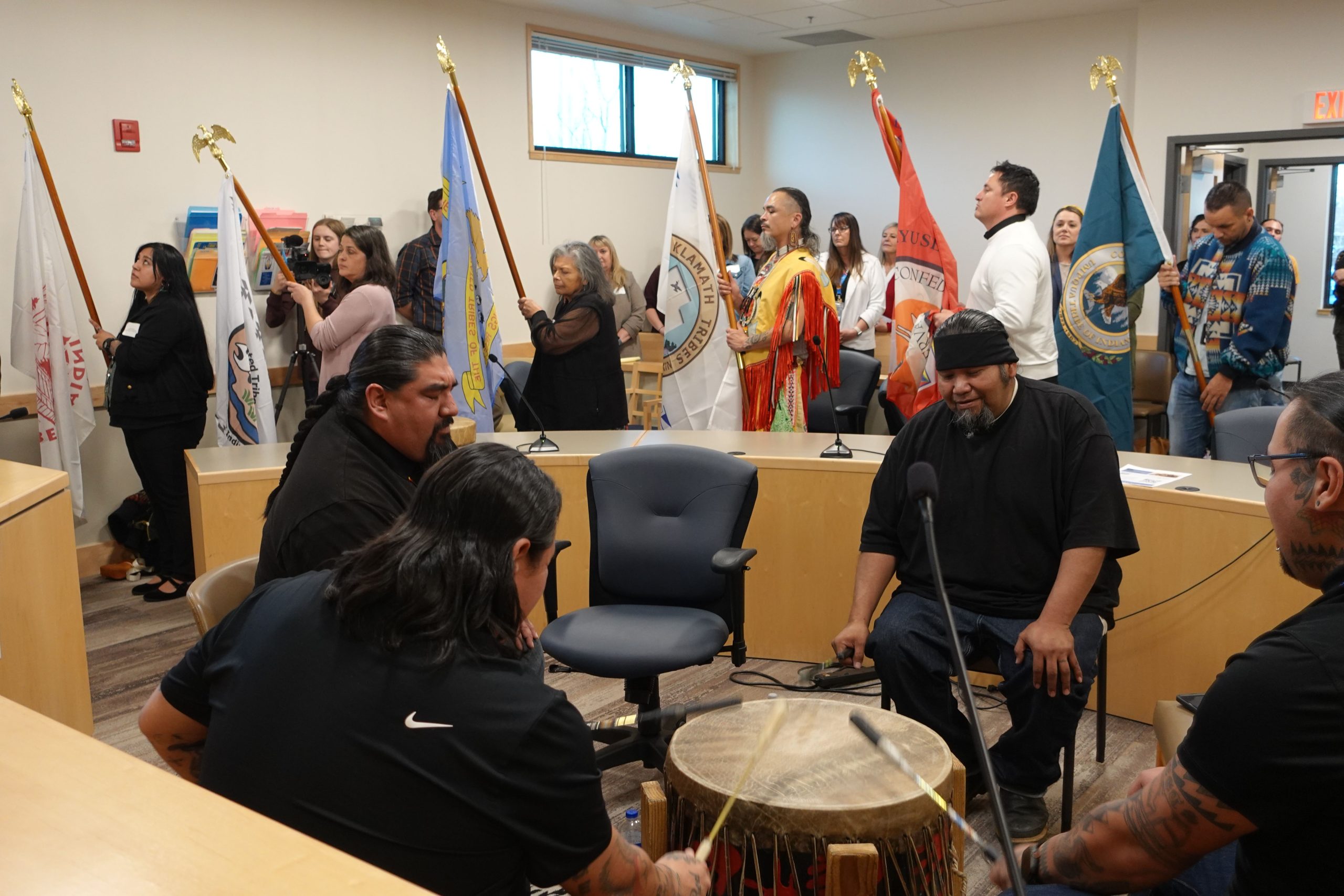
A March 6 event at the juvenile court celebrated the new docket with a drum group, songs and a posting of flags from the federally recognized tribes in Oregon.
DeGarmo said the ceremony helped share Native culture and teachings with the attorneys involved in Native child welfare cases.
He said he would measure the program’s long-term success by how effective it is at reuniting children with their families and keeping them connected with their culture.
Local tribes have “amazing resources,” he said, such as transitional homes for adults coming out of treatment or incarceration, many of whom grew up in the foster care system themselves.
“When we talk about breaking generational cycles, it’s got to start with our youth,” he said. “We can start doing that with these kids right now by approaching them and engaging them with love. So many of our kids grow up feeling like they’re not wanted, the lack of identity, the lack of belonging.”
That means helping Native children embrace their tribe, culture and language. DeGarmo said cultural identity “gives such a huge sense of belonging” to Native kids who have lost their immediate family for the near future. It serves as a reminder that their ancestors who faced oppression and genocide prayed for their lineage to go on.
“I want them to know how powerful that is and how sacred they are,” he said, “that they’re literally the answered prayers of our ancestors just by existing, and they’re worthy of all that love.”
CLARIFICATION: This story was updated to reflect that a federal grant paid for the Oregon Judicial Department to support Marion County in establishing its Native child welfare court docket.
This story was also updated to reflect that there are around 18 Native child welfare cases pending in Marion County. Of those, four or five are awaiting a judge’s decision.
Contact reporter Ardeshir Tabrizian: [email protected] or 503-929-3053.
A MOMENT MORE, PLEASE– If you found this story useful, consider subscribing to Salem Reporter if you don’t already. Work such as this, done by local professionals, depends on community support from subscribers. Please take a moment and sign up now – easy and secure: SUBSCRIBE.

Ardeshir Tabrizian has covered the justice system and public safety for Salem Reporter since September 2021. As an Oregon native, his award-winning watchdog journalism has traversed the state. He has done reporting for The Oregonian, Eugene Weekly and Malheur Enterprise.