At Salem Hospital, a robot can now help detect lung cancer

Dr. Brandon Tieu’s eyes flicked between three screens as he followed a virtual blue path through a maze of dark tunnels. His controls, one for each hand, were an oversized scroll wheel to move forward, and a ball that he could roll to turn in any direction.
Tieu compared it to playing “Centipede.” But this wasn’t a video game. It was a lung surgery demonstration.
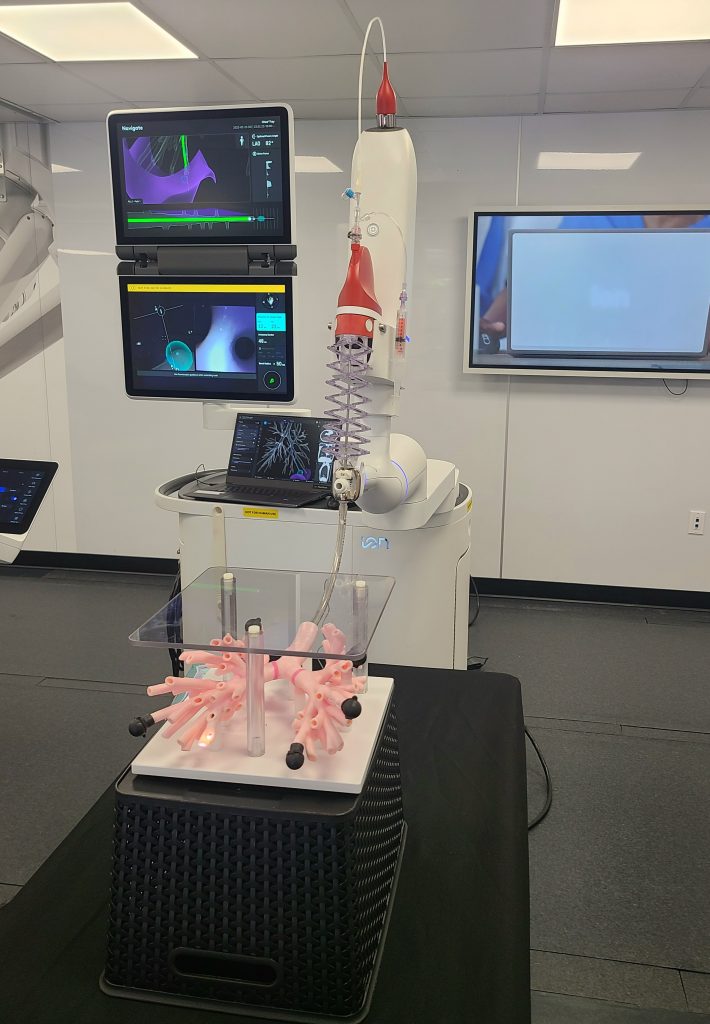
His patient during the May 30 event at Salem Hospital was a disembodied, plastic set of pink lungs with black caps at the end of artificial bronchi, the lung’s air tubes. They represented potential cancerous growths.
Tieu, a Salem Health chest and lung surgeon, joined representatives from Intuitive Surgical in their 18-wheel demonstration truck as part of a tour showing off the latest innovations in robotic surgery. Doctors, Salem hospital employees and one of Tieu’s patients undergoing lung cancer treatment were among those who stopped by to try their hand navigating through plastic lungs and using robotic hands to solve miniature puzzles.
The lung biopsy robot, which Tieu demonstrated, turns a patient’s lung scans into a 3-D, virtual copy. It then uses AI to find the quickest recommended path through the airways to the cancer. The left screen shows the virtual copy of the lung, like a GPS system, and the right shows the real-time feed of Tieu guiding the catheter through the airways.
It’s a tool that Tieu and other cardiothoracic surgeons at Salem Health have had for about two months. Tieu said he’s already seeing a difference in patient care.
The catheter is 0.35 millimeters across, the smallest in the market according to a representative, a similar size to the tip of a ballpoint pen.
Once the surgeon reaches the lesion from the inside, they can pull the camera out and push a brush or other tool through the same tube to take a sample of it. It’s the furthest Tieu’s ever been able to go into a lung from the inside.
“What it does is allows us to get out there into small airways with this really kind of flexible, thin, but also very sturdy catheter,” Tieu said, rotating the ball to turn it. “If we diagnose the patient early, we can offer them treatment.”
Previously, Salem’s lung surgeons had a bigger scope that couldn’t reach the outer edges of the lung. Typically, any lesions there would need to be accessed by cutting in from the patient’s chest, rather than the knife-free entrance through the throat. It came with more risks, and only one lesion could be tested at a time, giving the patient time to heal between each surgery.
“Imagine the lungs as a balloon. You can create a leak, right? So that increases the chance of patients having a collapsed lung. And so, obviously, if you’re sticking a needle through a balloon, you don’t want to stick it through multiple sites,” Tieu said.
Tieu said that he found the older approach to biopsies frustrating in comparison. The robot allows him to be more accurate, reduce risks and diagnose cancer earlier. The robot doesn’t do everything for him, though. Some of the routes are trickier, and during real surgery there’s mucus and other obstacles awaiting in the lung’s highways.
“I wish every tumor was at the end of an arrow,” he said, and laughed.
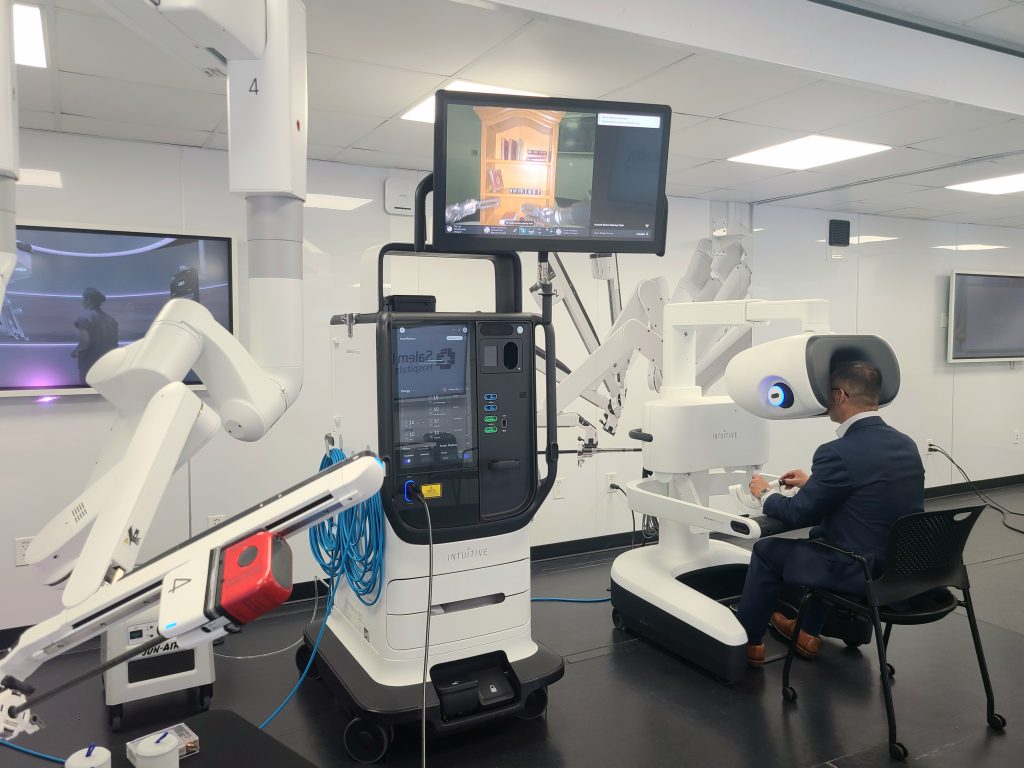
Visitors also got to try their hand at the Da Vinci robot, which Salem Health has had on-site since 2007. At Salem hospital, the robot is used for precise surgery on hearts, the pelvic area, abdominal area and more. The hospital bought the latest model in 2020. To use it, a surgeon sits to look through a viewfinder, which magnifies a surgical site up to tenfold, and holds a controller in each hand.
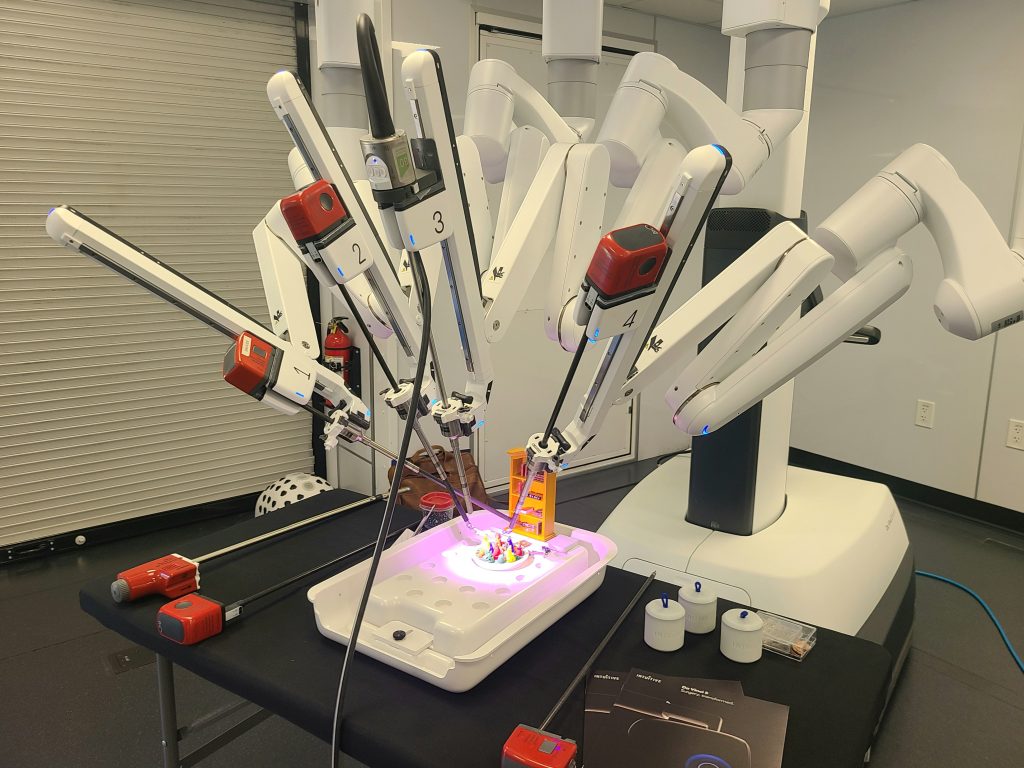
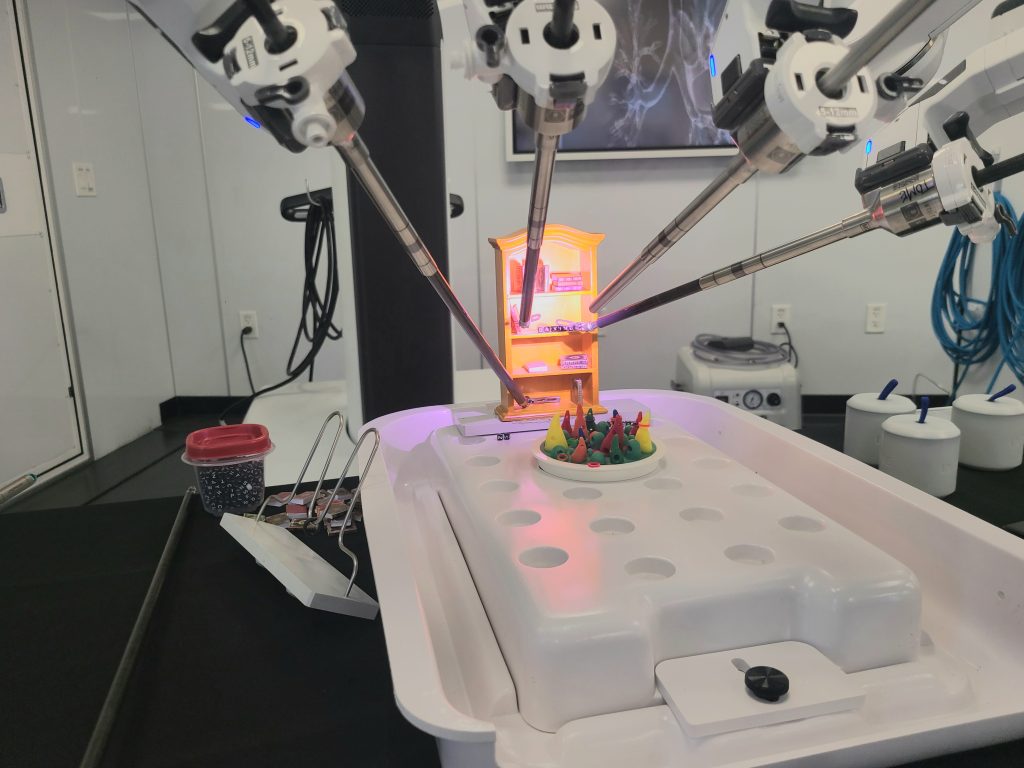
The controls allow the surgeon to essentially shrink their hands to the size of a Barbie’s hands, remotely controlling two tiny pinchers that can twist and move like a human wrist mimicking the surgeon’s movements.
During the Friday event, guests could play with a ring toss set-up, and use the robot to pick miniature books off a shelf and flip through their pages.
Tieu came to Salem from Portland’s Oregon Health and Science University in 2020 to help establish its chest and lung surgery programs. Most of his workday revolves around lung cancer, which he said brought him to the demonstration truck for the event.
He said they want to increase awareness about early screening for lung cancer.
“That’s where we can really make a difference in cancer care. We have some really great toys here, we wanted everybody to come see this and see what we have to offer here,” he said.
Tieu said that the field has changed a lot since 2011, when he finished his fellowship.
“I didn’t imagine that my practice was going to end up being like this,” he said, gesturing to the robot. “It’s just really great for the patients to be able to have all these advanced tools at their disposal to help them.”
Contact reporter Abbey McDonald: [email protected] or 503-575-1251.
A MOMENT MORE, PLEASE– If you found this story useful, consider subscribing to Salem Reporter if you don’t already. Work such as this, done by local professionals, depends on community support from subscribers. Please take a moment and sign up now – easy and secure: SUBSCRIBE.

Senior Reporter Abbey McDonald joined the Salem Reporter in 2022, where she covers homelessness and housing. She previously worked as the business reporter at The Astorian. A University of Oregon grad, she has also reported for the Malheur Enterprise, The News-Review and Willamette Week.