Oregon employers cite high cost of housing as hiring challenge
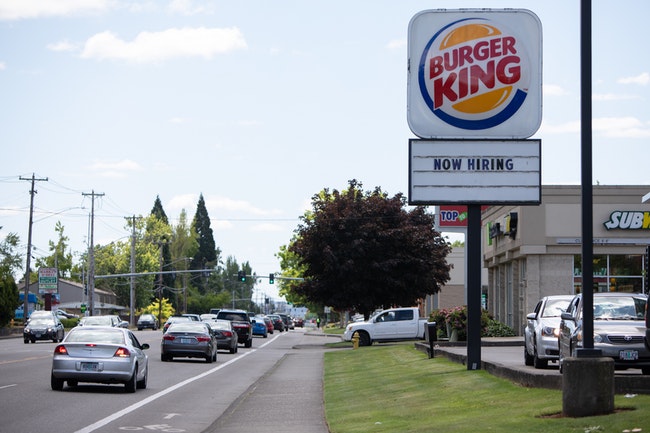

A ‘now hiring’ sign outside of a Burger King on Lancaster Drive in Salem (Amanda Loman/Salem Reporter)
About 84% of Oregon industry respondents in a recent survey had difficulty finding qualified applicants for open positions in 2021, according to the Oregon Workforce and Talent Development Board and Higher Education Coordinating Commission.
The biennial Oregon Talent Assessment–data surrounding Oregon industries’ input regarding skills, talent, gaps and trends–revealed that housing, the pandemic and inflation are having an impact on state industries.
“The findings of this year’s Talent Assessment will help inform employer and community collaboration in the implementation of the unprecedented Future Ready Oregon investment package,” said workforce board chair Anne Mersereau in a prepared statement. “Employers and partners have shown they want to collaborate with college and workforce partners in a variety of ways to build equitable pathways to prosperity, and the more we know the better we can use this data to tailor our strategies to best serve all Oregonians during this time of change.”
Employers from 11 industries participated in the online survey, generating 314 responses in addition to 31 interviews.
Oregon’s high cost of living – specifically housing – was called out, with 76% saying housing had a high or moderate impact on hiring.
Employers, the assessment said, raised wages an average of 17% to retain workers since the pandemic began.
“But inflation,” the assessment reads, “has eroded purchasing power such that adjusted wages increased only 5% during the past two years.”
An aging workforce, resignations and employee mental health were listed as key concerns for employers. The pandemic, and its drive towards remote work, was also listed.
“Employers are encountering one of the most unusual labor markets since the end of World War II”, said John Tapogna, Senior Policy Advisor with ECONorthwest in a press release regarding the assessment. “It’s no surprise that 84 percent of surveyed firms reported trouble finding qualified applicants during the last year. The tight market has put employee retention and well-being at the top of management priorities.”
In Salem, state government is a major employer and according to the assessment, is expected to grow. Between 2020 and 2030, the local government industry is expected to grow about 10% in Oregon. That falls on the lower end with federal government jobs expected to grow about 2%, or 300 jobs, and leisure and hospitality expected to grow by about 45%, or 73,800 jobs.
The assessment comes just a Future Ready Oregon–a $200 million workforce and education investment package–is set to be implemented. The program is expected to support Oregonians with postsecondary training.
The full report is available here.
-Caitlyn May