Few affordable apartments are vacant in Salem, unlike Portland
Portland made headlines recently when a real estate analysis found that nearly 1,900 affordable apartments were sitting vacant while thousands of people lived in tents and cars throughout the area.
There’s no such trove of vacancies in Salem, according to Nicole Utz, the Salem Housing Authority’s housing administrator. Affordable apartments are nearly filled in Salem due to a combination of market factors that differ from Portland.
Ever since The Oregonian/OregonLive reported the high rate of Portland vacancies in December, Utz and Jessica Blakely, the housing authority’s deputy director, have been fielding questions about their agency’s ability to fill apartments.
“When we’re explaining affordability in Portland, it’s a very different market. There’s a different set of economic conditions that are taking place there,” Blakely said.
The Salem Housing Authority budgets for a vacancy rate between 3-5%, which is considered standard to account for the time to make repairs to units after someone moves out, and to approve the new tenant for move-in.
As of Friday, Feb. 13, the Salem Housing Authority’s portfolio of over 200 affordable apartments has a vacancy rate of 2.6%, and half the vacant units will soon have people moving in, according to Blakely. Some of the five affordable apartment complexes they manage, including Parkway East and Parkway West, have no vacancies.
Portland’s vacancy rate for subsidized apartments was 7.4% even though there was seven applicants for every opening, according to The Oregonian.
In Portland, families who qualify for affordable housing are more likely to find an apartment at the same price, or cheaper, than what’s subsidized, Blakely said.
In Multnomah County, an affordable studio apartment available to someone who makes less than 60% of the area’s median income on average is rented at $1,303 per month, under state requirements. A look through Zillow shows that a Portland renter can find an apartment for around that price without applying to be on an affordable housing waitlist.
Blakely said it’s the first time in her career she’s seen a county’s affordable housing rate match the market rate.
“It’s very unusual for the 60% rent to be at market rate. But in Portland, that’s what’s happening,” Blakely said.
She said that renters seeking government-supported apartments can be faced with a long application process and end up rejected or become disqualified because of a change in income or family size. Instead, many appear to be going to the standard apartments, which are also more likely to have amenities like gyms and pools, Blakely said.
It’s a different story in Salem, where an affordable studio apartment costs $973, which is several hundred dollars under the market rate of around $1,300.
Blakely said that the limited rate of $973 for a studio isn’t something a lot of people can afford, but it’s a significant enough gap below the market rate to draw applicants.
In Salem, standard rents are beginning to slow down after several years of rapid increases. It’s something the Salem Housing Authority takes into account when the landlords at its partner properties submit proposed rent increases.
“We’re just kind of in an unusual place where the rents grew so fast and now we’re all kind of catching up. But we’re not seeing the same vacancy rate (as Portland), by any means,” Blakely said.
Applications pose a challenge for families
Blakely and Utz said another issue leaving apartments vacant for longer in Portland is also a challenge in Salem: a confusing application process that means people are often applying to live in apartments for which they don’t qualify.
Utz said that they’ve heard from landlords that they’ve had trouble finding tenants who make enough to pay rent, but are still under the income limit for subsidized housing. For a two-person household in Marion County, that would be a combined income of $44,460.
“That’s really hard to find that niche,” Utz said.
She said there’s a lack of common understanding that not all apartments that are labeled affordable housing come with a housing voucher or subsidy attached to it, which would allow for someone to pay for, at most, 30% of their income toward rent.
Many instead have a rate lower than other apartments in the area, but the tenant has to pay the full cost.
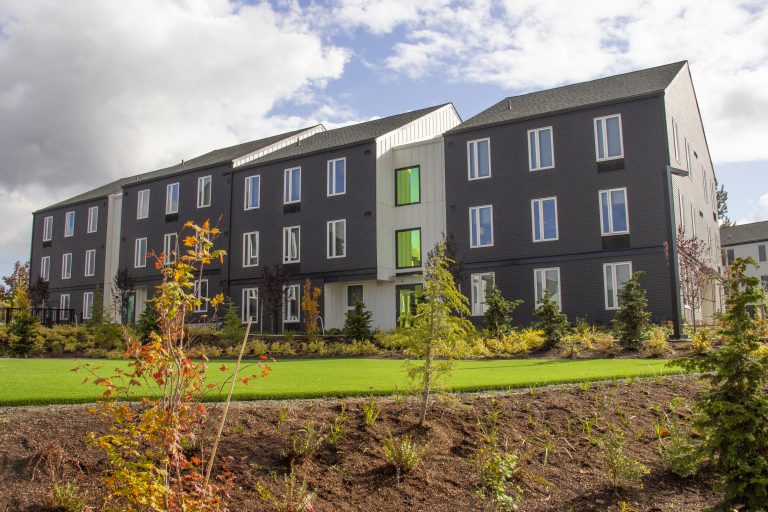
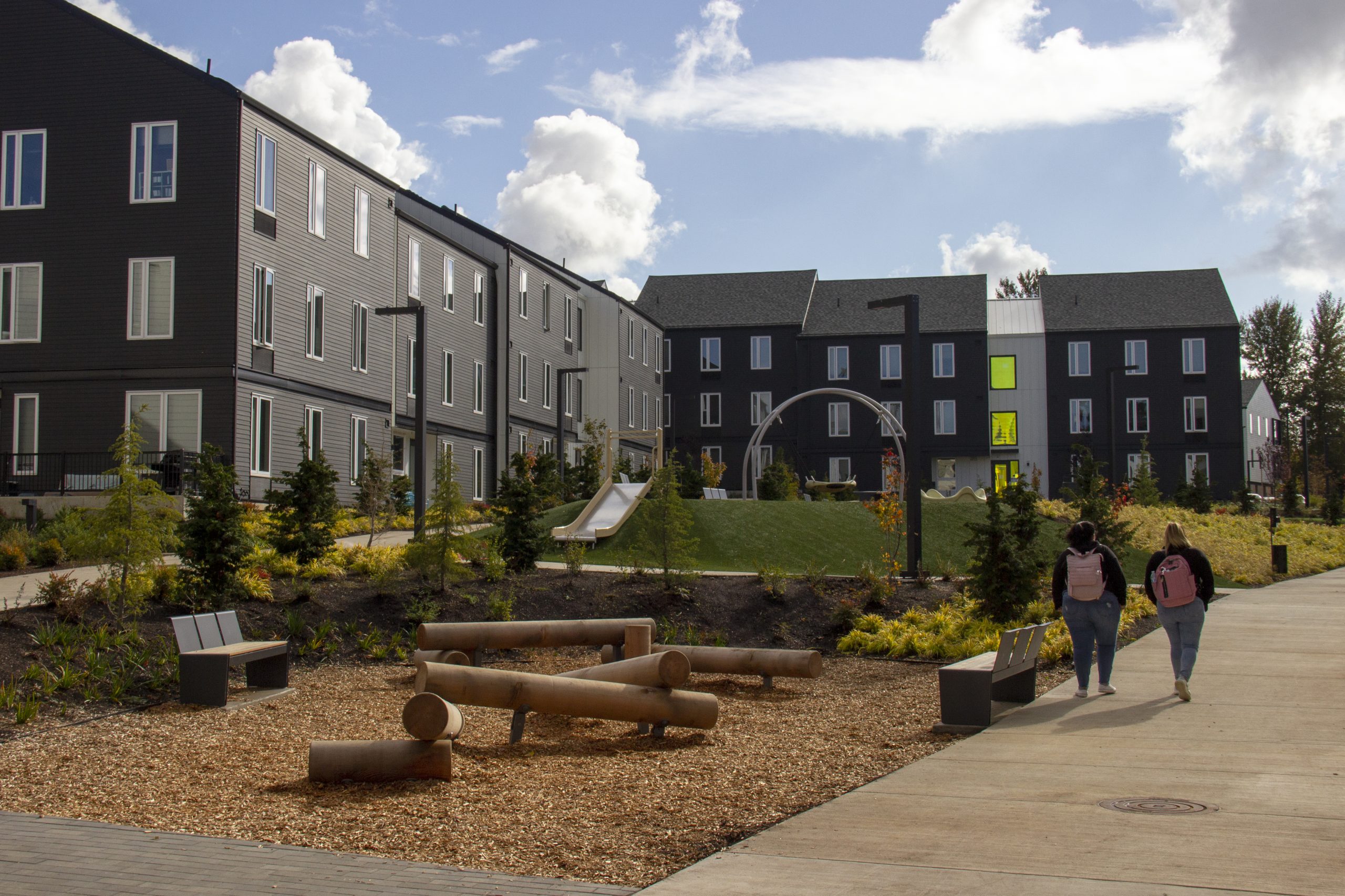
Utz said she’s seeing the “mass confusion” about the qualifications with Gussie Belle Commons, a newly-built affordable housing complex with 120 apartments set to open in Northeast Salem this year. The Salem Housing Authority doesn’t own the complex, and it won’t have subsidized units. The project is defined as an affordable housing because of its rental rate but tenants are on their own to cover the full cost.
Utz heard from an applicant who relies on Social Security and disability for income, and was frustrated because she hadn’t heard back about the waiting list.
“They’re probably processing the 400 applications, only for her to be disappointed to be hearing it’s not a subsidized complex, and she’s probably not going to qualify for it,” Utz said.
Blakely said agency employees spend a lot of administrative time working through waitlisted applications and meeting with families, before ultimately finding out they don’t qualify. There’s a complicated list of qualifications and exemptions that vary by program.
“It’d be really hard for someone to say ‘Hey, I make this much,’ and for us to say ‘Hey, you qualify.’ We actually have to get all this third-party documentation. It’s just labor intensive, no matter how you look at it,” Blakely said.
Utz said she’s trying to increase collaboration and education in the community to ensure that people are applying to something that they’ll qualify for.
“We just want people to rationalize: If you’re making $972 in Social Security a month and you’re not anticipating getting any additional income, then Parkway probably isn’t a good fit for you because $973 is going to be the lowest rent possible,” Utz said.
Utz said there won’t likely be a single application to cover all the housing scenarios. The investors, including the state and the U.S. Department of Housing and Urban Development, require separate waitlists for every program.
As of Friday, Feb.13, there were 140 families with vouchers seeking apartments. Some are homeless.
The housing authority has a full-time employee to match people who have vouchers with apartments that will take them.
“That’s the only way we’ve been able to figure out how to get our folks in line and assistance through this very challenging process,” Blakely said. “It’s a full-time employee for our agency.”
Contact reporter Abbey McDonald: [email protected] or 503-575-1251.
LOCAL NEWS DELIVERED TO YOU: Subscribe to Salem Reporter and get all the fact-based Salem news that matters to you. Fair, accurate, trusted – SUBSCRIBE.

Senior Reporter Abbey McDonald joined the Salem Reporter in 2022, where she covers homelessness and housing. She previously worked as the business reporter at The Astorian. A University of Oregon grad, she has also reported for the Malheur Enterprise, The News-Review and Willamette Week.