Local attorneys are fighting against what they describe as new state work quotas that attempt to tackle the state’s ongoing crisis in legal representation by requiring public defenders to represent more clients.
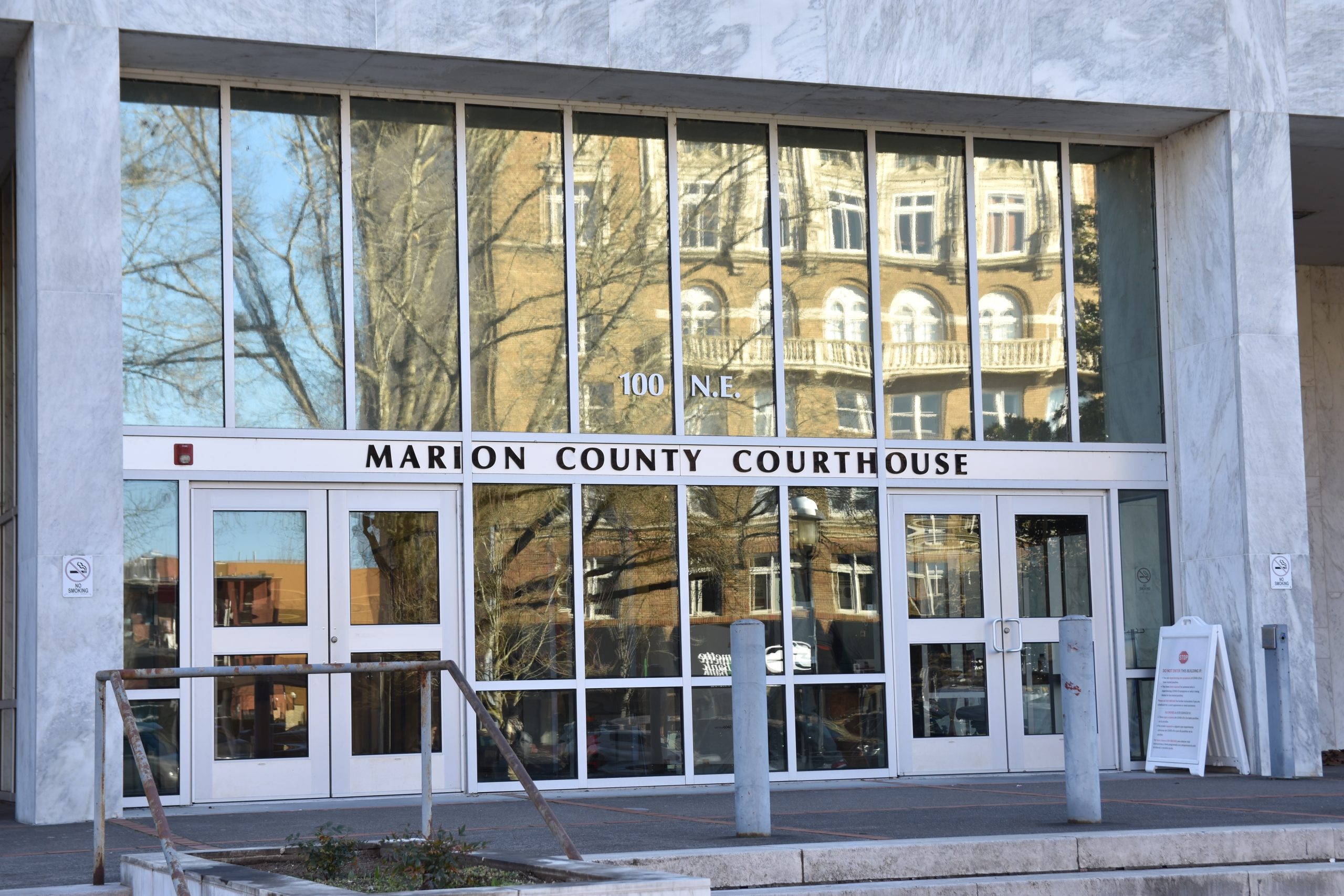
The executive director of Marion County’s public defense law firm filed a lawsuit Tuesday, Sept. 30, in Marion County Circuit Court against the Oregon Public Defense Commission claiming it recently added minimum caseload requirements to the firm’s contract with the state.
Tiffany Woods, a spokeswoman for the commission, disputed that, saying the new contract has the same expected workload for attorneys as prior contracts and allows for variation in attorney workload.
The new contracts, which took effect Oct. 1, expect Marion County public defenders to handle the equivalent of 300 misdemeanor cases or 138 serious felonies, like kidnapping or first-degree assault, per year, according to the complaint filed by Shannon Wilson, executive director of the Public Defender of Marion County. That’s the firm of 20 attorneys providing public defenders for people in Marion County facing criminal charges who generally can’t afford a lawyer.
The contract gives more serious charges more weight to account for the additional time needed. First-year attorneys would be eligible for a reduced caseload of 200 misdemeanors.
Public defenders say the quotas could lead to serious consequences for people accused of crimes, including unnecessary sentences, increased time in jail and wrongful convictions, according to Wilson.
If attorneys don’t meet contract work requirements, the commission could reduce contract funding or cut full time positions, according to Joshua Krumholz, attorney for the Public Defender of Marion County.
Wilson said that would increase attorney workloads to unsustainable levels and pressure them to settle for unfair outcomes in order to meet quotas.
“Not only are these quota terms in the contract unethical, and not only do they directly harm our community and and really threaten the foundations of our legal system, but they also are going to result in attorney attrition and driving public defenders away from the workforce,” Wilson said.
The firm’s contract with the commission expired Sept. 30. The commission is responsible for providing and funding public defense representation around Oregon. The previous contract showed the commission paid from $213,085 to $246,378 per attorney per year.
Woods initially declined to answer questions about the new contract or the efforts the commission made to discuss alternatives with Marion County’s public defenders. In a statement following publication, she disputed that the new contract contained “quotas” or that the commission now expected lawyers to work more cases.
The requirements are part of contracts offered to all public defenders in Oregon, not just Marion County, Woods said.
The caseload requirements are part of a state effort to solve a yearslong public defense crisis.
The statewide shortage of public defenders left thousands of people accused of crimes around the state without an attorney at the start of 2025, violating their constitutional right to representation, according to reporting by OPB.
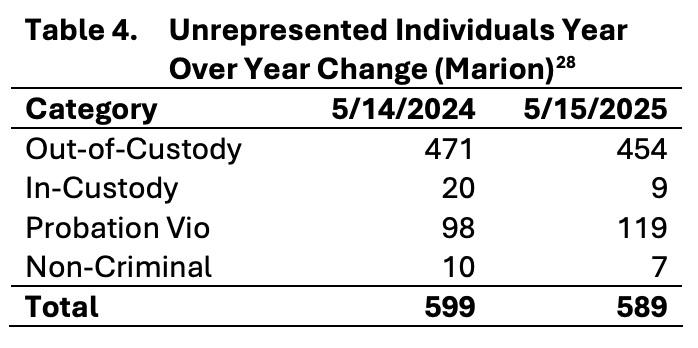
As of Tuesday, Marion County has around 236 people facing criminal charges without legal representation, according to an Oregon Judicial Department dashboard.
“Rather than dedicating real resources to that problem, or engaging in a difficult but long overdue reevaluation of the state’s prosecutorial practices, penal code and diversionary programming strategies, the state’s short-sighted solution is to foist the problem onto already overworked public defenders, demanding even more of them,” the suit argues.
The commission presented the new contract with quotas Sept. 12, the lawsuit claims.
The firm’s previous contract with the Oregon Public Defense Commission operated under a maximum caseload of 300 misdemeanor cases per year. Woods said while the new contract allows for variation in workload, “no provider is expected to exceed those case limits.”
The new contract “creates the same improper incentives found in a traditional pay-per-case system by encouraging public defenders to move their cases quickly and with minimal effort in order to try to meet an unsustainable caseload threshold,” the lawsuit claims.
The new contract would also cut funding for four attorneys and a supervisor, according to a letter Wilson sent to the public defense firm’s board of directors.
The lawsuit asks a judge to replace the standards with national ones allowing attorneys to spend more time with each client and ensure they’re following ethical guidelines.
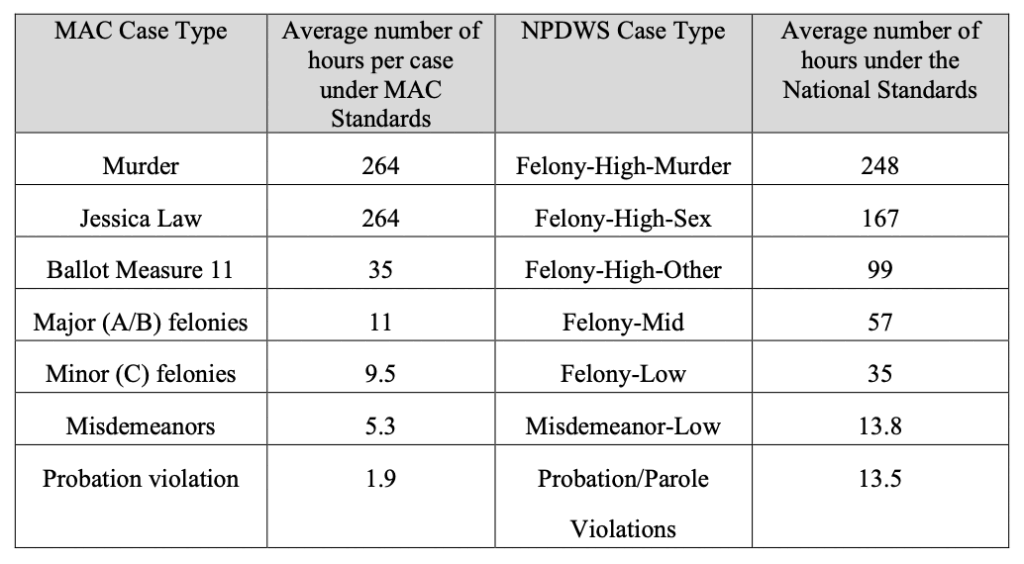
Wilson’s team of around 20 attorneys have been relying on the national standards for caseloads. Those standards were developed by the National Defense Workload Study in 2023 and recommend spending almost triple the amount of time on cases as the quotas demanded by the Public Defense Commission.
The commission publicly adopted the national standards in 2024, but does not apply them to its contracts with public defenders.
Earlier this year, Gov. Tina Kotek asked the commission to come up with a plan to solve the public defense crisis, documents online show.
The commission created a 12-month plan in June, focused on six “crisis” counties especially suffering from lack of legal representation, including Marion County.
In its plan, the commission said it would enforce maximum caseloads by requiring attorneys to meet 85% of the maximum, which is 255 misdemeanor cases per year. If attorneys don’t meet the mark, it could lead to reductions in contract funding or full time positions at their firm.
Days after receiving the new contract last month, Wilson met with the commission and requested either signing an hourly contract or one without the quota, according to a declaration. The commission rejected both options, according to the lawsuit.
For a misdemeanor case, the national standards require an attorney to spend an average of close to 14 hours, according to the lawsuit. Meanwhile, the contract quotas would shrink that number to just over five hours.
“Everyone in this county at least understands that on misdemeanor cases … you go to the annex for the initial hearing, two hearings, and maybe get to meet with your client briefly, just the initial meeting, and with that travel time and those first appearances, you’re at five hours,” Wilson said. “You haven’t even started your representation, really, at that point, you’re still receiving evidence, and so it’s really out of touch with the work.”
With shorter time requirements, attorneys can’t fairly or accurately challenge charges against their clients or take weaker cases to trial, according to Krumholz.
“A minor felony, which, with collateral consequences, could mean that a person loses their job, loses the ability to adopt or foster children. I think there’s over 1,000 collateral consequences for somebody who’s convicted of a misdemeanor, let alone a minor felony. You’ve got nine and a half hours to get it done,” Krumholz said.
The contract would require attorneys handling the highest level felonies to reach a resolution in 11 hours. Those would include people accused of first-degree manslaughter, rape or arson.
Wilson and the firm “are ready and willing” to enter a new contract with the commission if quota standards are removed, Krumholz said.
“Ultimately, at the center of all of this is our deep commitment to protecting our clients, and that’s something we’re really proud of that we center here in our office,” Wilson said. “I think it’s something that public defenders carry in their hearts, but this type of quota system asks them to abandon that and abandon their ethics just for a contract.”
This article was updated on Friday, Oct. 10, to incorporate information from the Oregon Public Defense Commission.
Correction: This article misstated the equivalent number of serious felonies lawyers would be expected to work under the plan, and the number of currently unrepresented people in Marion County. It also misstated where the state applies national lawyer representation standards. Salem Reporter apologizes for the errors.
Contact reporter Madeleine Moore: [email protected].
A MOMENT MORE, PLEASE– If you found this story useful, consider subscribing to Salem Reporter if you don’t already. Work such as this, done by local professionals, depends on community support from subscribers. Please take a moment and sign up now – easy and secure: SUBSCRIBE.

Madeleine Moore joined Salem Reporter in 2024 and reports on a variety of topics including public safety, addiction, treatment and the criminal justice system. She came to Salem after graduating from the University of Oregon in June 2024 with a bachelor’s degree in journalism.