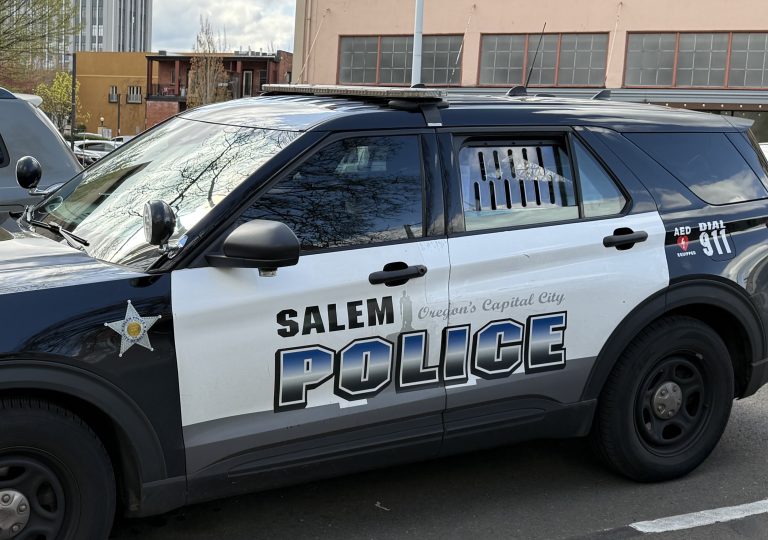
An overhaul of Salem Police Department policies in recent years includes stricter rules for police pursuits and more detailed guidance for when officers can use physical force.
For the first time, Salem police in May published all of their department policies online for the public to see.
“We want to be fully transparent with the community about our policies,” Salem Police Chief Trevor Womack told Salem Reporter.
His agency contracted in September 2024 with Lexipol, a Texas-based consulting company, to help review their more than 200 policies and ensure they were up-to-date with legal and industry standards. The city paid the consultant $31,000 for the work.
Salem police also consulted members of the public through the chief’s advisory council and Salem’s Community Police Review Board. It’s a wide mix that includes residents from different neighborhoods, people of color, community and faith leaders, business professionals and people with experience on both ends of the criminal justice system.
The policy changes took two and a half years of work and hundreds of staff hours, according to Womack. Salem police officials notified officers of the updated policies in batches of around 20.
Every policy was revamped in some form – but not significantly. “I think they’re just more clear and obvious,” he said.
Updated rules on pursuits and use of force are among the more significant policy changes that affect how Salem police interact with the public.
Vehicle pursuits by officers have fallen dramatically since a change Womack initiated in 2022 raising the bar for when officers can initiate vehicle chases.
Salem officers can no longer pursue drivers who are only suspected of traffic violations and not crimes.
Police pursuits have been the subject of national debate.
Many believe that not pursuing drivers who violate traffic laws allows them to avoid accountability, Womack said, but police chases can also be dangerous for the fleeing driver, the officer and innocent bystanders.
His agency created stricter rules for pursuits to lower the risk of injury and death, as well as exposing the city to civil liability.
Police vehicle crashes have been a major source of civil liability for the city.
The city has paid out $297,000 since 2018 to three people who filed lawsuits alleging they were injured in collisions involving Salem police vehicles. The suits, which did not mention police pursuits, stemmed from two crashes in 2015 and 2017.
Salem police started collecting police vehicular pursuit data in 2000, and the number of pursuits fluctuated over the last decade with a high of 91 chases in 2017.
In 2022, when the department established stricter rules for pursuits, its officers pursued 55 drivers. That number dropped to 24 in 2023 and just eight last year, according to the agency’s latest report on pursuits.
Salem police most recently updated their pursuit policy in December. It includes new language instructing officers not to pursue a driver while an arrested person is in their patrol car or while driving a vehicle not equipped with emergency lights and sirens.
The new policy also gave officers more specific guidance for driving safely during a pursuit – even while breaking traffic laws, as police are sometimes legally allowed to do while on the job.
Officers not directly involved in a pursuit can proceed safely to intersections ahead of the pursuit to warn other drivers.
Pursuing officers “should exercise due caution and slow down as may be necessary when proceeding through controlled intersections,” the policy said.
Officers also generally should not pursue a driver going the wrong way unless specifically allowed by a supervisor. If approved, they should drive parallel to the fleeing driver on the correct side of the road and request that other officers observe exits accessible to the suspect, according to the policy.
If officers lose a fleeing driver, they should stop the pursuit and broadcast to other officers to help find the driver.
When officers are deciding whether to use any “intervention” tactics such as ramming the suspect’s car, the new policy says they should weigh the risk of continuing the pursuit with dangers that the tactics may pose to the public and anyone in the suspect’s car.
“Proper self-discipline and sound professional judgment are the keys to a successful conclusion of a pursuit and apprehension of evading suspects,” the policy says.
The policy also provides more specifics about training that all officers below the rank of deputy chief must receive at least annually in the pursuit policy and the importance of responsible driving to protect public safety. The training includes balancing what a suspect is accused of and the need to immediately arrest them against the risks to officers and others.
Salem police’s most recent policy on use of force, which went into effect in December, gives officers more detailed guidance on what they should consider in determining how much force is reasonable.
Womack said he hopes the more specific policy reinforces and reminds officers of the legal standards they are already trained to follow.
Officers are instructed to consider factors including how serious a threat a person poses to the officer and the public, the person’s mental state, their ability to understand and comply with commands, and the officer’s training and experience.
The policy says officers should use non-violent alternatives to make the situation less intense, such as verbal de-escalation, “if reasonable, safe and feasible.”
The policy notes that firing shots at or from a moving vehicle is “rarely effective.”
It also includes new details on what police should consider about a person’s physical health.
Officers should not place people on their stomachs for a prolonged period to avoid impairing their ability to breathe, according to the policy.
It also lists symptoms that could put people at an increased risk of sudden death during a physical encounter with police. “Calls involving these individuals should be considered medical emergencies,” the policy says.
State administrative rules have required for over a decade that officers undergo at least eight hours of annual training in use of force or firearms.
“The Salem Police Department creates annual training plans that significantly exceed those standards,” according to Senior Officer Mark Jantz, a spokesman for the agency.
Salem officers this year are scheduled for more than 28 hours of training in use of force. Officers assigned to special teams, such as the Special Weapons and Tactics Team, typically receive over 200 hours of such training every year, Jantz said in an email.
Since Womack took over as chief in December 2020, Salem police became the first large police agency in Oregon to adopt nationally recognized training in de-escalation and critical decision-making by the Police Executive Research Forum.
Salem police used force 666 times during arrests in 2023. That’s 31 fewer uses – a 9% decrease – from the previous year. Last year, the number slightly increased to 669, according to the department’s annual use of force report dated April 3.
The number of Salem police officer shootings has fluctuated between one and four in recent years.
In 2020, Salem police reported one police shooting, which was fatal. Police shot three people in 2021, killing two.
Salem officers in 2022 killed three people and injured one in shootings. In 2023, they shot four people, killing two.
Since then, Salem officers have shot two people, killing one.
Womack said he also doubled staff in the agency’s Professional Standards Unit, which handles internal affairs.
Salem police under Womack also started publishing annual reports on their officers’ use of force. The chief said the reports weren’t published online before his tenure and he couldn’t find records that they were completed every year.
Salem police also started using body-worn cameras in 2023. New department policy now requires that supervisors randomly select and review body camera videos of three incidents handled by every officer as part of performance evaluations.
Womack said the policy changes were “a big step forward” for the department.
“It’s a demonstration, to me, of our commitment to transparency with the community,” he said.
Contact reporter Ardeshir Tabrizian: [email protected] or 503-929-3053.
A MOMENT MORE, PLEASE– If you found this story useful, consider subscribing to Salem Reporter if you don’t already. Work such as this, done by local professionals, depends on community support from subscribers. Please take a moment and sign up now – easy and secure: SUBSCRIBE.

Ardeshir Tabrizian has covered the justice system and public safety for Salem Reporter since September 2021. As an Oregon native, his award-winning watchdog journalism has traversed the state. He has done reporting for The Oregonian, Eugene Weekly and Malheur Enterprise.