REPORTER’S COLUMN: Reporting on the White House from Salem

Last week, I packed up the only three business-casual outfits I own and headed from Salem to Washington, D.C., where I had the opportunity to speak directly with longtime federal workers, former White House regulars and federal policy experts.
Now, it’s time to bring what I learned back to you.
I was among 30 journalists from around the country selected by the National Press Foundation for its Federal Action, Local Impact Journalism Fellowship. The program sought to help us better report on how the Trump administration’s policies, including massive cuts to the federal workforce and expansion of the executive branch’s powers, impacts our individual communities.
The speakers included Medaria Arradondo, the Minneapolis police chief who called in the National Guard in response to the protests of George Floyd’s murder; Washington D.C. Mayor Muriel Bowser, whose city government is at the center of federalization efforts that also are now playing out in Portland; and longtime federal staffers. This included some who recently departed, from the U.S. Department of Justice, National Weather Service, U.S. Customs and Border Protection and the Federal Emergency Management Agency.
Those who lived through the 1990s may also remember Mike McCurry, Bill Clinton’s White House press secretary. He shared his thoughts on the widening gap between political spin and reality, and how reporters should ask questions that cut to the facts.
Each session included remarks from the panelist followed by a Q&A session where the fellows could ask anything we wanted from detailed policy questions to insight on their decision-making processes.
I learned a lot over the three-day session, and have some ideas about how I’ll use what I learned to cover federal policy’s impact on Salem.
But first, I’d like to hear from you: What federal policies would you like me to report on from a Salem-area perspective? What national stories would you like to see explained on the neighborhood level in our community?
Let me know by sending me an email to [email protected].
Below, you’ll see three clips from the fellowship where I asked questions of the panelists. It’s just a glimpse of the kinds of conversations that took place. For those interested, the full discussions are linked on the National Press Foundation’s YouTube channel.
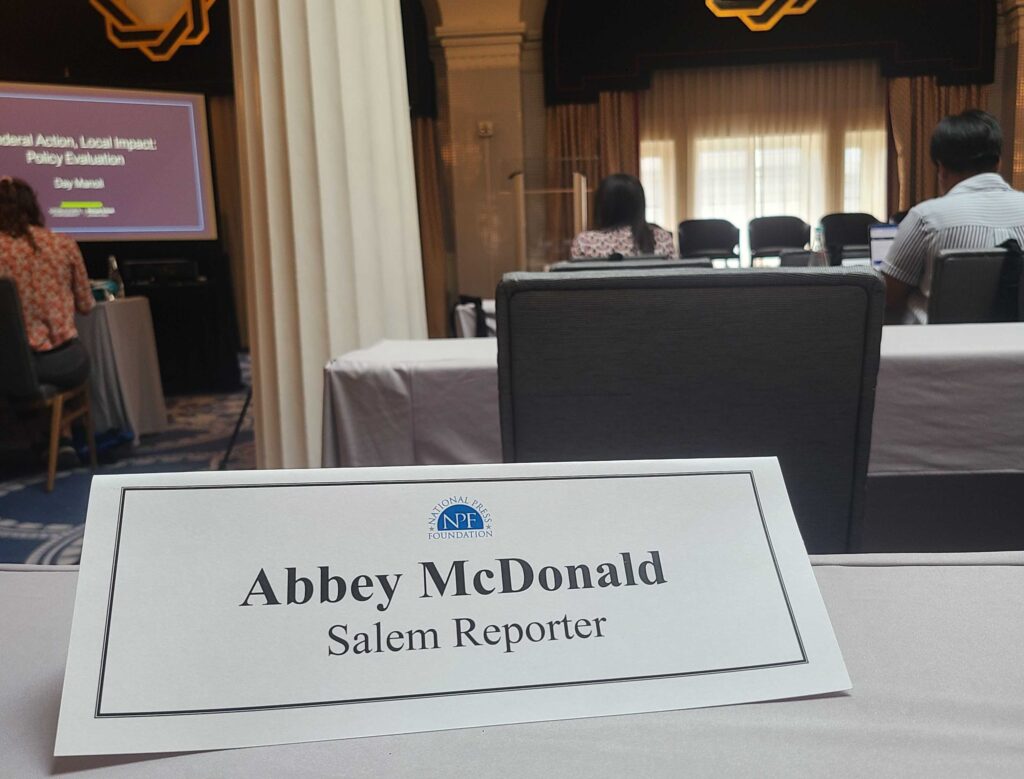
Abbey McDonald’s name placard for the Federal Action, Local Impact fellowship from the National Press Foundation. (ABBEY MCDONALD/ Salem Reporter)
Clip one: I asked D.C. Mayor Muriel Bowser how the federal government’s approach to homelessness differed from the established approach of local police, and whether the city was able to push back on any federal requests to be more punitive.
Bowser said, “You have raised, I believe, the single hardest problem that I have confronted in government. And that is dealing with homeless encampments and homeless residents who have significant, significant challenges.”
She shared an overview of D.C.’s efforts to invest in shelters, affordable housing and outreach. When the moderator followed up to ask whether the Trump administration’s approach undermined her city’s efforts, Bowser said that the administration’s desired approach of jailing homeless people wouldn’t work, and she’s been able to show that the city’s approach has been effective.
“I think the kind of push-pull of attention and resources is what will work. So I won’t say that it’s undermining because I do think that we’ve been able to moderate the instinct,” she said.
Clip two: I asked two former federal immigration judges, Anam Petit and Emmett Soper, what options they had as judges to resist an unjust deportation.
“We’re very limited,” said Petit, who emphasized the need for judges to be unbiased while helping people understand due process and the legal options available to them.
Petit said that she steered clear of doing anything that could be perceived as interfering with Immigration and Customs Enforcement, because judges were fired for doing so. That included rejecting requests from people who said they wanted to appear in their hearing by video because they were afraid of immigration enforcement. She said it was a very difficult position to be in.
Soper agreed that his authority as a judge was limited.
“It was a very difficult thing for me to deal with, and I think for a lot of my colleagues as well, knowing I control my courtroom but I don’t control the lobby. I walk through the lobby and I see six or seven guys with masks who I know are there from ICE… I can’t stop them. All I can do is hope that the person who just appeared in front of me isn’t going to be arrested,” he said. “One of the most difficult things in the last few weeks for me as a judge was being confronted, really, by the limits of my control.”
Clip three: I ask Michael Waldman, president and CEO of the Brennan Center for Justice, New York University’s nonpartisan law and policy institute, whether the Watergate scandal would last a single news cycle today, and whether journalism can still hold presidents accountable.
Waldman shared a history of how the Watergate story broke and became national news, which was a gradual process, and done in a much different media environment.
“What would happen now, first of all it might be in one news cycle. There would be an amen chorus of partisan or ideological (outlets) praising the burglars for fighting communism or something like that. A lot of the stuff would be, on all sides, instantly relegated to the bubbles,” he said.
But he said that polling has shown that Americans’ top three issues of concern are corruption, inflation and abuse of power.
“That’s not because Walter Cronkite told them it was. People, your readers, have intuited that from all the pieces of information they’re getting from all the things you’re covering. I think that citizens are actually processing it in a way that is heartening,” he said.
Contact reporter Abbey McDonald: [email protected] or 503-575-1251.
A MOMENT MORE, PLEASE– If you found this story useful, consider subscribing to Salem Reporter if you don’t already. Work such as this, done by local professionals, depends on community support from subscribers. Please take a moment and sign up now – easy and secure: SUBSCRIBE.

Abbey McDonald joined the Salem Reporter in 2022. She previously worked as the business reporter at The Astorian, where she covered labor issues, health care and social services. A University of Oregon grad, she has also reported for the Malheur Enterprise, The News-Review and Willamette Week.