Marion County farmer represents Oregon on international Farm Bureau program

Jon Iverson usually starts his mornings with a farm meeting, reviewing with staff what needs to be done that day at Wooden Shoe Farm in Woodburn. He’ll check the sugar levels of the grapes in the vineyard before interacting with customers in the store, as most farmers might.
“One of the beautiful things about agriculture is every day is different,” Iverson said. “As soon as you get bored with a task, it seems like you’re on to the next thing.
What makes Iverson’s days a little different from most farmers, though, is that on some afternoons, he’s spending his downtime completing online lessons for the Partners in Advocacy Leadership program, or PAL, with the American Farm Bureau.
As part of the program, Iverson and nine other farmers from across the U.S will embark on a trip to South Africa on Sept. 2. His is the 12th class to participate in the two-year program.
The PAL program brings in farmers aged 30 to 45, younger than the average age of a farmer in the U.S., which is 58, according to the 2022 USDA Census of Agriculture.
The goal of the program is to support farmers’ personal and professional development and to create advocates for agricultural issues in political settings. PAL participants also learn to demystify their farming operations, helping people understand the origins of their food and farm goods.
“Most farmers tend to be introverted. ‘I’m going to do this, trust me, leave me alone. I know what I’m doing,’” Iverson said. “I feel like with my generation, there’s been a lot more awareness that we have to be open, because you might not be doing anything wrong, but if you’re not open with people, they assume the worst.”
Since starting the PAL program in May of 2024, Iverson has become more active on the Instagram account for Wooden Shoe Farm, where he shares behind-the-scenes footage. He said it’s been received well, not just by customers, but by fellow agriculturalists.
Reactions range from “‘Oh, I never knew that’s why you did that,’ or ‘That’s an interesting way to do it,’” Iverson said. “The more open I’ve been, the response has been more positive than I was expecting.”
Leadership and advocacy
Before being selected as a participant for the PAL program, Iverson, now 39, served as the board chair for the Farm Bureau’s Young Farmers and Ranchers national committee. Motivated to be involved to serve as a voice for the agricultural community, he spent a year in that position.
The international farming advocacy program wasn’t really on Iverson’s radar, he said. He heard about the program through Angi Bailey, the president of the Oregon Farm Bureau, who encouraged him to pursue it after her own PAL experience years ago.
Participants in the PAL program are chosen based on demonstrated leadership. As a third-generation family farmer, it was ingrained in him early on that if he wanted to have a hand in agriculture, he needed to apply himself and work hard.
He said that his grandfather, who had six kids, “realized very quickly that if all their kids came back, that the farm is just not sustainable,” he said.
“They created a rule that you had to get your degree and you had to work off the farm for two years before you came back,” Iverson said. “They wanted it to be a decision of ‘This is what I want to do,’ not ‘I don’t know what I’m going to do, so I’m just going to work for the farm.’”
Iverson did just that — he worked on a labor exchange in New Zealand as a farmhand for three months before he finished his degree in crop and soil science with a minor in agricultural business at Oregon State University. After graduating, he became an agronomist for Orchard and Vineyard Supply, a position he held for two years.
He returned to work at a family farm, Wooden Shoe Tulip Farm, in 2011. Wooden Shoe also operates a vineyard, and sunflowers in the summertime. Iverson Family Farms runs a handful of farms throughout the Willamette Valley.
After his tenure as board chair for the Young Farmers and Ranchers committee ended in March of 2022, he dedicated time to Wooden Shoe before applying to the PAL program.
When he was accepted in May of 2024, the group jumped into work quickly, going on an East Coast trip to begin the program.
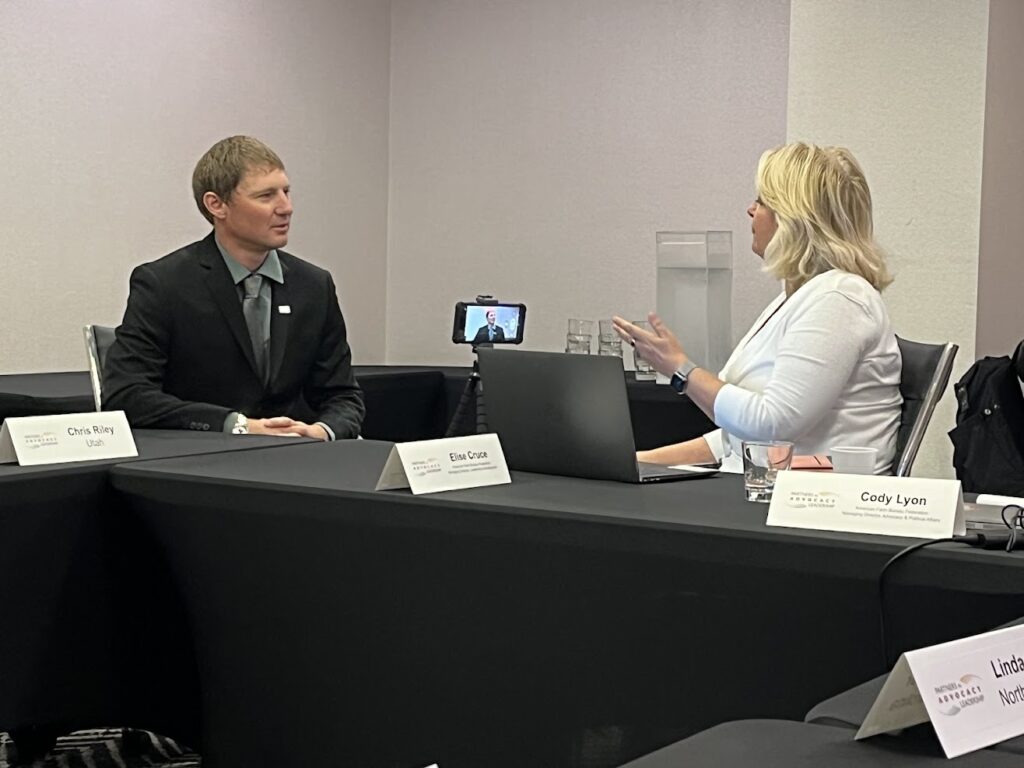
In New York, the group trained on media presence and how to conduct oneself in an interview, working with former TV reporters and the editorial board of The Wall Street Journal.
In Washington D.C., they focused on talking to congresspeople and legislators, and how to have the “most effective message in the shortest amount of time.”
In Chicago, the group focused on stakeholder engagement.
“It’s trying to find allies so that you can work together to make your message stronger,” Iverson said. “Sometimes those allies might be people that you tend to be opposed to.”
A focus on labor issues
One focus of the PAL class is working across ideological divides to achieve goals that are shared by people from varying political backgrounds. He used labor as an example, citing differing perspectives on immigration and workers rights.
“I think one of (the examples) was workers’ justice (organizations). They tend to be pretty hostile to ag organizations, but they also want fixes to immigration. They want fixes to guest worker programs. Those are all things that we want,” Iverson said. “If these two opposing sides can work together, then we’ll have a stronger message when we go speak to legislators.”
The leadership and advocacy skills the class has been building will prepare them for their trip to South Africa, where they plan to learn more about labor practices in the country over the course of nine days.
Iverson was one of the students in the PAL class to pitch South Africa as a location to visit and learn from as a cohort. He knows from his international work in New Zealand that sometimes, to find solutions, you can look at what’s worked in other places.
“As part of the class, we have to create a 10-minute presentation on where we should go in the world that we can maybe get some answers to the labor issue,” Iverson said. “South Africa itself has a strong ag economy, but they also use guest worker programs from Mozambique and Zimbabwe. They also are a leading source of labor for agriculture in the United States.”
South Africa’s guest worker program isn’t a singular program like the H-2A guest worker visas in the U.S. Instead, it’s a system of different temporary work visas and permits, each with specific requirements.
The guest worker visa program in the U.S. has come along with complications, according to Iverson. And the agriculture industry is really “looking for a better way to address this problem.”
“It seems like in the United States, if we can make it more complicated, we do, and what I’m hoping to do is (learn), is there a streamlined process that protects employees and also protects employers, but is flexible for both, to make it easier that we can hopefully bring those ideas back,” he said.
He says that he looks forward to learning from different perspectives while on the trip — asking questions about the workforce and any challenges that farmers face. Ultimately, he said, the goal is to learn.
“Today’s group of farmers that are coming up are more open-minded and more professional than they’ve been assessed,” he said.
Contact reporter Mirandah Davis-Powell: [email protected].
A MOMENT MORE, PLEASE– If you found this story useful, consider subscribing to Salem Reporter if you don’t already. Work such as this, done by local professionals, depends on community support from subscribers. Please take a moment and sign up now – easy and secure: SUBSCRIBE.

Mirandah Davis-Powell was an intern for Salem Reporter in the summer of 2025, primarily covering food, farms and agriculture. She joined the newsroom from the Charles Snowden Program for Excellence in Journalism as a reporter from the University of Oregon.