Salem teen finds sobriety, clean slate in youth treatment court
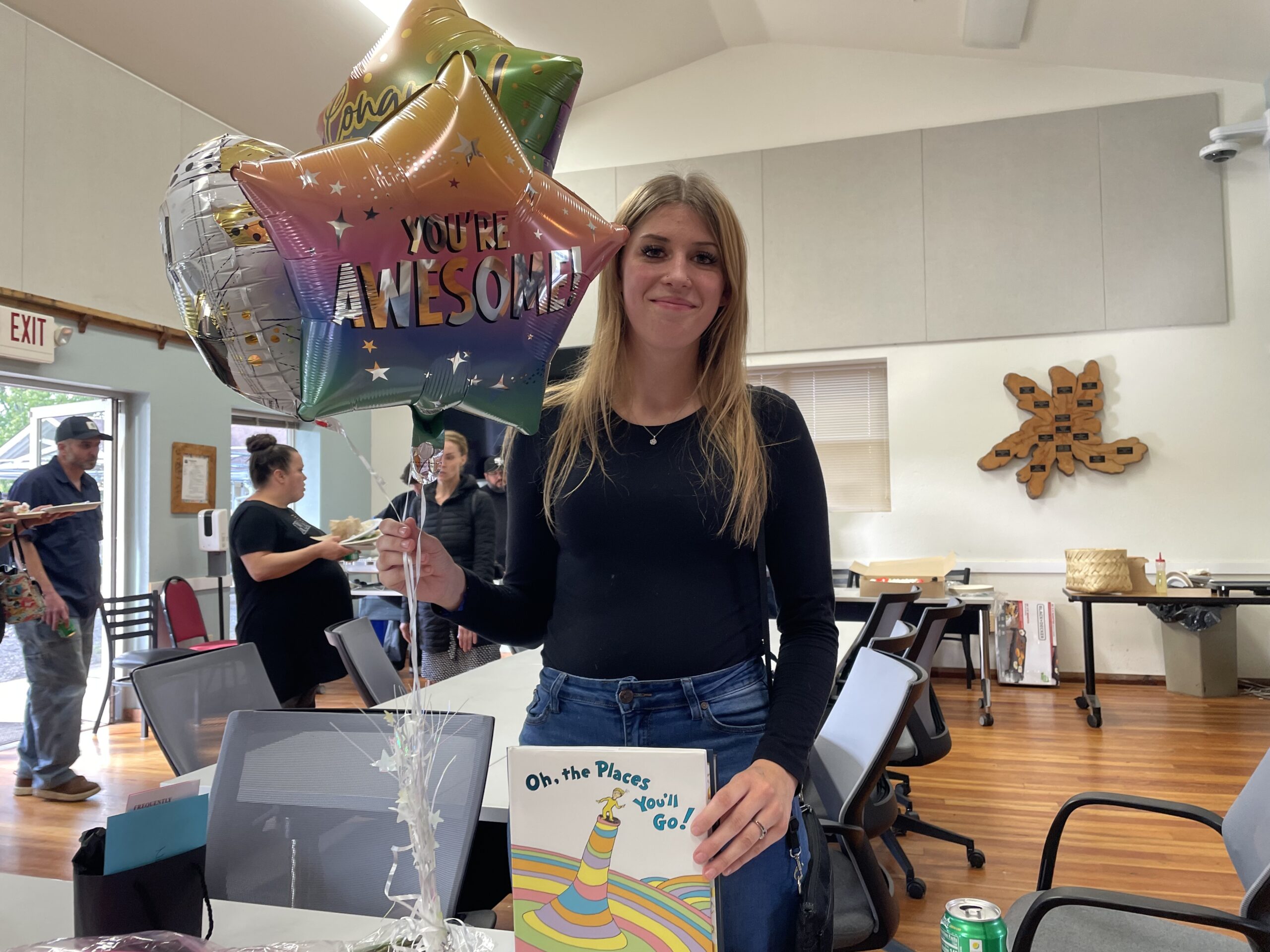
Natalee Moore’s stack of expunged court records was thick enough to jam a shredder.
At her recent graduation from treatment court, a room full of Marion County and state staff laughed and cheered Moore on as she shredded pages of police reports and criminal cases that were no longer part of her juvenile record.
“Say goodbye to your past,” Janalee Weitman, a state juvenile and family treatment court manager, said as Moore, 17, shredded the first pages.
She is one of dozens of local teenagers who have cleared their criminal history and recovered from substance use through a Marion County program called Supervised Treatment And Recovery Court.
“It just made me open my eyes, that it’s like, other people are actually seeing me grow and change as a person,” Moore said about her graduation. During the Oct. 1 ceremony, which included balloons, flowers and cake, the program team took turns sharing their memories and hopes for her.
Over the last 23 years, 100 youth involved in the justice system have graduated from the program and connected to treatment, counseling and their communities, according to Weitman.
The STAR Court team includes staff from county and state agencies, including the courts, Oregon Youth Authority, the Marion County District Attorney’s Office and the Department of Human Services. HYB Counseling, a local practice, provides recovery and mental health resources.
The program aims to treat underlying substance abuse and lifestyle challenges to help teenagers involved in the justice system have better opportunities in the future.
It also gives them a long list of people rooting for them. About 30 people gathered just to celebrate Moore.
The attorney who prosecuted her cases said she proved him wrong that she could change.
“I was leery about it,” Marion County Deputy District Attorney Tim O’Donnell said in an interview, recalling when Moore applied to the program in January. “Then she came in and killed it and proved me wrong. Happy to admit it.”
Moore grew up in Salem and attended local high schools prior to her incarceration.
She first applied to STAR Court in October 2024 while serving time at Oak Creek Youth Correctional Facility on misdemeanor charges, including interfering with police and resisting arrest. She spent five months at the Albany facility.
Her parole officer Angela Denning advocated for her to join the program to set Moore up with services after her release.
The team turned down her application as they wanted Moore to finish her time at Oak Creek and see what progress she made while at the facility, according to Weitman. She reapplied in January after her release and was accepted.
Moore started STAR Court with almost one year sober from marjuana and alcohol.
Her sobriety started when she was lodged in jail and then a youth correctional facility. When she got out, she chose not to go back to using substances.
“The way I got lost the first time … I knew I wanted better for myself. I wanted a journey. I knew I wouldn’t get none of that if I went the way I was going,” she said.
Through STAR Court, Moore added another 106 days of sobriety to her belt. At graduation, she’d been sober for 426 days.
The program mostly draws youth from the Marion County Juvenile Department, Weitman said. The rest are often referred by the Oregon Youth Authority.
To be eligible for STAR Court, teenagers have to have been adjudicated for a misdemeanor or felony — the juvenile court equivalent of a criminal conviction. They must have a proven substance abuse issue, be at high risk for re-offending and be 14-17 years old.
Over the last five years, Weitman said firearm and assault charges have become now the most common charges among the teenagers she sees.
The program provides substance use treatment, counseling, community service, rent assistance and guidance on how to apply for jobs. Mentorship is also available for the teenager’s parents, which can set up families for better communication and healthy relationships, according to Weitman.
Teens in the program can qualify for full expungement, partial expungement or heightened supervision, which gets youth off of parole quicker. The Marion County District Attorney’s Office decides which path a teenager will go on based on their charges and case information.
Participants can choose to complete the program in either 90 or 120 days, but can take longer if they face setbacks.
The shorter track requires 90 consecutive days of sobriety, with daily hotline call check-ins and weekly urine tests. If a participant misses one check-in, they have to start the 90 days over.
The longer path requires 90 days of check-ins and urine tests, but not consecutively. If a urine test is missed or comes back positive, their progress is paused until they’re able to give a negative test and check-in. Once the 90 days are met, there is an additional 30 consecutive days of sobriety.
Moore chose the first option.
She achieved 84 days with the program after starting in January. Then, a hard and busy day at work made her miss her hotline check-in.
“I wanted to quit at first, but then it was like, if I quit, then I go back to detention, then I restart detention, and then once I get out then I have to restart STAR Court. But instead, I could just restart STAR Court. So there was no point in making things worse,” Moore said.
Many program staff mentioned that moment at her graduation last week, recalling her determination to start from scratch after being days away from finishing the program.
“I was very worried that she wasn’t going to be able to turn it around, just given her history, but hopeful at the same time, because she’d done so well for 84 days … it was above and beyond,” Julio Garcia, Oregon Youth Authority’s representative on STAR Court, said in an interview.
To make sure she wouldn’t miss a check-in again, Moore started calling the hotline to check in several times a day, she said.
In interviews, program staff spoke highly of Moore’s growth from a teenager who was often disruptive and intimidating to one who was focused and driven. At her graduation, some expressed pride and joy at her offer to return to the program and help other teenagers like her.
For O’Donnell, who prosecutes juvenile cases for the Marion County District Attorney’s Office, Moore’s changes while in custody and again in STAR Court proved him wrong about not just her, but other kids who might not seem capable of changing.
“Remembering that they’re not just a name on a paper or a charge or a police report, that they are a person who has a life, who has circumstances that contributed to how they got to where they are in juvenile court,” O’Donnell said. “Young people are malleable. They have the ability to learn and change if they’re given that opportunity.”
Program staff are hopeful that more teenagers can have similar journeys to Moore’s, and leave unhealthy relationships and criminal behavior for recovery and independence.
Moore finished high school last month, graduating from Sprague. Looking forward, Moore is planning to apply for jobs and gain more independence, according to Weitman.
Marion County Circuit Court Judge Manuel Perez, another member of the STAR Court team, wishes more kids would join the program to get the experience of succeeding at a hard program and finding community.
“Natalee is the reason we do this job. Because I believe that every child, if given the proper resources and support, can succeed and can make the right decisions, and that Natalee is the proof of that,” he said.
Contact reporter Madeleine Moore: [email protected].
A MOMENT MORE, PLEASE– If you found this story useful, consider subscribing to Salem Reporter if you don’t already. Work such as this, done by local professionals, depends on community support from subscribers. Please take a moment and sign up now – easy and secure: SUBSCRIBE.

Madeleine Moore joined Salem Reporter in 2024 and reports on a variety of topics including public safety, addiction, treatment and the criminal justice system. She came to Salem after graduating from the University of Oregon in June 2024 with a bachelor’s degree in journalism.